
Core Concepts
Speed Ratings in Horse Racing
What they are, how they are built and how to read them, the backbone signal behind our dashboard and raceday calls.
See live speed ratings freeWhat Is a Speed Rating?
A speed rating is a single number that expresses how fast a horse ran, adjusted so that performances at different courses, distances and going can be compared on one scale. A raw time on its own tells you very little: a quick time at a sharp track on firm ground is not the same as the same time on a stiff course in soft. A speed rating strips out that context so two runs you could never otherwise compare sit on the same yardstick.
At EquiAnalytix every horse racing speed rating is built from more than 20 years of UK and Irish form, normalised for the conditions on the day, so the number you read reflects merit rather than the accident of where and how a race was run.
Why Raw Time Isn't Enough
Raw times vary by track, weather and pace shape. Our ratings correct for those distortions so you are comparing like for like across courses and distances.
- Normalised finishing time per distance
- Going and surface adjustments
- Pace profile (true-run vs false-run)
- Course configuration effects
- Draw bias (especially sprints and turning tracks)
How a Speed Rating Is Calculated
We begin with the raw finishing time, then layer a series of contextual adjustments on top. Each one answers the same question: would this time mean something different under different conditions?
Going & surface
The same time on firm and on heavy are not equal performances; we adjust for both.
Distance
Times are calibrated per furlong so sprints and staying trips share one scale.
Pace shape
A true-run race and a false-run, sprint-finish race produce very different raw times.
Course configuration
Stiff finishes, sharp tracks and undulations all leave their mark on the clock.
Draw position
Stall position can flatter or punish a time, especially in sprints and around turns.
Class & field strength
Beating a strong field matters more than the same time against weak rivals.
Weight carried
Weight is factored so a run under a big burden is not undersold.
How to Read the Numbers
Treat the figures as a relative scale, not a verdict. The trend across a horse's recent runs usually tells you more than any single number.
Spot the improver
76 → 82 → 88 signals a horse on the up that the market may not have caught yet.
Fade the hype
96 → 90 → 84 on a short-priced favourite often flags a vulnerable jolly.
Compare fairly
Judge an all-weather run at Kempton against a turf run at Newbury on the same scale.
Using Speed Ratings on Raceday
- 1Shortlist on the ratings. Start with the top-rated runners to focus your attention.
- 2Check the context. Was each figure earned in a true-run race, or flattered by a soft pace or a kind draw?
- 3Overlay pace and draw. Match the ratings against the likely race shape and stall positions.
- 4Find the trend. Back improvers on a rising line; be wary of favourites on a falling one.
- 5Bet for value. Take a position only where the price is bigger than your assessment justifies.
Common Mistakes
- Trusting one big figure from a freak run instead of the overall trend.
- Reading the number without the pace, draw and going context behind it.
- Comparing ratings from different providers as if they share a scale.
- Backing the top-rated horse blindly, at any price, regardless of value.
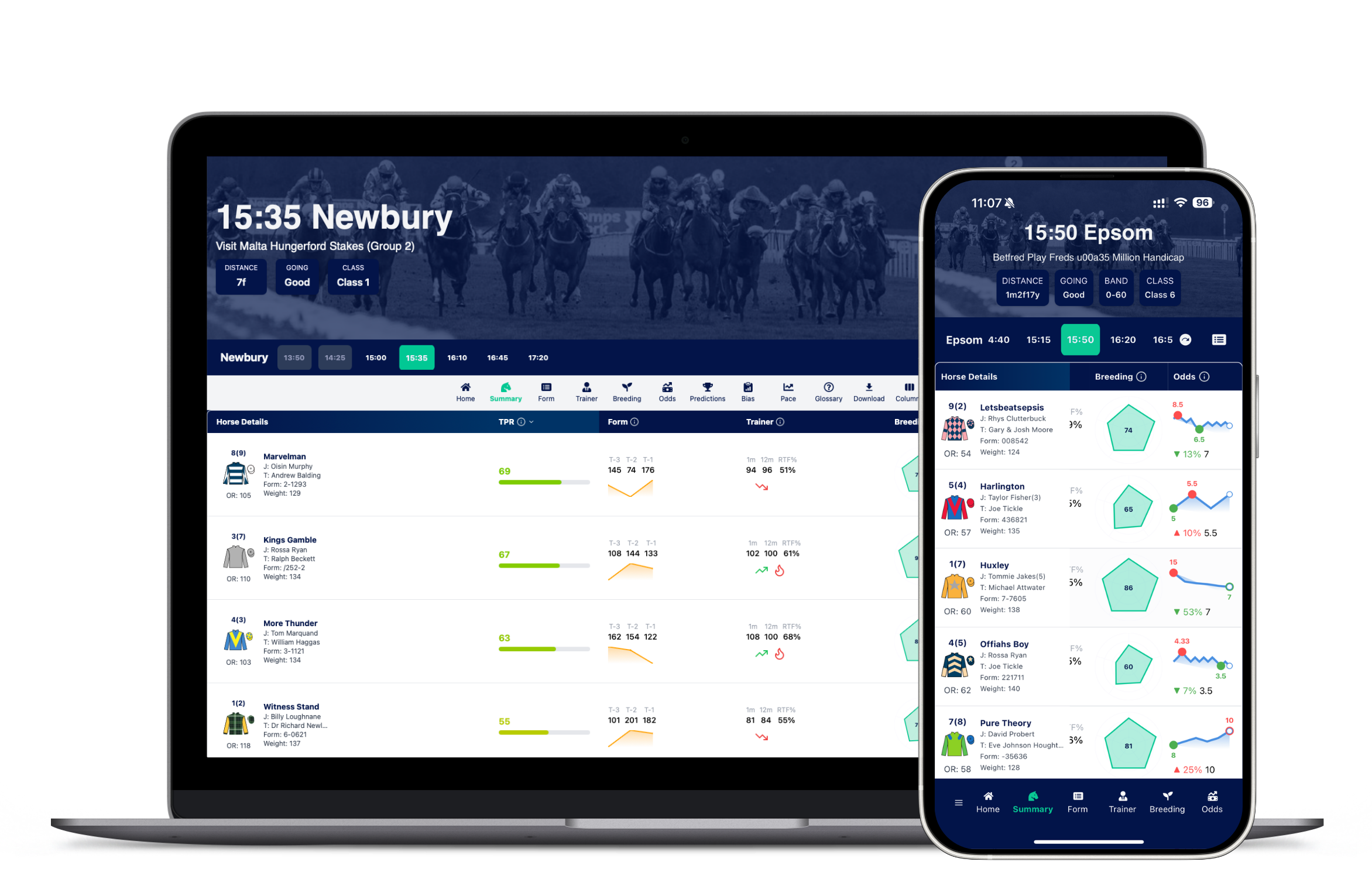
See live Speed Ratings on the Dashboard
iOS, Android and Web, synced for raceday.
Glossary
- Speed Rating
- Adjusted performance number enabling fair comparisons across races.
- Going
- The state of the ground, from firm to heavy, which alters times.
- Pace Profile
- The tempo/shape of a race (strong, even, or slow early pace).
- Course Bias
- Track tendencies favouring certain run styles or lanes.
- Draw Bias
- Systematic advantage/disadvantage from stall position.
FAQs
- A speed rating is a single number that expresses how fast a horse ran, adjusted so performances at different courses, distances and going can be compared on one scale. It turns a raw time, which means little on its own, into a like-for-like measure of merit.
Get the next raceday guide, free
Every big raceday we read the whole card with the model: ratings, speed figures, pace and draw. We send the next one to your inbox the morning it is published. No charge, and you can unsubscribe in one click.
We use your email to send racing guides and occasional news about EquiAnalytix. We never share it. 18+ | Please gamble responsibly.