
Markets
Horse Racing Market Movers & Odds Movements
Treat the tape as a supplement: confirm or challenge what your model already says.
Track live market movers freeWhat Are Market Movers in Horse Racing?
A market mover is any horse whose odds shorten or lengthen significantly in the lead-up to a race. When bookmakers across the board cut a horse from 8/1 to 4/1, that horse is described as a market mover — money is coming for it, and the market is adjusting accordingly.
Understanding market movers in horse racing is essential because price changes reflect the collective view of thousands of market participants — including professional analysts, stable connections, and high-volume operators. An odds movement is the raw data: the change in a horse's price between two points in time. Market movers are the horses where those movements are large enough to be noteworthy.
However, not all odds movements are equal. A horse drifting from 3/1 to 7/2 in a thin weekday seller is not the same signal as a horse steaming from 10/1 to 5/1 across all major firms on a Saturday feature card. Context — field size, race class, liquidity, and timing — determines whether a move is meaningful or noise.
How to Read Odds Movements
Reading the tape effectively means evaluating three dimensions of every odds movement: timing, breadth, and liquidity.
- Time-to-off: Late steam (within the final 15–30 minutes) carries sharper information than early morning fluctuations. By the time the market is close to the off, late money tends to come from participants with finalised intelligence on ground conditions, declarations, and horse wellbeing.
- Market breadth: Multi-firm shortening is a stronger signal than a single-bookmaker anomaly. If a horse shortens at one firm only, that firm may simply be managing its own liability. If it shortens everywhere, the market is genuinely moving.
- Liquidity context: Moves in high-turnover markets (Saturday feature races, World Pool events) carry more weight than moves in thin Monday afternoon sellers. The deeper the market, the harder it is to move prices with small sums.
Early Market Movers vs Late Market Movers
Early market movers are horses whose prices move in the overnight or morning markets — often before final declarations and going reports. These moves can reflect stable confidence, ante-post positions being hedged, or promotional pricing by bookmakers. While early movers are worth noting, they tend to be less informative because the market is still absorbing incomplete information.
Late market movers — those shortening in the final 30 minutes before the off — are generally regarded as carrying sharper information. By this point, participants have access to the latest going descriptions, jockey bookings are confirmed, and preliminary paddock observations have circulated. A sustained late move across multiple bookmakers is one of the strongest signals the market produces.
The most effective analytical approach is to monitor both, but weight late moves more heavily in your decision-making. Use early moves to build a watchlist, and late moves to confirm or adjust confidence in your analysis.
Odds Movement Strategy: How to Use Market Movers
An effective odds movement strategy never relies on market signals alone. Instead, it uses odds movements to confirm, contradict, or refine analysis you have already conducted using objective metrics like TPR speed ratings, pace maps and draw bias, and course form.
Confirm
When a horse you have rated highly on speed ratings is also steaming in the market, that convergence of independent signals strengthens your position. Multi-firm steam on a top-rated horse is a confirmation signal.
Contradict
If a horse with a poor pace map or unfavourable draw is shortening, that contradiction should prompt caution rather than excitement. The market may be reacting to information you have already factored in, or it may simply be wrong.
Wait
When a horse you rate highly is drifting, the odds movement may be offering a better price. If your analytical edge remains intact and the drift is not driven by new negative information (withdrawal of pace, ground change), a drift can be an opportunity rather than a warning.
Combining Market Movers with EquiAnalytix Analytics
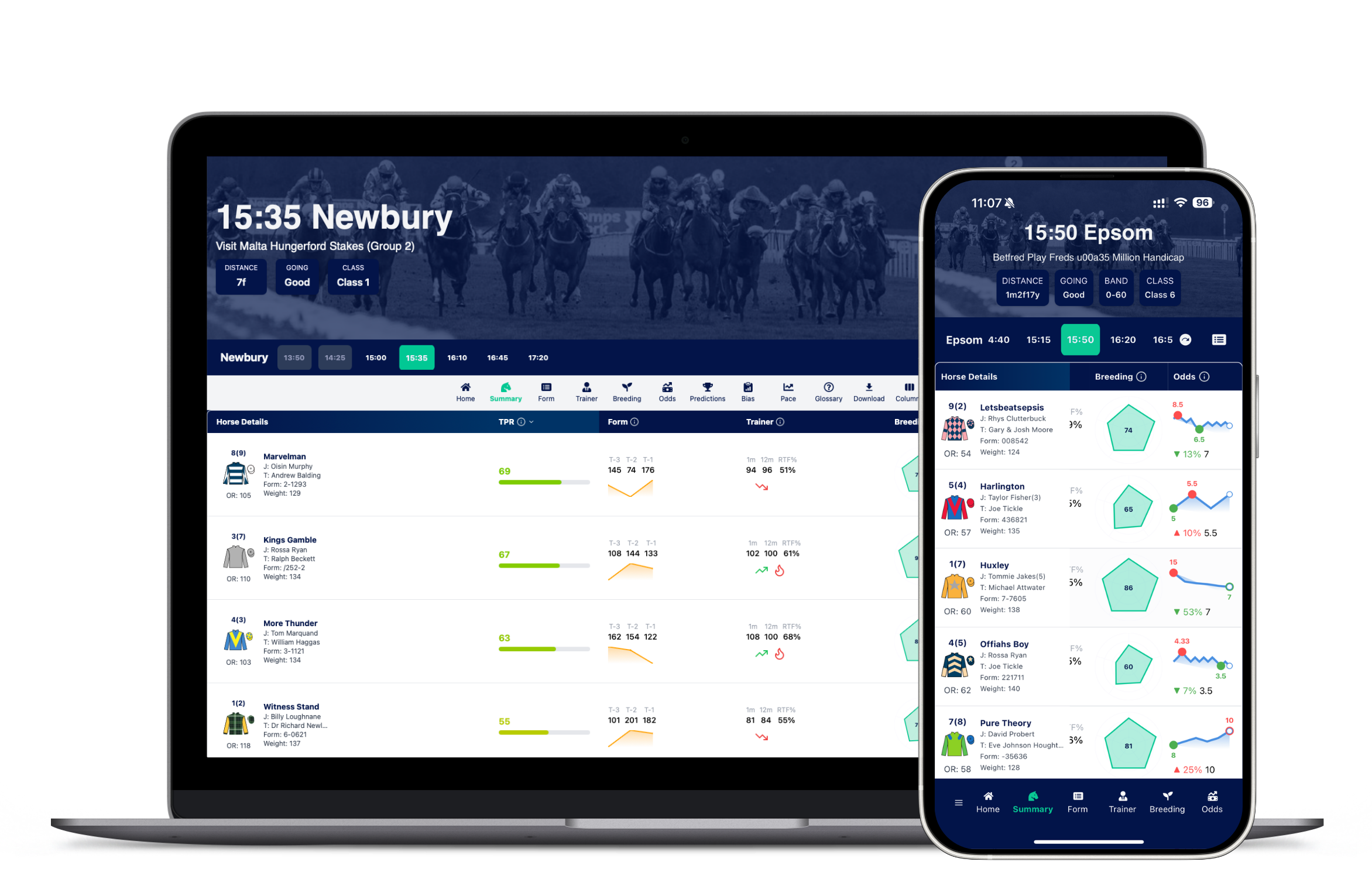
EquiAnalytix integrates odds movement data directly into the dashboard alongside proprietary TPR speed ratings, trainer and jockey form analysis, breeding intelligence, and pace maps with draw bias data. This means you can see at a glance whether the market agrees with your model — or diverges from it.
Our approach treats market movers as one analytical layer among many. A horse that tops the speed ratings, has a favourable pace scenario, and is steaming in the market represents a convergence of independent signals. A horse that is steaming but has poor speed figures and an unfavourable draw is a horse the market may have wrong.
This multi-layered approach — combining objective performance data with real-time market intelligence — is available across UK, Ireland, Hong Kong, and UAE racing. View EquiAnalytix subscription plans to access speed ratings, pace maps, and integrated odds movement data.
Glossary
- Steam
- Sustained, multi-firm odds shortening — the horse is being backed heavily. Stronger signal when occurring close to the off across the majority of the market.
- Drift
- Odds lengthening as money moves away from a horse. Can indicate negative information, but may also create value if your independent analysis still supports the selection.
- Market Mover
- A horse whose odds have moved significantly — typically shortening by 20% or more across multiple bookmakers. The term usually refers to horses being backed (shortening), though technically any significant move qualifies.
- Tissue Price
- The opening price set by bookmaker traders before the public market forms. Comparing a horse's current price to its tissue reveals the direction and magnitude of the market move.
- Overround
- The bookmaker's built-in margin across all runners in a race. Changes in overround can affect individual prices without reflecting genuine market confidence.
- Gamble
- A co-ordinated or large-scale backing of a horse, causing a sharp and rapid odds shortening. Gambles are the most dramatic form of market mover activity.
FAQs
- Market movers are horses whose odds shorten significantly across multiple bookmakers before a race. A horse that opens at 10/1 and is backed down to 5/1 across several firms is a market mover. These moves can indicate informed money entering the market, though they can also reflect public sentiment or promotional activity.
Related Guides
Get the next raceday guide, free
Every big raceday we read the whole card with the model: ratings, speed figures, pace and draw. We send the next one to your inbox the morning it is published. No charge, and you can unsubscribe in one click.
We use your email to send racing guides and occasional news about EquiAnalytix. We never share it. 18+ | Please gamble responsibly.