Introduction
Royal Ascot’s fourth day is the richest of the week for the Classic generation, with two Group 1s, the Commonwealth Cup sprint and the Coronation Stakes, plus the Ascot Derby, all on good to firm ground. This is our race-by-race read of the card, driven by the data rather than the noise. It is free and open for everyone this year, so before the racing, here is exactly what that data is and how we use it.
How we read a race
At the centre of everything is our TPR, the Total Performance Rating. It is a machine-learning model trained on more than twenty years of racing that turns everything we know about a runner into a single number: its calibrated chance of winning today’s race, shown as a percentage. The higher the figure, the stronger the model’s case. A percentage on its own does not tell you why, though, so underneath it we read a handful of supporting signals, and those are what the write-ups lean on.
What the numbers mean
- TPR (the win probability). Each horse’s calibrated chance of winning, as a percentage. In a wide-open race the leading few may be split by a point or two; in a strong one the best can stand clear.
- Speed figures. The standalone numbers you will see, such as a 173 or a 195. Each is a class and weight-adjusted rating of how fast a horse ran on the day, so figures from different tracks and grades compare directly. Higher is faster, and a horse running close to its best is the one to respect.
- Conditions form. How well a horse has performed on today’s going, over today’s trip and at this track. A high TPR backed by strong conditions form is a sturdier case than one without.
- Pace and run-style. Whether a horse leads, races handily or comes from behind, and how fast the race is likely to be run overall. A race full of front-runners often sets up for closers; a steadily-run one rewards those handy to the lead.
- Draw and course bias. What tens of thousands of past Ascot runs tell us about which stalls and which run-styles over- or under-perform on this ground. We quote these as real figures, for example a run-style that has historically won 28% less often than the market expected, rather than leaning on folklore.
Convergence Analysis
Where multiple independent data points, the TPR rating, recent speed ratings, trip and going profile, course form, trainer momentum, and historical pace-and-draw fit, all point to the same horse, we call that convergence. It is the foundation of everything we do. A horse can top the TPR rating, but if they have never been tested at today’s trip and the trainer’s strike rate has halved in the last month, the convergence is weak. When everything aligns, the signal is strong. We will show you exactly where that happens, race by race.
Let’s get into the card.
Albany Stakes (Group 3, Fillies, two-year-olds)
6f · Good to Firm · 25 runners
Model probability % · TPR v2, the engine of the time
Race Analysis
The Albany opens Day 4, a Group 3 sprint for two-year-old fillies over six furlongs, with twenty-five going to post on good to firm. Most of these have run only once, so there is plenty of guesswork, but two things sharpen the picture. Every runner carries a TPR, our Total Performance Rating: a machine-learning score, built on more than twenty years of results, that turns everything we know about a filly into a single calibrated chance of winning today, and here it cannot split the front pair, with DARK ISSUE and JOLIVETTE sharing top billing at 15.3% from LIBERTANGO at 13.4%. And on Ascot’s straight six the track has firm opinions: leaders have historically won about 15% more often than the market expected, a leader drawn high or low more again, while hold-up types are marked down to around 0.72 on fast ground and the middle of the track is the spot to avoid. Run-style and draw, in other words, matter here as much as raw ability.
JOLIVETTE ticks the most boxes. Andrew Balding’s filly won her only start and earned a class-adjusted speed figure of 152, our measure of how fast she ran with an adjustment for the class of race so that figures compare like for like, a strong number for a once-raced juvenile. Crucially she races up with the pace, the profile the sprint bias rewards, rather than against it. The breeding is a real plus too: she is by Wootton Bassett, who posts one of the best juvenile-sire ratings in the field at 90, our measure of how well a stallion’s two-year-olds tend to perform, and her dam-progeny rating of 125, which tracks how a mare’s earlier foals have fared, is among the highest here. Colin Keane rides. A model-topping, well-bred front-runner whose style fits the track is about as complete as a juvenile profile gets.
LIBERTANGO is the one the raw figures single out. George Boughey’s filly ran to a 170 on her only start, comfortably the fastest figure in the race, and she tops both our going model and our distance model, the parts of the system that rate how well a profile fits today’s ground and trip. Her page is striking as well, a dam-progeny rating of 170 the best in the field by some way. The one reservation, and the reason the model rates her third rather than first, is her running style: she is held up, and the Ascot sprint bias is hard on closers. But a figure that far clear, backed by the conditions data and a low draw, makes her much the most interesting of the hold-up types, and she is open to plenty more on just one start.
DARK ISSUE is the other joint-favourite, a front-runner like Jolivette with a 140 on debut and a high dam-progeny rating of 140 for Richard Hannon and Pat Dobbs, so her profile fits the bias just as neatly. SUN GODDESS is the most experienced of the principals, twice-raced and consistent with figures of 155 and 154 for Aidan O’Brien and Ryan Moore, though she does her racing in midfield. TOPAZ carries a 152 and a strong page for Tom Marquand, while of the others KINGS PRIZE is nicely bred for Ralph Beckett and LIGHT OF DAWN owns a tidy 143 for K R Burke, even if both, like several here, are drawn on the higher side.
With a big field on the straight track this will likely split into groups across the course, and which side dominates is part of the puzzle, but the front-running principals both come from the lower half of the draw. Where the data lands: JOLIVETTE, the well-bred model-topper whose front-running style suits the track, with LIBERTANGO, the standout on the clock and the conditions data, the one most able to overcome a hold-up trip on sheer class.
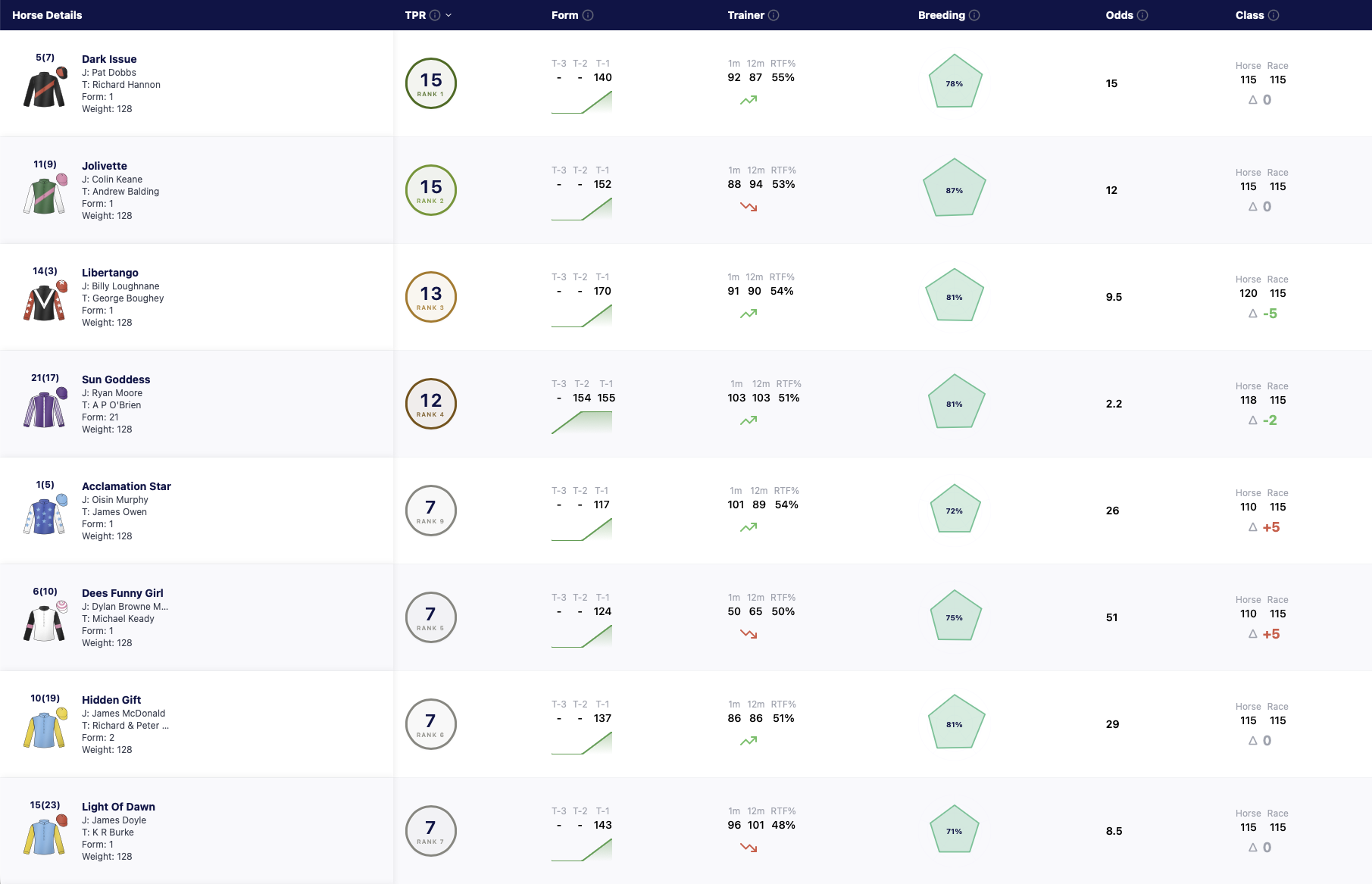
The full field
Commonwealth Cup (Group 1)
6f · Good to Firm · 22 runners
Model probability % · TPR v2, the engine of the time
Race Analysis
The Commonwealth Cup is the first of the day’s two Group 1s, a championship sprint for three-year-olds over six furlongs with twenty-two going to post. It is run on the same straight six as the Albany, so the same pattern holds: leaders win more often than the market expects, a leader drawn high or low more again, and hold-up and mid-division types are marked down, with the middle of the track the place to avoid. Our TPR finds it tight at the head, WISE APPROACH and ZANTHOS sharing top billing at 14.8% from ALBERT EINSTEIN at 12.0%, but in a deep, fast-run Group 1 the supporting signals do the separating.
VENETIAN SUN is the one our conditions data sweeps. K R Burke’s filly tops all three of our going, track and distance models at once, our reads of how well a profile fits today’s ground, this course and this trip, a clean sweep no other runner here manages. She backs it with strong figures, a 152 and a 144, our class-adjusted ratings of how fast she ran, and she eases a couple of points in class on our measure today. Clifford Lee rides. The one caveat to weigh is run-style: she races in midfield, which the sprint bias marks down a touch against the pace-setters, so she does not want to get too far back, but on the conditions data and the clock she has the most going for her.
ZANTHOS is the model’s joint-top, and on figures it is easy to see why: a 144, a 156 and a 151, three big numbers, and as a genuine front-runner from a low draw she fits the favoured sprint profile perfectly. Here, though, we owe you some honesty about the data. Those figures are her two-year-old form, the latest of them her win in the Group 2 Rockfel Stakes at Newmarket last autumn. Her actual most recent run was a below-par ninth in a Group 1 at Longchamp, which sits outside our records, because we hold full figures for Britain and Ireland only. So she is not arriving on the back of that 144; she is a high-class filly who needs to bounce back from a quiet run abroad we cannot see. The numbers are strong enough, and the profile right enough, to keep her firmly in the picture, but go in with eyes open. Simon and Ed Crisford train, Oisin Murphy rides.
WISE APPROACH is the other joint-favourite and represents the red-hot Appleby yard, its one-month rating well clear of the year’s, with William Buick, but his recent figures have been modest and he is a hold-up type, so he has the bias to beat as well as the clock. ALBERT EINSTEIN steps up sharply in class for Aidan O’Brien and Ryan Moore, while CHARLES DARWIN is the fascinating wildcard: he owns a huge back figure of 217, far bigger than anything else here, but his recent form has collapsed and he sits a long way below that peak, so he is strictly one for those who trust he can find it again. Of the rest, DIVISION holds sound figures for the in-form William Haggas and COPPULL a 156 for Clive Cox.
With a big field on the straight track the runners will fan across the course and the early pace should be strong, so a handy position on the right side will be worth plenty. Where the data lands: VENETIAN SUN, the filly our going, track and distance models all rate the best suited to today, with ZANTHOS, the high-class front-runner whose three big figures make her the standout if, and it is an if, she bounces back from that unseen run in France.
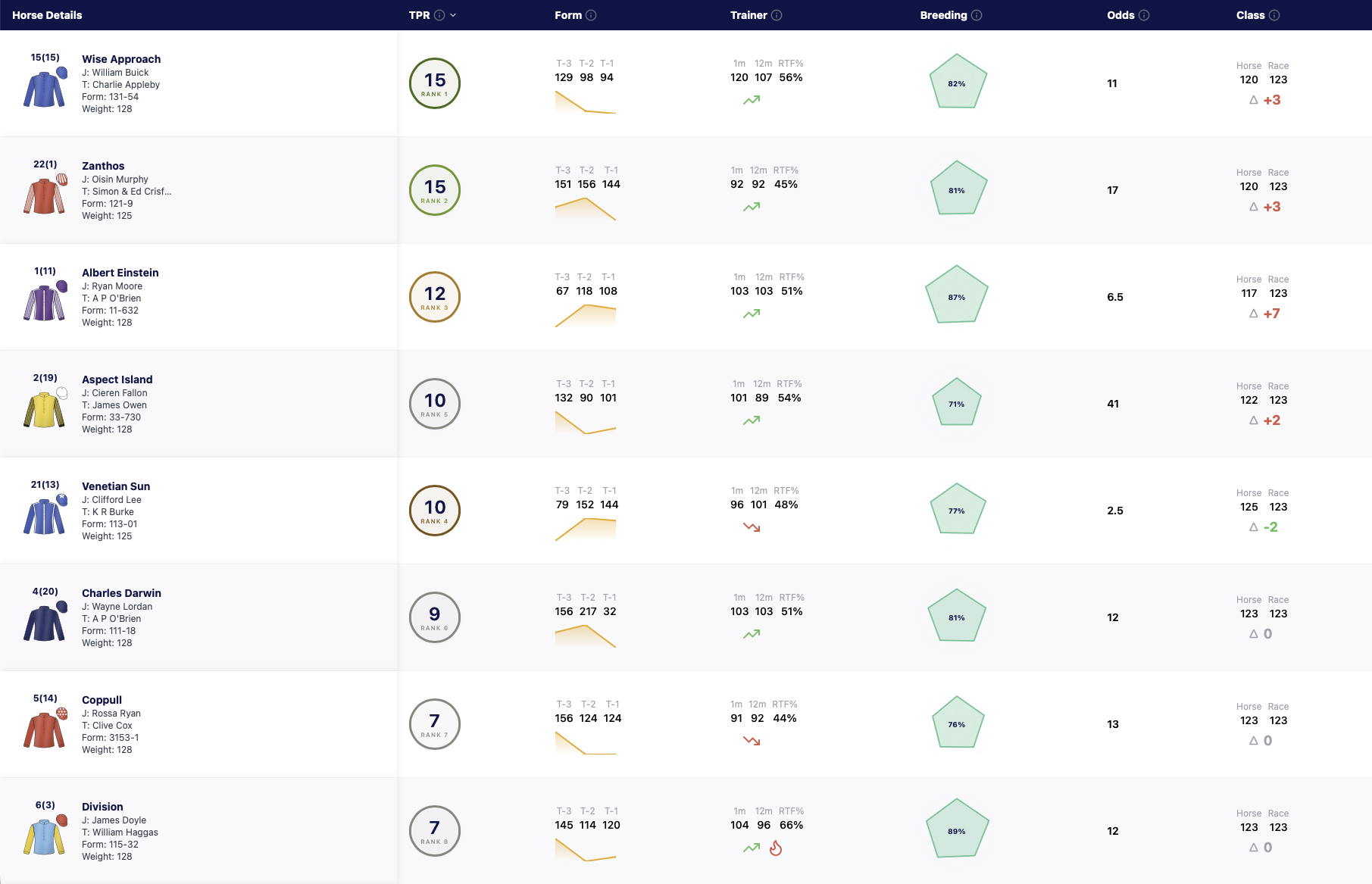
The full field
Duke of Edinburgh Stakes (Heritage Handicap)
1m4f · Good to Firm · 19 runners
Model probability % · TPR v2, the engine of the time
Race Analysis
The Duke of Edinburgh Stakes is a valuable staying handicap over a mile and a half, with nineteen going to post on good to firm. Like all the big handicaps this week it is built to be competitive, so the model spreads its hand and our conviction drops to match: it makes WARRANT HOLDER its narrow top at just 11.3%, with a wall of others from 8.2% down. On the round course over a mile and a half the draw is far less of a factor than in the straight-track handicaps, so this is more about which horses are on the right curve, and the steer is towards those still improving.
WARRANT HOLDER is the model’s top, and the profile of a horse going the right way. John and Thady Gosden’s gelding is at his peak on our trend measure, which sets a horse’s current level against its career best, his figures are consistent, and his official handicap mark is on the way up, which our system flags as a rising trajectory, often the sign of a horse the handicapper has yet to catch. William Buick rides. The one thing to weigh is the weight: as the highest-rated runner he carries top weight, the price of that progress, but a progressive type for a top yard with the right jockey is the soundest place to start in a race like this.
EMIT is the one the raw figures and a stable signal flag up together. Joseph O’Brien’s gelding owns much the biggest body of form in the field, a 192 and a 190 among his figures, our class-adjusted ratings of how fast he ran, and he drops a hefty eight points in class on our measure today, our way of saying he has been campaigned in far tougher races than this. Just as telling, the yard books Ryan Moore, usually the clearest pointer to the one it fancies, and he is drawn low. The model rates him only seventh, the editorial-value spot, because he is exposed and has been below those peak numbers lately, but on class dropping into a handicap he is the most interesting name in the pack.
There is no shortage of others with claims. INSANITY actually owns the single highest recent figure in the race, a 196, and is at his peak for Alan King, though he is a hold-up type and thoroughly exposed after seventeen runs. HOPEWELL ROCK tops our going model for today’s ground and is on a rising mark for the in-form George Boughey, and OMNI MAN brings the biggest class drop of all, ten points, with big back figures for Joseph O’Brien, even if his recent form has dipped. FRENCH DUKE is interesting for the red-hot Hamad Al Jehani yard and sits close to his peak, the wide draw his only real worry, while AMBIENTE FRIENDLY, once a smart staying sort, has lost his way and is hard to trust on recent evidence.
In a nineteen-runner handicap there is always luck in running to account for, so treat it with the usual caution. Where the data lands: WARRANT HOLDER, the peaking model-top on a rising mark for an in-form yard, with EMIT, the class-dropper carrying the biggest figures and the stable’s choice of jockey. In a field this size, though, several others can muscle into it.
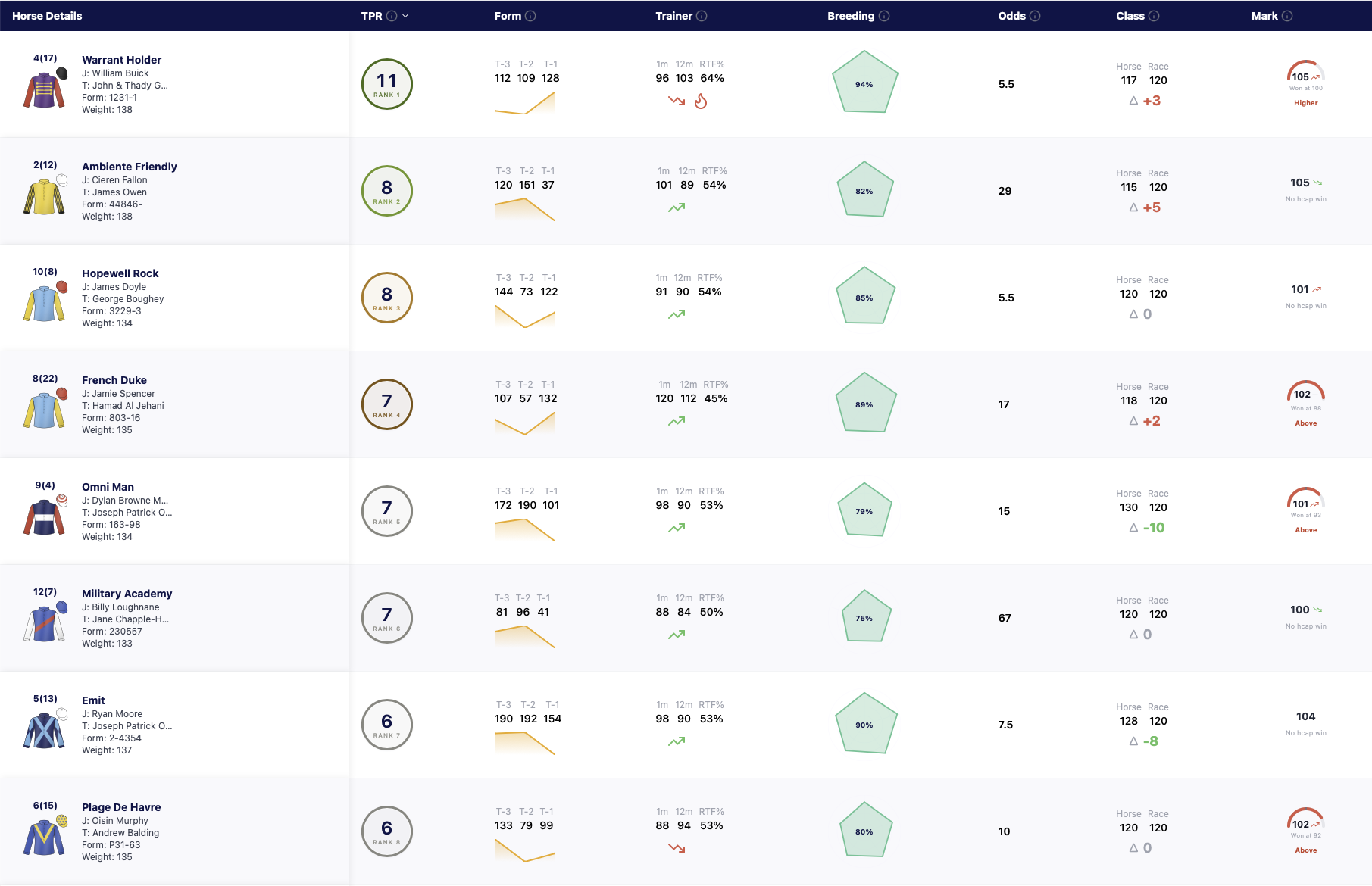
The full field
Coronation Stakes (Group 1, Fillies)
1m · Good to Firm · 9 runners · the day’s feature
Model probability % · TPR v2, the engine of the time
Race Analysis
The Coronation Stakes is the second of the day’s Group 1s and the season’s championship for three-year-old fillies over a mile, with nine going to post on good to firm. It is a small, high-class field, decided on class and the clock rather than the draw, and our TPR cannot split the two Aidan O’Brien fillies at its head: PRECISE and TRUE LOVE share favouritism on 23.4% apiece, from BALANTINA and BLACK CAVIAR GOLD on 17.5%. One feature of the shape is worth noting: with only one confirmed front-runner, the pace looks moderate, so a filly with a turn of foot, settled just off the speed, should be well placed.
PRECISE is the one the data makes the strongest case for, and she comes here a winner last time. On the clock she is the pick of the field: a 161 and a 159 this year, with a 196 in her two-year-old book, our class-adjusted ratings of how fast she ran. She also tops our distance model for the mile, the part of the system that rates how well a filly’s profile suits today’s trip, and she eases seven points in class on our measure. Aidan O’Brien runs two, and the booking of Ryan Moore here, over stablemate True Love, is usually the clearest sign of the yard’s first string. As a filly held up for a turn of foot, the steadily-run mile in prospect should suit her ideally. On the figures and the booking, she is the most complete runner in the race.
TOULEEN is the one arriving in the best heart. Owen Burrows’s filly ran a 161 last time, matching Precise’s best of the year, and our trend measure, which sets a horse’s current level against its career best, has her closer to her peak than any of the principals. The breeding adds to the appeal: she carries the highest dam-progeny rating in the field at 136, our measure of how a mare’s earlier foals have performed on the track, and is by the high-class sire Lope De Vega. Saffie Osborne rides. The model rates her sixth rather than at the head, the editorial-value spot, but a filly running to a Group 1 figure and still on the up is exactly the kind our data likes to flag against the market.
The rest are headed by the second O’Brien filly. TRUE LOVE shares top spot on the model and owns a big back figure of 185, though she has been some way below that lately and needs to bounce back. BALANTINA is the intriguing one: she tops our track model, our read of how a profile fits Ascot, and holds a smart 170 in her book for Donnacha O’Brien and Oisin Murphy, but she has not run since last August, so there is a clear fitness question after a long absence. BLACK CAVIAR GOLD is consistent for the in-form Paddy Twomey, while ROSE GHAIYYATH tops our going model for today’s ground but needs to bounce back from a quiet recent run.
This is the strongest race on the card and a true championship, but the data points a clear way. Where the data lands: PRECISE, the model’s joint-top and first string of the O’Brien pair, best on the figures and suited by the likely tempo, with TOULEEN, the progressive filly closest to her peak and the best bred in the race, the one most likely to upset the favourites.
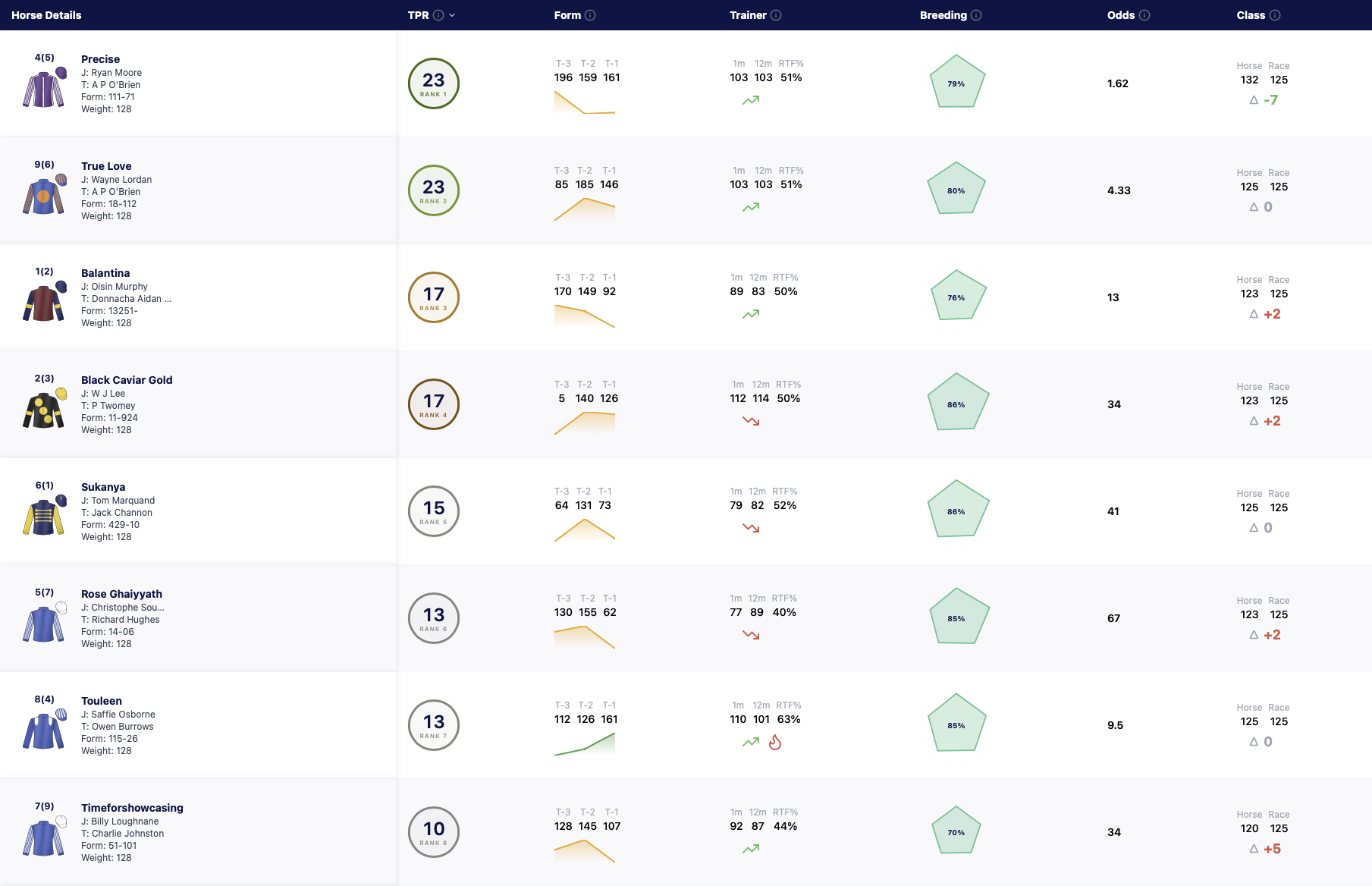
The full field
Sandringham Stakes (Heritage Handicap, Fillies)
1m · Good to Firm · 30 runners
Model probability % · TPR v2, the engine of the time
Race Analysis
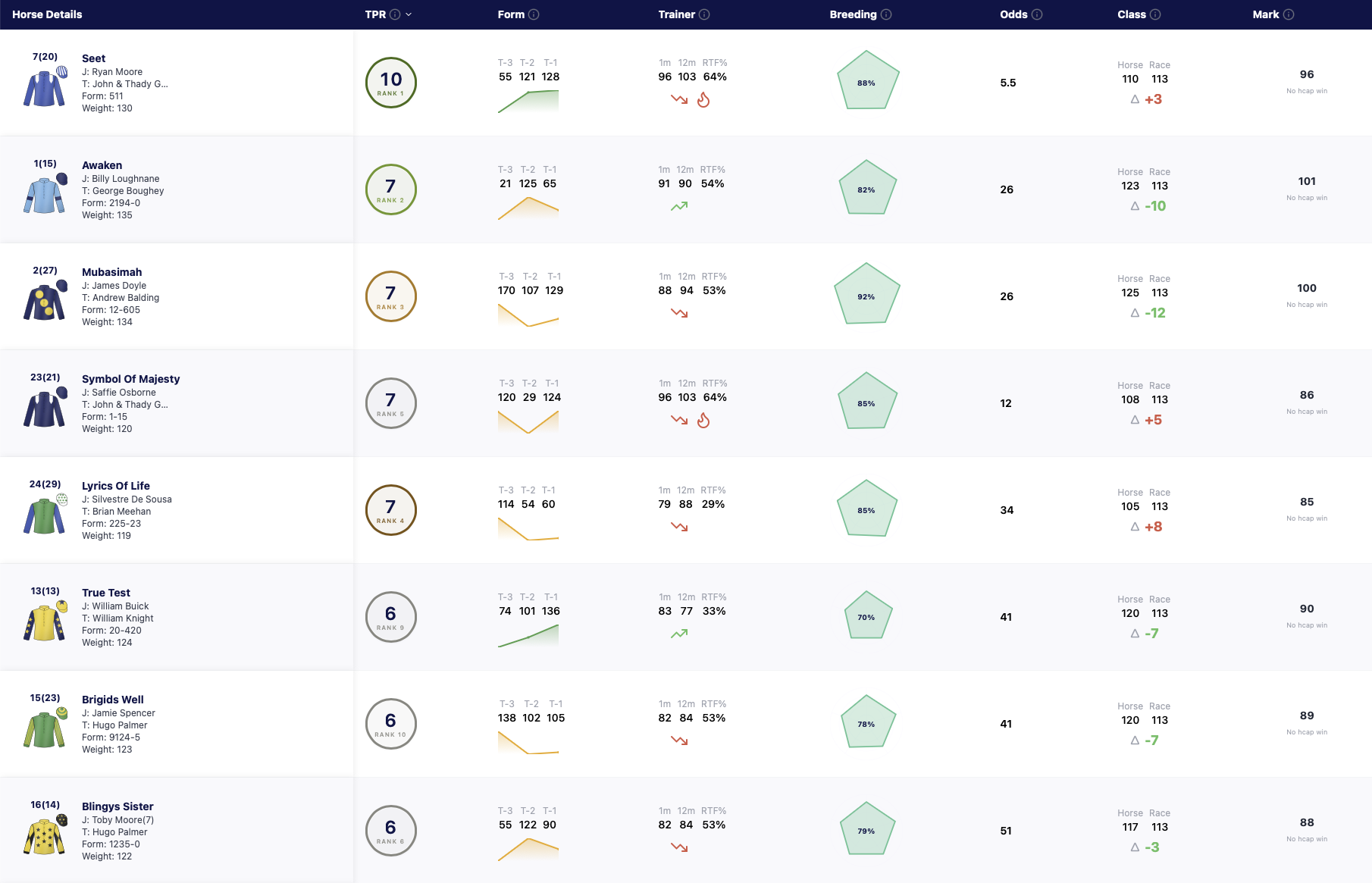
The Sandringham Stakes is the day’s cavalry charge, a thirty-runner fillies’ handicap over the straight mile, and our lowest-conviction race. In a field this size the draw can decide everything: the runners split into two groups across the track, our data has the middle worth an index of 0.98 against 0.83 for the high and low extremes, and which side gets first run is the great unknown. The model is flat to match, SEET its narrow top at just 10.3%, so the sensible approach is to lean on fillies who are progressing, and to respect a strong figure from the right part of the draw.
SEET is the model’s top and a filly going the right way. John and Thady Gosden’s runner is at her peak on our trend measure, which sets a horse’s current level against its career best, her figures are solid and consistent, and she has the booking of Ryan Moore. She is drawn high, in the band that may well prove the place to be. A lightly-raced, progressive filly for the top yard with the stable’s big-race jockey is the soundest anchor in a race this messy.
MUBASIMAH is the one our class data flags. Andrew Balding’s filly drops a full twelve points in class on our measure, the biggest easement in the entire field, our way of saying she has been running in much tougher races than this, and she owns a big back figure of 170, our class-adjusted rating of how fast she ran. James Doyle rides. She, too, is drawn high, alongside Seet, so the pair share the same draw question, but a well-related filly dropping this sharply in grade is exactly the profile that springs these big handicaps.
At a much bigger price, QUIET MUTINY demands respect. Gavin Cromwell’s filly posted a 161 last time, the highest recent figure anywhere in the race, a genuinely eyecatching run, and our trend measure has her right at her peak. Crucially she is drawn high too, on what looks the favoured side, so unlike most outsiders she has the draw in her corner as well as the clock. The model rates her down the field, but a filly with the fastest figure and the right berth is precisely the kind of overlooked runner our data is built to surface. Of the others, AWAKEN tops both our going and track models and drops sharply in class for George Boughey, though her recent form is poor, while on the opposite side of the track TRUE TEST is the low-drawn alternative, at her peak and easing in class for William Buick, and BINTAZIZA carries a big back figure from a low draw for Roger Varian.
In a thirty-runner handicap the draw writes much of the story, so treat the whole leg with caution. Where the data lands: SEET, the peaking model-top with Moore booked, and MUBASIMAH, the sharp class-dropper alongside her, both drawn high, with QUIET MUTINY the big-priced danger, the fastest of the lot on the clock and drawn on the right side of the track.
The full field
King Edward VII Stakes (Group 2, Colts & Geldings)
1m4f · Good to Firm · 6 runners
Model probability % · TPR v2, the engine of the time
Race Analysis
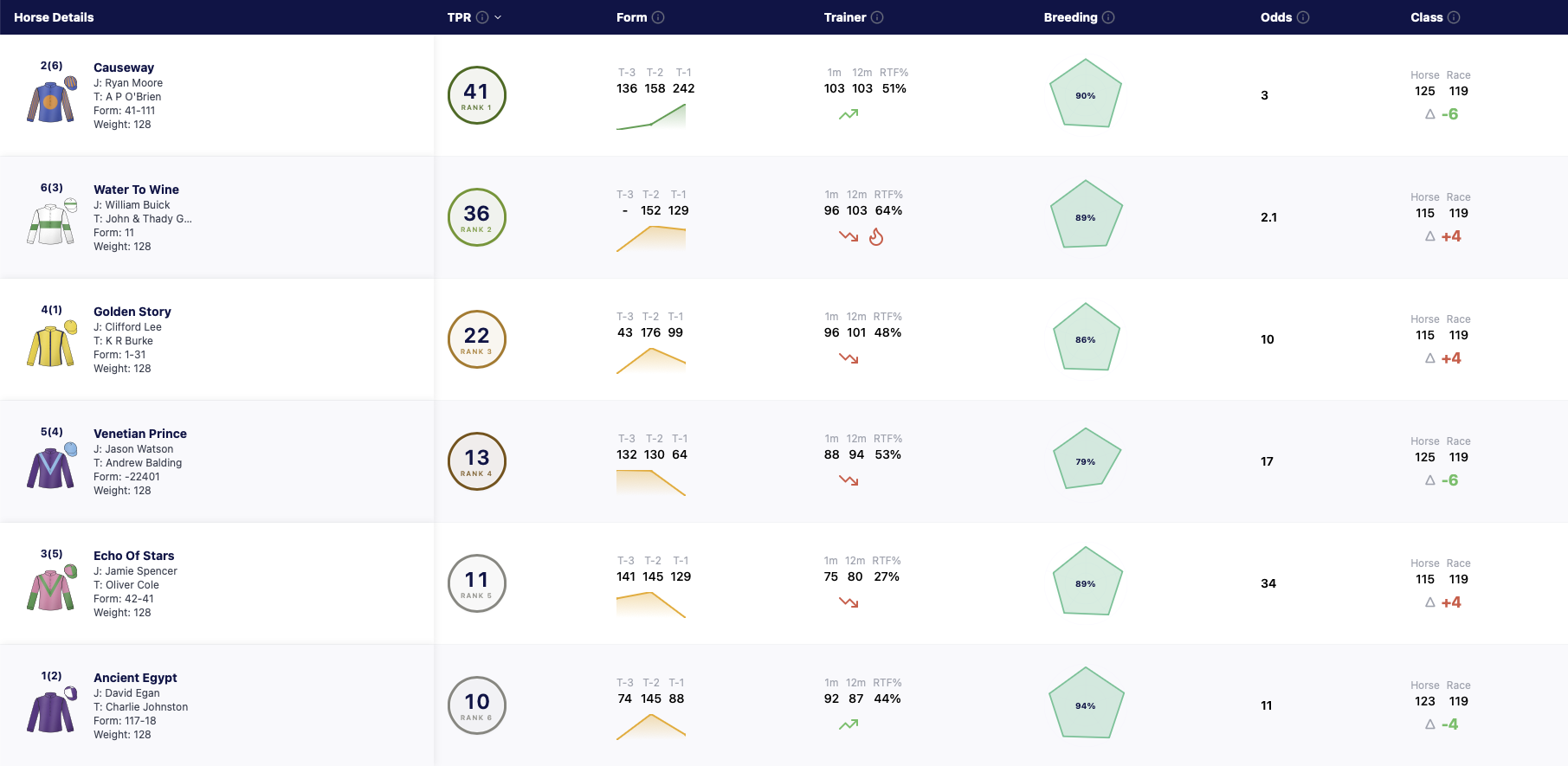
The King Edward VII Stakes is often called the Ascot Derby, a Group 2 over a mile and a half for three-year-old colts and geldings, with just six going to post on good to firm. A small field means class and the clock decide it, the draw barely a factor, and our TPR is unusually emphatic for a Group race: it makes CAUSEWAY a 41.5% chance, from WATER TO WINE at 35.9% and GOLDEN STORY at 22.2%, the rest some way back.
CAUSEWAY is the standout, and by a distance on the data. Aidan O’Brien’s colt ran to a class-adjusted speed figure of 242 last time, our rating of how fast a horse ran with an adjustment for the class of race, and that is not just the best in this field but the highest figure anywhere on today’s card. Our trend measure, which sets a horse’s current level against its career best, has him right at his peak, he eases a touch in class on our measure, and his page is strong too, by the top sire Wootton Bassett with a high dam-progeny rating. Ryan Moore rides. When the model gives a single runner better than a 40% chance in a Group race it is rarely doing so lightly, and the figure underneath that confidence is exceptional.
WATER TO WINE is the one most likely to make him work for it. John and Thady Gosden’s colt has had just two runs, so he is open to plenty of improvement, and our trend measure already has him close to his peak, with figures of 152 and 129. As a front-runner he can dictate from an inside draw, and William Buick takes the ride. He has it all to do against Causeway’s figure, but a lightly-raced, progressive colt for that yard is the obvious second and the type who can step forward again.
Of the others, GOLDEN STORY is the pick of the supporting cast for K R Burke, a front-runner with a big back figure of 176 to his name, though he has been below it since. ECHO OF STARS is the value angle on the conditions data: he tops both our going and track models for today and is consistent and close to his peak for Oliver Cole, even if his figures fall short of the front pair. VENETIAN PRINCE eases in class for Andrew Balding but has to bounce back from a quiet spell, and ANCIENT EGYPT, by Frankel and with the best stamina pedigree in the race, sets out to make all for Charlie Johnston.
In a race this small there is nowhere to hide, and the data could hardly be clearer. Where the data lands: CAUSEWAY, who owns the standout figure of the entire day and is peaking for the strongest yard-and-jockey combination in the race, with WATER TO WINE, the progressive Gosden colt, the one to fear if anything can lay a glove on him.
The full field
Palace of Holyroodhouse (Handicap)
5f · Good to Firm · 28 runners
Model probability % · TPR v2, the engine of the time
Race Analysis
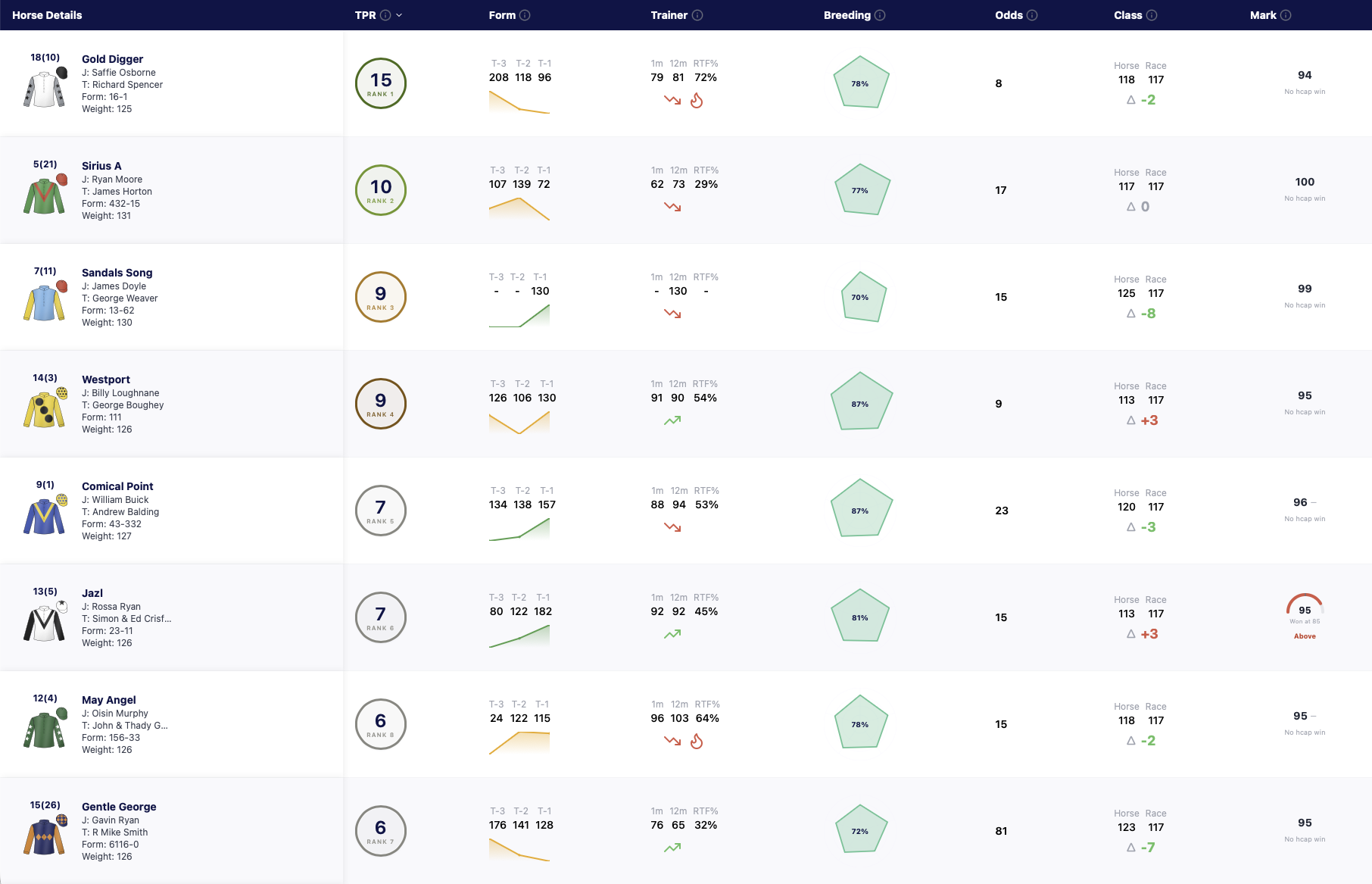
The Palace of Holyroodhouse closes Day 4, a twenty-eight-runner five-furlong sprint handicap, and the one race on the card outside the Tote Placepot, which covers the first six legs. It is run at a furious pace, so the Ascot sprint bias is in full force: leaders win more than the market expects, a leader drawn high or low more again, while the middle of the track and the hold-up types are marked down. In a field this size the draw is the wildcard, and today the high numbers look the side to be on, which shapes the whole race. The model is flat, GOLD DIGGER its top at 14.8%, but it leans on a runner poorly drawn for that bias, so we look elsewhere.
GENTLE GEORGE fits the brief better than anything. R Mike Smith’s colt is a front-runner drawn high in stall 26, and a leader from a high draw is the strongest single profile in our sprint data, worth an index of 1.42, meaning that type has won far more often than the market expected. He also tops our track model, our read of how a profile fits Ascot specifically, and he drops seven points in class on our measure today, with a big back figure of 176 to show the ability is there. His recent figures are a touch below that peak, the one caveat, but on run-style, draw and the class drop he ticks the boxes that matter most in a race like this.
SIRIUS A is the model’s pick of the high-drawn runners, rated its second overall, and from stall 21 he is on the right side too. James Horton’s colt has the booking that catches the eye, Ryan Moore taking the ride, often a pointer worth heeding in a competitive handicap, and he has run to a useful 139 in the past. The honest note is that his most recent figures have been quiet, so he needs to bounce back towards that level, but a well-drawn runner with that booking is the sensible second.
The frustration is that the two fastest on the clock are on the wrong side if the high draw holds up. JAZL owns the best recent figure in the race, a 182, and is a peaking front-runner, but he is drawn low in stall five, as is the consistent COMICAL POINT, a 157 for Andrew Balding and William Buick, in one, so both need the far side to come good. GOLD DIGGER is the model’s top on the strength of a huge back figure of 208, but she is a hold-up type from a middle draw, two strikes against the bias. Of the other high-drawn types, CHERRY BAKER carries a big back figure and a rising mark for the in-form James Owen yard, and the unraced MOOJEED is an interesting newcomer for Francis Graffard, both worth a second look on the right side.
As ever in a twenty-eight-runner sprint the draw will tell much of the tale, and our steer is firmly towards the high numbers. Where the data lands: GENTLE GEORGE, the front-runner whose high draw and run-style fit the favoured profile exactly, with SIRIUS A, the model’s high-drawn second with Ryan Moore booked. The low-drawn pair, Jazl and Comical Point, are the ones to fear if the far side springs a surprise.
Access every racecard, live analytics and the complete blog on your phone:
The full field
The day at a glance
Where the data landed, race by race.
More racedays, read by the data
Every runner, every race, every day
Everything this guide runs on, the percentages, the engine readings, the figures, the pace maps, lives on the dashboard for every British and Irish race. From 27p a day.
Explore the dashboard →EquiAnalytix provides horse racing data and analysis only. We do not take bets. 18+ | Please gamble responsibly. GamCare 0808 8020 133.