Introduction
Royal Ascot’s third day is built around the Gold Cup, the staying championship of the whole meeting, on good to firm ground. This is our race-by-race read of the card, driven by the data rather than the noise. It is free and open for everyone this year, so before the racing, here is exactly what that data is and how we use it.
How we read a race
At the centre of everything is our TPR, the Total Performance Rating. It is a machine-learning model trained on more than twenty years of racing that turns everything we know about a runner into a single number: its calibrated chance of winning today’s race, shown as a percentage. The higher the figure, the stronger the model’s case. A percentage on its own does not tell you why, though, so underneath it we read a handful of supporting signals, and those are what the write-ups lean on.
What the numbers mean
- TPR (the win probability). Each horse’s calibrated chance of winning, as a percentage. In a wide-open race the leading few may be split by a point or two; in a strong one the best can stand clear.
- Speed figures. The standalone numbers you will see, such as a 173 or a 195. Each is a class and weight-adjusted rating of how fast a horse ran on the day, so figures from different tracks and grades compare directly. Higher is faster, and a horse running close to its best is the one to respect.
- Conditions form. How well a horse has performed on today’s going, over today’s trip and at this track. A high TPR backed by strong conditions form is a sturdier case than one without.
- Pace and run-style. Whether a horse leads, races handily or comes from behind, and how fast the race is likely to be run overall. A race full of front-runners often sets up for closers; a steadily-run one rewards those handy to the lead.
- Draw and course bias. What tens of thousands of past Ascot runs tell us about which stalls and which run-styles over- or under-perform on this ground. We quote these as real figures, for example a run-style that has historically won 28% less often than the market expected, rather than leaning on folklore.
Convergence Analysis
Where multiple independent data points, the TPR rating, recent speed ratings, trip and going profile, course form, trainer momentum, and historical pace-and-draw fit, all point to the same horse, we call that convergence. It is the foundation of everything we do. A horse can top the TPR rating, but if they have never been tested at today’s trip and the trainer’s strike rate has halved in the last month, the convergence is weak. When everything aligns, the signal is strong. We will show you exactly where that happens, race by race.
Let’s get into the card.
Chesham Stakes (Listed, two-year-olds)
7f · Good to Firm · 15 runners
Model probability % · TPR v2, the engine of the time
Race Analysis
The Chesham opens Day 3, a seven-furlong Listed race for juveniles. A Listed race sits one rung below the Group races, but it regularly turns up a smart youngster, and as most of these have run only once or twice there is more guesswork than usual. Every runner carries a TPR, our Total Performance Rating: a machine-learning score, built on more than twenty years of results, that turns everything we know about a horse into a single calibrated chance of winning today. Here the model is decisive. It makes APEROLL a 23.4% chance, from AIX LA CHAPELLE at 20.0%, then a clear gap back to TIME FOR THE MOON at 14.8%.
APEROLL is the one the data keeps pointing back to. Richard Hannon’s filly won her only start, and the clock made it count: a class-adjusted speed figure of 148. That figure is our measure of how fast she ran, adjusted for the standard of the race so runs on different days and tracks compare like for like, and 148 is a strong number for a once-raced juvenile. She also tops our going model, the part of the system that rates how well each horse’s profile suits the prevailing ground, today good to firm. On top of that she eases slightly in class on our measure, meaning the level of race she meets today looks no stiffer than what she has already handled. She races up with the pace, and there is even a breeding hint in her favour: her sire, Ghaiyyath, is one whose runners handle quick ground especially well on our sire ratings. Pat Dobbs rides, and for a filly with a single run behind her, very little is missing.
AIX LA CHAPELLE is the one whose page does the talking, and it is some page. Aidan O’Brien’s colt is by Justify, the unbeaten American Triple Crown winner. On our juvenile-sire rating, which measures how well a stallion’s two-year-olds tend to perform, Justify is the best-represented sire in this field: his juveniles score 103, clear of the two Frankel colts on 92. Justify also passes on stamina, so a step up beyond seven furlongs later in the season should hold no fears. The bottom half of the pedigree is just as good: the dam, Immortal Verse, was herself a dual Group 1 winner, and on our dam-progeny rating, which tracks how a mare’s earlier foals have performed on the racecourse, she scores 128, one of the highest here. A page like that points to a colt bred to keep progressing, not simply to win first time. And the racecourse evidence backs it up: a speed figure of 144 on debut, second on our distance figures for today’s trip, the model’s clear second, and Ryan Moore booked. The breeding says there is more to come, and that is exactly what edges him in for us.
The obvious threat on the clock is TIME FOR THE MOON, who carries the fastest figure in the entire field, a 169, clear of everything else, and makes his own running for Charlie Johnston, even if the model is warier of him in third. NOLA SOUL may be the most intriguing of the others: another son of Justify, he posted a 156 on debut, and his dam, Sing Me Home, returns a dam-progeny rating of 156, the highest in the race on that measure, so on breeding alone he matches anything here. The one worry is that he, too, wants to lead, in a race already full of front-runners.
The two Frankel colts appeal for different reasons. PIKACHU and ROMANZA share the best sire-distance rating in the field at 91, our guide to how a stallion’s stock cope as the trip stretches, and ROMANZA adds a twist by topping our track model, which rates how a horse’s profile fits Ascot specifically, with James McDonald booked; the clock, though, has yet to back either of them. REVELS brings a neat debut 118 for K R Burke and is bred to be sharp. And there is a stable signal worth noting: Aidan O’Brien saddles two, and it is AIX LA CHAPELLE, not the hold-up type SOUTH DAKOTA, who gets Ryan Moore, usually the clearest pointer to the one the yard prefers.
With several wanting to lead, the early pace should be honest, so this ought to be won on merit rather than stolen from the front, and over seven furlongs on Ascot’s round course the draw matters far less than in the straight-track sprints. The data lands on APEROLL, the model’s clear top, who also heads our going model and owns the proven figure, with AIX LA CHAPELLE the beautifully-bred O’Brien colt whose pedigree and debut number mark him the one most likely to improve past her, if anything can.
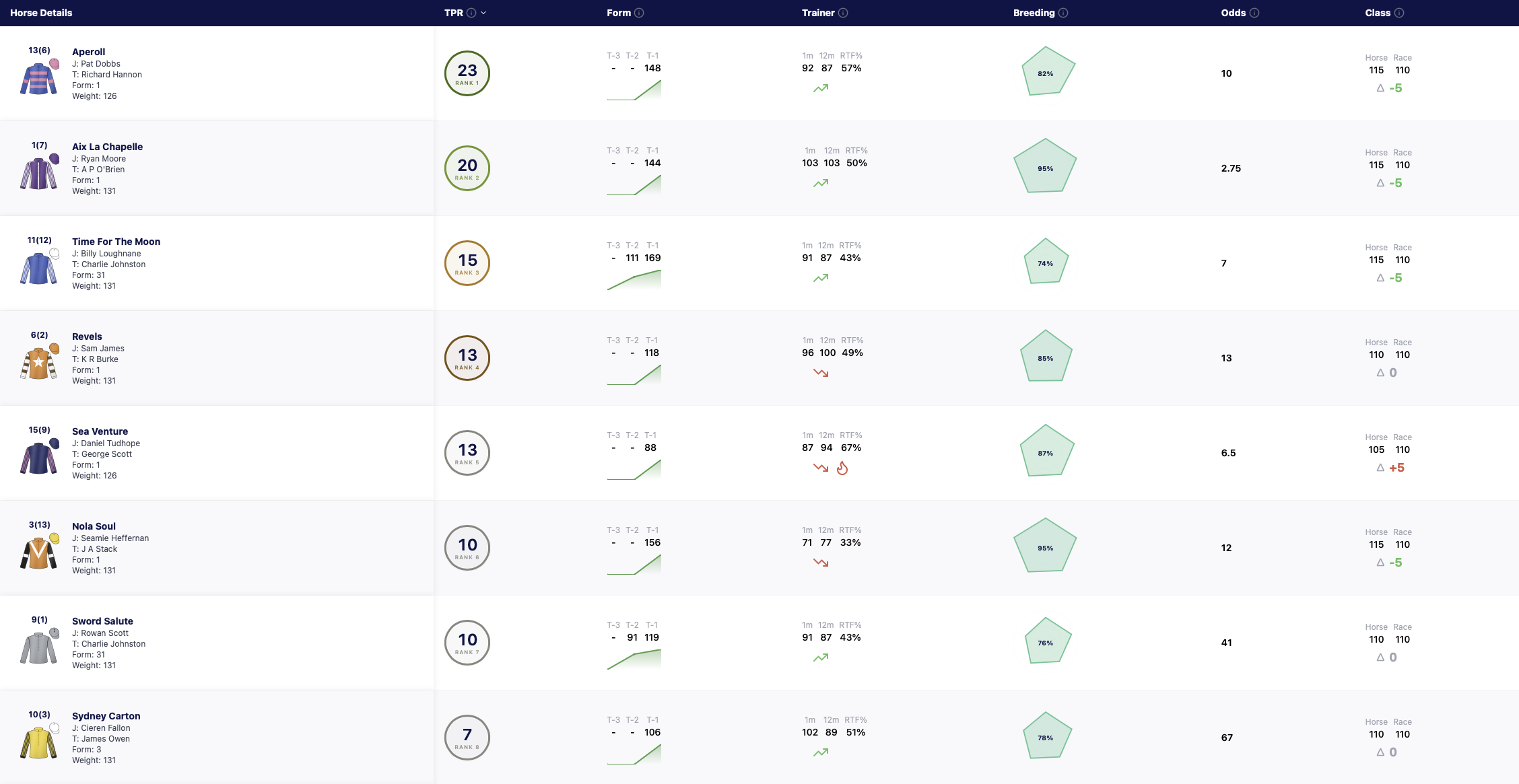
The full field
King George V Stakes (Heritage Handicap, three-year-olds)
1m4f · Good to Firm · 19 runners
Model probability % · TPR v2, the engine of the time
Race Analysis
The King George V Stakes is a Heritage Handicap, one of the big, valuable three-year-old handicaps the meeting is built around, over a mile and a half with nineteen lining up. Races like this are designed to be competitive, every horse weighted to have a say, so the model spreads its opinion thinly and our conviction drops to match. It makes GUILDMASTER its narrow top at just 15.3%, but with a sizeable caveat. John and Thady Gosden’s colt ran well below par last time, posting a class-adjusted speed figure (our pace-and-class rating of a performance) of only 88, when he had earned a 138 and a 122 in the runs before. The model still respects the body of his form, but that most recent drop, allied to top weight, is off-putting at the head of the market, and the data looks elsewhere.
INTO THE LIGHT is the one the data makes the strongest case for. Charlie Appleby’s colt has the most progressive profile in the race: our trend measure, which compares a horse’s recent form against its career peak, has him right at the top of his game rather than past it, and his figures read steadily upwards. Just as importantly, the yard is flying. Appleby’s runners are rating well above their twelve-month norm on our trainer-form measure, the one-month figure (119) clear of the longer-term mark (107), and William Buick takes the ride. He looks well treated on an official handicap mark of 88, and as a horse who settles in midfield he wants exactly the strong gallop a field this size should guarantee. The profile of a handicapper still going the right way is the soundest in the race.
HEYZOOM brings the standout recent figure of the principals, a 159 that is clear of anything Into The Light or Guildmaster have managed lately. Owen Burrows trains, and like Appleby he is in a hot spell, his one-month trainer figure (111) above the year’s (101), with Saffie Osborne booked. The model is more cautious, rating him around fourth, so this is a case where our reading of the figures sits ahead of his overall rating. He makes his own running, so from a workable draw he can prove hard to peg back if left alone in front, and on the clock he has the most to offer of the pace-setters.
After those two the race is genuinely open, with plenty holding live claims. AL AZD is the one our conditions data most likes: he tops both our going model and our distance model for today, our reads of how a profile fits the ground and the trip, his official mark is on the way up, and he carries a big back figure of 174, so do not be put off by the model placing him only mid-pack. JOULANY actually owns the single highest figure in the race, a 176, though the model doubts how repeatable it is, and he is drawn low. GALILEAN QUALITY is another progressive front-runner on a rising mark who sits third on our distance figures, while GENCHEV has a 172 to his name from earlier in the year and the booking of Colin Keane.
Joseph O’Brien fields a strong hand of four and they are tough to split: DIAL ME IN is the most fancied of them on the model and gets James McDonald, ENCELADUS is interesting for the booking of Ryan Moore despite a lower rating, and ATOMIC CITY (Tom Marquand) and CANNES are also in the mix. Of the rest, TIERRA DEL TORO drops in class on our measure and carries a useful 136 for Ralph Beckett and James Doyle, and WATERFORD CASTLE tops our track model, our read of how a profile fits Ascot specifically, on a rising mark for George Boughey.
On the round course over a mile and a half the draw is far less of a worry than in the big straight-track handicaps, and with several wanting to lead the pace should be strong and truly run, which suits a horse held up off it. In a contest this open, give it the caution any nineteen-runner handicap deserves, but the data points to INTO THE LIGHT, the progressive type at the peak of his powers for an in-form yard, with HEYZOOM the fastest of the front-runners and the alternative on the clock. GUILDMASTER is the one the figures mark down on that below-par last run.
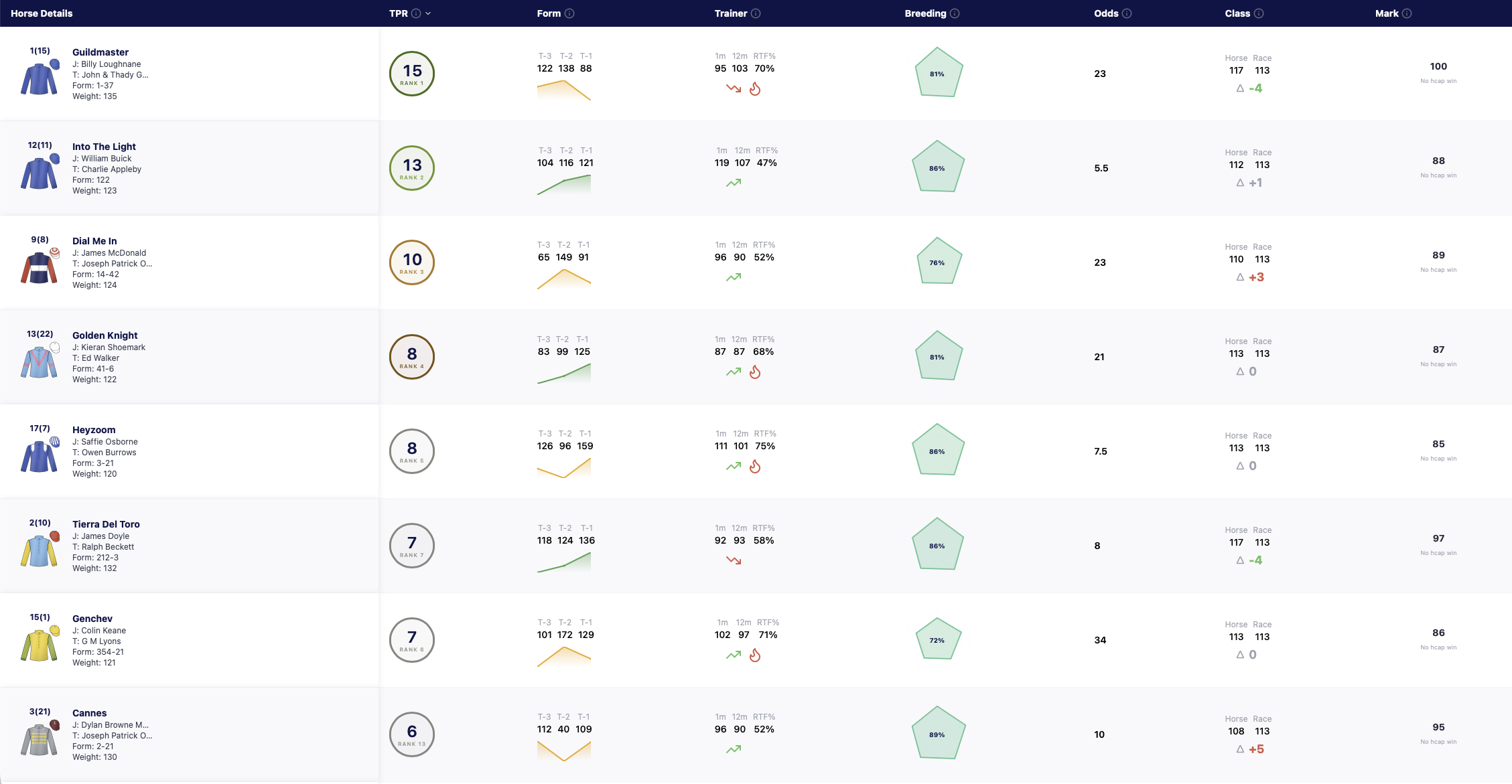
The full field
Ribblesdale Stakes (Group 2, Fillies)
1m4f · Good to Firm · 12 runners
Model probability % · TPR v2, the engine of the time
Race Analysis
The Ribblesdale is the fillies’ staying showpiece of the meeting so far, a Group 2 for three-year-old fillies over a mile and a half that regularly unearths an Oaks-class filly, with twelve going to post on good to firm. Being a Group race rather than a handicap, it is decided by class and the clock rather than by the weights. The model finds the head of the market close: it makes EARTH SHOT a 22.2% chance, from COMPOSING at 21.2% and LADY ROISIA at 13.4%, with a cluster around 10%. The most compelling case on the data, though, sits a little further down that order.
LEGACY LINK is where the numbers make their strongest case. She brings high, consistent figures: a class-adjusted speed figure of 143 last time with a 167 earlier in her career, our ratings of how fast she ran with an adjustment for the class of each race, and those are among the strongest on offer here. More striking still, she drops a full thirteen points in class on our measure, the biggest easement in the field, which is our way of saying she has been competing in markedly tougher races than this one and now meets a softer assignment. She also tops our distance model, the part of the system that rates how well each filly’s profile suits today’s mile and a half, and the pedigree backs the stamina up: she is by the outstanding sire Dubawi and carries the best dam-progeny rating in the race at 126, our measure of how a mare’s previous foals have performed on the track. John and Thady Gosden train, Colin Keane rides. The model places her only fifth, so the figures argue more strongly for her than her overall rating does, and statistically she has the most in her favour here.
EARTH SHOT is the model’s clear top, and she earns it on profile. William Haggas’s filly is at the very peak of her form on our trend measure, which sets a horse’s current level against its career best, and her figures have climbed with each run. James Doyle rides. The honest note the data raises is class: she steps up seven points in grade on our measure today, a meaningful rise, and her best figure so far, a 114, is some way below Legacy Link’s, so she is a filly improving into this race rather than one already proven at the level. A progressive Haggas filly taking another step forward would be no surprise, and if she does she is the one to beat.
COMPOSING is the one to treat with real caution despite the strong booking of Aidan O’Brien and Ryan Moore and a model rating of second: her latest figure was a dismal 36 and she sits a long way below her career peak, so the recent evidence is hard to set aside. Among the rest, DARK LUCINDA is the unexposed improver, and a smart one, her 145 from her only start the fastest single recent figure anyone here has posted, with plenty more likely to come for Paddy Twomey. VENETIA tops our track model, our read of how a profile fits Ascot specifically, for Ralph Beckett, though her figures need to find another level in this grade. BRILLIANT STAR is a puzzle, owning the highest single figure in the race, a 191, and topping our going model for today’s ground, yet her recent form has fallen away and she has to recapture that old peak. GILDED PRIZE is the complete unknown, an unraced Frankel filly who holds the best sire-distance rating in the field with Oisin Murphy booked for Francis Graffard, one the model can place on breeding alone but not yet on form.
Over a mile and a half on the round course the draw is only a minor factor, and our pace map points to a fair gallop, so this should come down to class and stamina. Where the data lands: LEGACY LINK, whose figures, sharp drop in class and distance rating together make the strongest statistical case in the race, with EARTH SHOT, the peaking Haggas filly the model puts on top, the likeliest to confirm the form if she improves again.
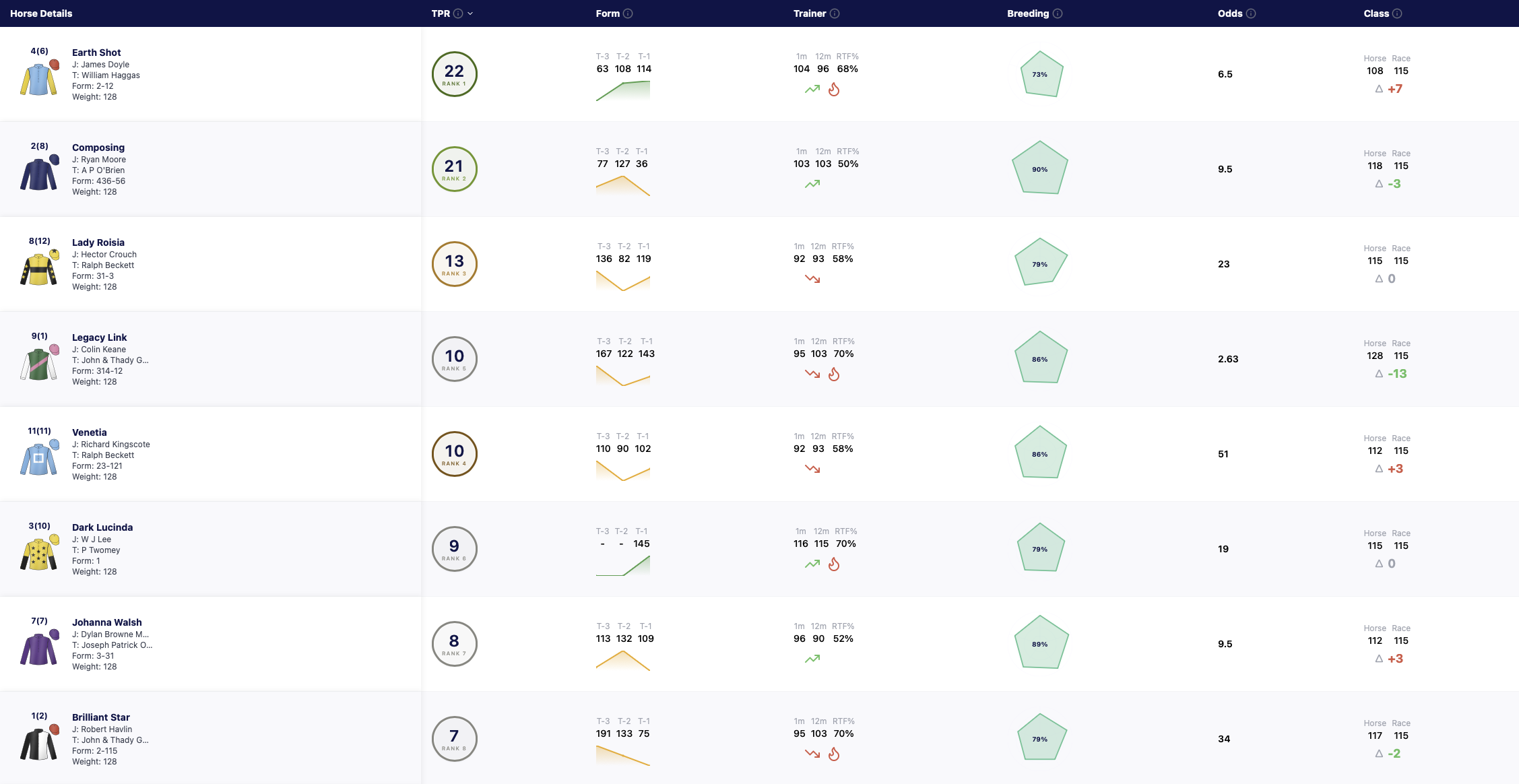
The full field
Gold Cup (Group 1)
2m4f · Good to Firm · 11 runners · the day’s feature
Model probability % · TPR v2, the engine of the time
Race Analysis
The Gold Cup is the centrepiece of Day 3 and the staying championship of the whole meeting, a Group 1 over two and a half miles that asks for relentless stamina as much as class, with eleven going to post on good to firm. Our TPR, the machine-learning rating that turns each horse’s profile into a single calibrated chance of winning, cannot separate the top two: it makes TRAWLERMAN and SCANDINAVIA joint favourites on 23.4% apiece, clear of CABALLO DE MAR at 17.5%. One piece of course data frames the race. Over Ascot’s marathon trips our records show a strong edge to horses ridden close to the lead: front-runners have won around 16% more often than the market expected across nearly 900 staying runs here, an index of 1.16, while those held up at the back are marked down to 0.74, winning far less often than their chance suggests. Both market leaders race up with the pace.
TRAWLERMAN is the standout on the clock. Last time he posted a class-adjusted speed figure of 241, our rating of how fast a horse ran with an adjustment for the class of the race, and that is the highest figure any of these has recorded. What matters just as much is that it came on his latest start: where several rivals own big numbers from the past, Trawlerman is producing his right now, as our trend measure (which sets a horse’s current level against its career best) confirms by placing him at his peak, no small thing for a veteran of nineteen runs. He also tops both our track model and our distance model, the parts of the system that rate how well a profile fits Ascot specifically and this extreme trip, so the figure is backed by suitability on every front. He races prominently, the favoured staying profile here, for John and Thady Gosden and William Buick. On the data this is as complete a case as the race offers.
SCANDINAVIA is the one the model cannot split from him, and the reason is easy to see. Aidan O’Brien’s stayer owns career-best figures of 239 and 214, among the very best on offer, and he tops our going model for today’s good to firm, the measure of how well a horse handles the prevailing ground. Ryan Moore rides. The query the data raises is recency: his latest figure, a 160, fell short of those career peaks, so he needs to climb back towards his best. He, too, wants to lead, and with both principals and a couple of others keen to go forward, the early pace should be genuine, which is worth bearing in mind for anything ridden with restraint.
Behind the pair, several carry big figures from the past without the current peak to match. CABALLO DE MAR is the exception, a front-runner at his own peak on our trend measure with a 174 last time for George Scott and Oisin Murphy, the most progressive of the chasing group. CARMERS (a 224 in the book) and RAHIEBB (a 237) both hold huge back figures but sit well below their best on current evidence, as does FURTHUR, who is worth a mention all the same: he holds the strongest stamina pedigree in the field, a sire-distance rating of 124, our guide to how well a sire’s stock stay as the trip stretches, comfortably the highest here. SWEET WILLIAM is the proven Gold Cup-class stayer of the field for Gosden, with a 235 to his name, though he is held up at the back, the one run-style the Ascot staying bias marks down hardest.
This looks a strong renewal but a clearly-framed one. Where the data lands: TRAWLERMAN, who owns the best figure in the race, sits at his peak and tops our track and distance models, with SCANDINAVIA, the joint-favourite on career-best form for O’Brien and Moore, the most obvious threat if he returns to those heights. The pace the front-runners set could yet bring a closer into it, but on the numbers the two market leaders set the standard.
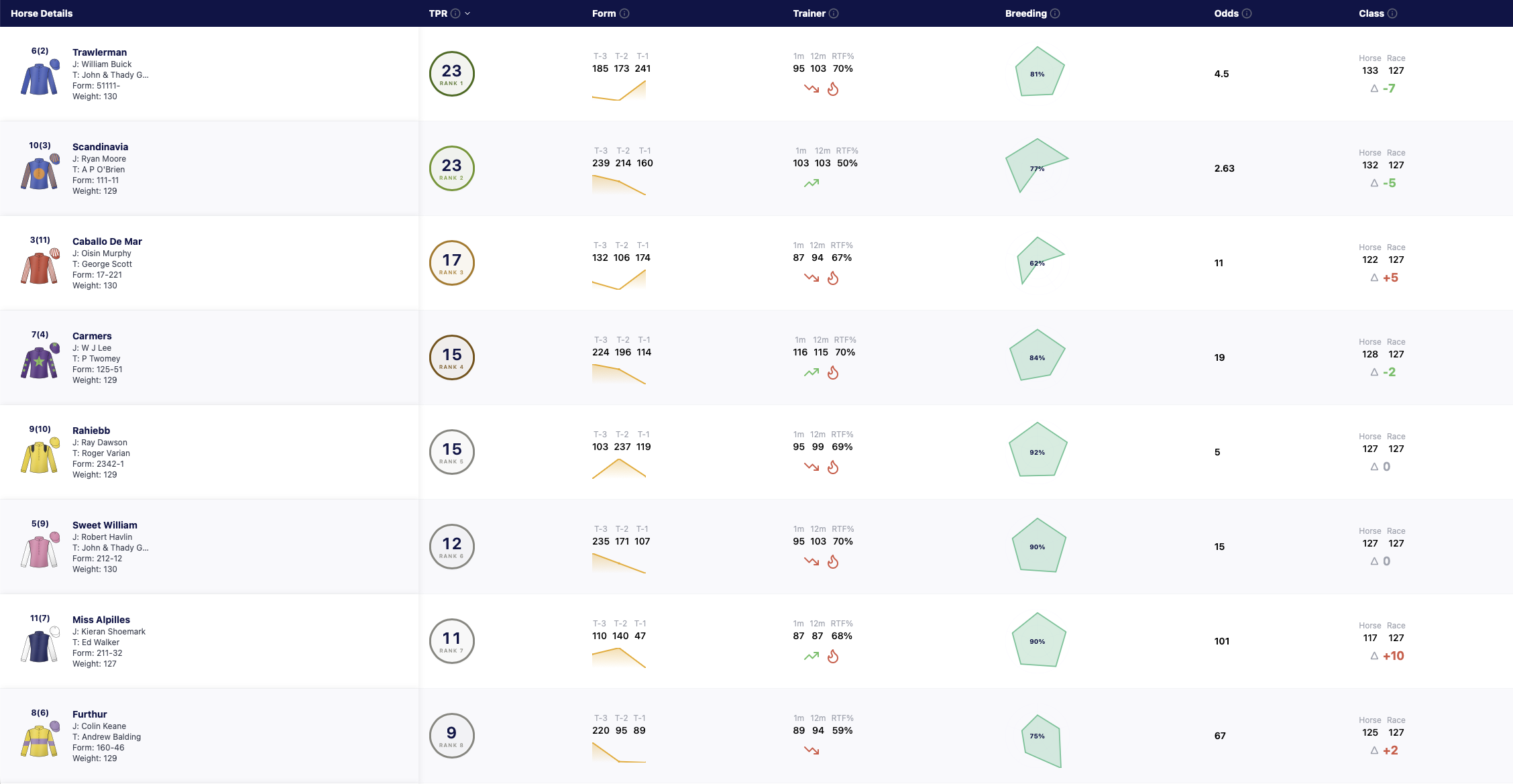
The full field
Britannia Stakes (Heritage Handicap, Colts & Geldings)
1m · Good to Firm · 30 runners
Model probability % · TPR v2, the engine of the time
Race Analysis
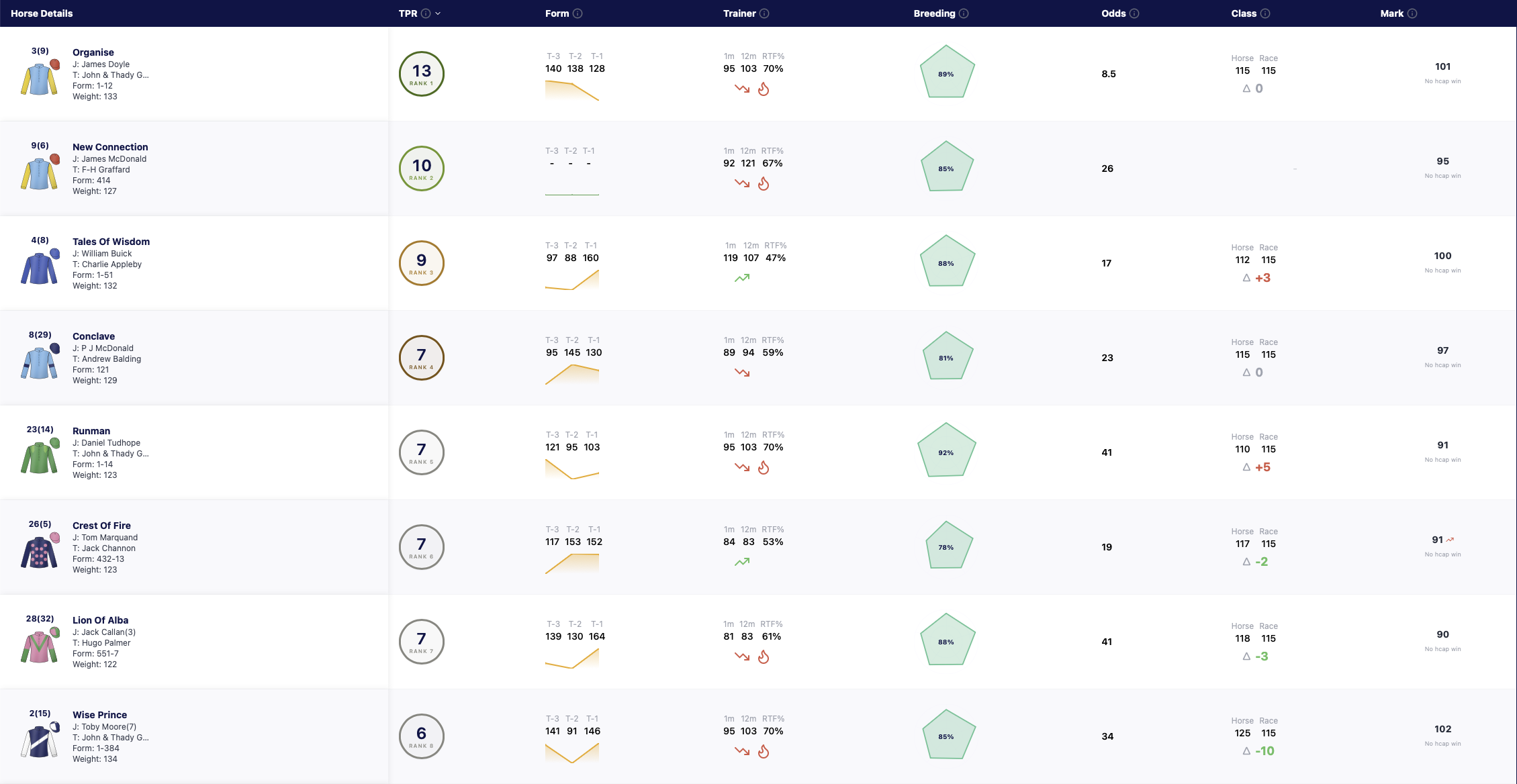
The Britannia is the day’s cavalry charge, a thirty-runner handicap for three-year-old colts and geldings over the straight mile, and comfortably the hardest race on the card to call. In a field this size the draw can decide everything: the runners usually split into two groups across the track, and which side gets first run is impossible to know in advance. Our long-run figures show the middle of the straight worth an index of 0.98 against 0.83 for the high and low extremes, but on any given day either rail can dominate, so this is our lowest-conviction race and everything that follows carries that warning. The model is flat too, making ORGANISE its narrow top at just 13.4%, so the data steers towards progressive types still on the upgrade from a workable position.
TALES OF WISDOM has the most going for him on the clock. Charlie Appleby’s colt ran to a class-adjusted speed figure of 160 last time, our rating of how fast he ran adjusted for the class of race, the best recent number among the principal contenders, and our trend measure has him right at his peak. He also tops our distance model for the mile, the part of the system that rates suitability for today’s trip, the yard is in excellent form (its one-month trainer rating of 119 well clear of the twelve-month 107), and William Buick rides. He is drawn low, in the pack rather than out wide. The one quibble the data raises is his running style: he presses the pace, and over the straight mile our records mark prominent racers down a touch against those who either lead outright or come from behind. Set against the figure and the peak form, that is a quibble rather than a barrier.
ORGANISE is the model’s top and the most consistent runner in the race. John and Thady Gosden’s colt has posted a tight, high cluster of figures, 128, 138 and 140, so there is little guesswork about his level, and he sits close to his peak. He makes his own running, a style that rates around par here rather than against it, and he is drawn in the low-to-middle band. James Doyle rides. The one thing to weigh is the weight: as one of the higher-rated horses he shoulders a big burden, the price of his consistency. From a fair draw, a reliable front-runner is exactly the profile that copes best with a race this chaotic.
After those two it is wide open. LION OF ALBA owns the single highest recent figure in the entire field, a 164, and tops our going model for today’s ground, but he is drawn widest of all in stall 32, so he needs his side of the track to be the right one. CREST OF FIRE is another on the upgrade, with consistent figures around 152 and a rising handicap mark, drawn low for Tom Marquand. WISE PRINCE drops a striking ten points in class on our measure for Gosden, a sign he has been campaigned in much tougher races, while the unraced NEW CONNECTION is the field’s unknown, a Francis Graffard newcomer with James McDonald booked whom the model can place only on profile. Ryan Moore’s mount FLUSHING MEADOWS, and WERE GOOSERS (a 152 in the book, Oisin Murphy up), are others to note in a race where a couple of dozen hold some sort of claim.
In a thirty-runner handicap the draw will write much of the story, so treat the whole leg with caution. Where the data lands: TALES OF WISDOM, the peaking, top-figure colt for the in-form Appleby yard, and ORGANISE, the model’s consistent front-running top, with the open caveat that which side of the track the race is won on is something none of us can know in advance.
The full field
Hampton Court Stakes (Group 3)
1m2f · Good to Firm · 10 runners
Model probability % · TPR v2, the engine of the time
Race Analysis
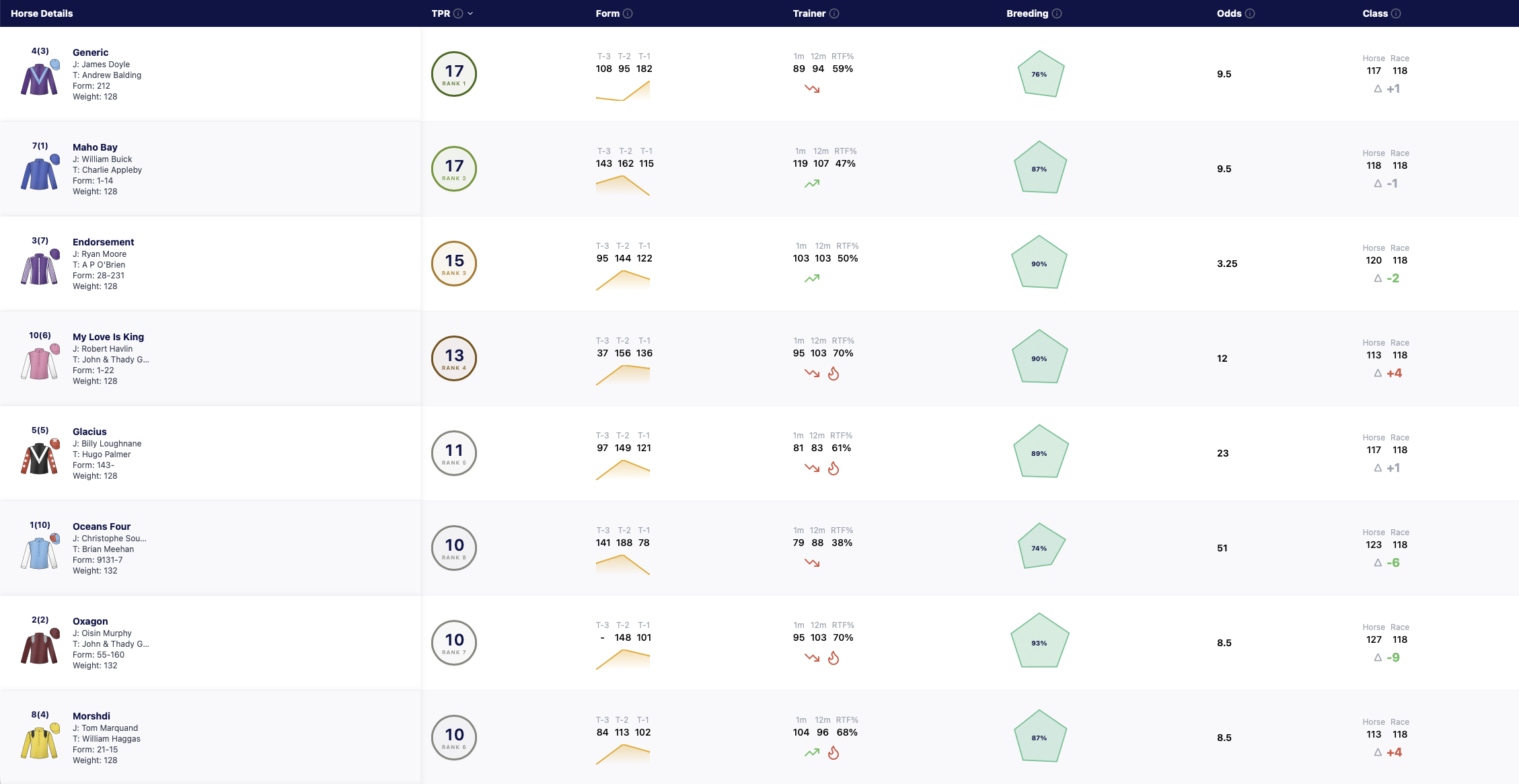
The Hampton Court Stakes is a competitive Group 3 for three-year-olds over a mile and a quarter, with ten going to post on good to firm. It regularly features colts working their way up towards Group 1 company, and the model finds the top tight: GENERIC and MAHO BAY share favouritism on 17.5%, from ENDORSEMENT at 15.3% and MY LOVE IS KING at 13.4%. With a small, classy field over a middle-distance trip on the round course, the draw is a minor concern, so this comes down to class, the clock and the way the race is run.
GENERIC stands out on the figures. Andrew Balding’s colt ran to a class-adjusted speed figure of 182 last time, our rating of how fast he ran adjusted for the class of race, and that is the best current number in the field by a clear margin, the nearest rival on 143. Just as encouragingly, our trend measure, which compares a horse’s current level with its career best, has him right at his peak rather than going the other way, so that big figure is the real him now. James Doyle rides. For a lightly-raced three-year-old still on the upgrade, a figure of that size already puts him on the fringe of Group 1 level, and it is the standout statistical case in the race.
ENDORSEMENT is the one our conditions data most likes. Aidan O’Brien’s colt tops our going model for today’s good to firm, the part of the system that rates how well a horse handles the prevailing ground, and he backs it with consistent figures, a 144 among them, and a strong page: he is by the top sire Wootton Bassett and carries a dam-progeny rating of 120, our measure of how a mare’s earlier foals have performed on the track, one of the best here. Ryan Moore takes the ride, and as a front-runner he can dictate. He is the soundest blend of form, conditions and pedigree in the chasing group.
MAHO BAY is the joint-favourite and beautifully bred, by Dubawi with a dam-progeny rating of 121, for Charlie Appleby and William Buick, and he owns big back figures of 162 and 143; the slight concern is that his latest run, a 115, dipped below that peak, so he needs to find his best again. MY LOVE IS KING holds a 156 in the book and sits high on both our going and distance models for John and Thady Gosden. OXAGON is the interesting class-dropper, easing nine points in grade on our measure, with Frankel as his sire and Oisin Murphy booked, while OCEANS FOUR owns a huge back figure of 188 but is a long way below it on current form. MOUNTAIN CAT is lightly raced and carries the highest dam-progeny rating in the race at 132, one for the notebook even if today may come a fraction soon.
With several wanting to lead, the pace should be honest, which should let the best horse settle it rather than a soft lead being stolen up front. Where the data lands: GENERIC, who owns much the best current figure and is peaking for an in-form yard, with ENDORSEMENT, the going-model leader whose form, breeding and booking make him the most rounded of the rest.
The full field
Buckingham Palace Stakes (Handicap)
7f · Good to Firm · 29 runners
Model probability % · TPR v2, the engine of the time
Race Analysis
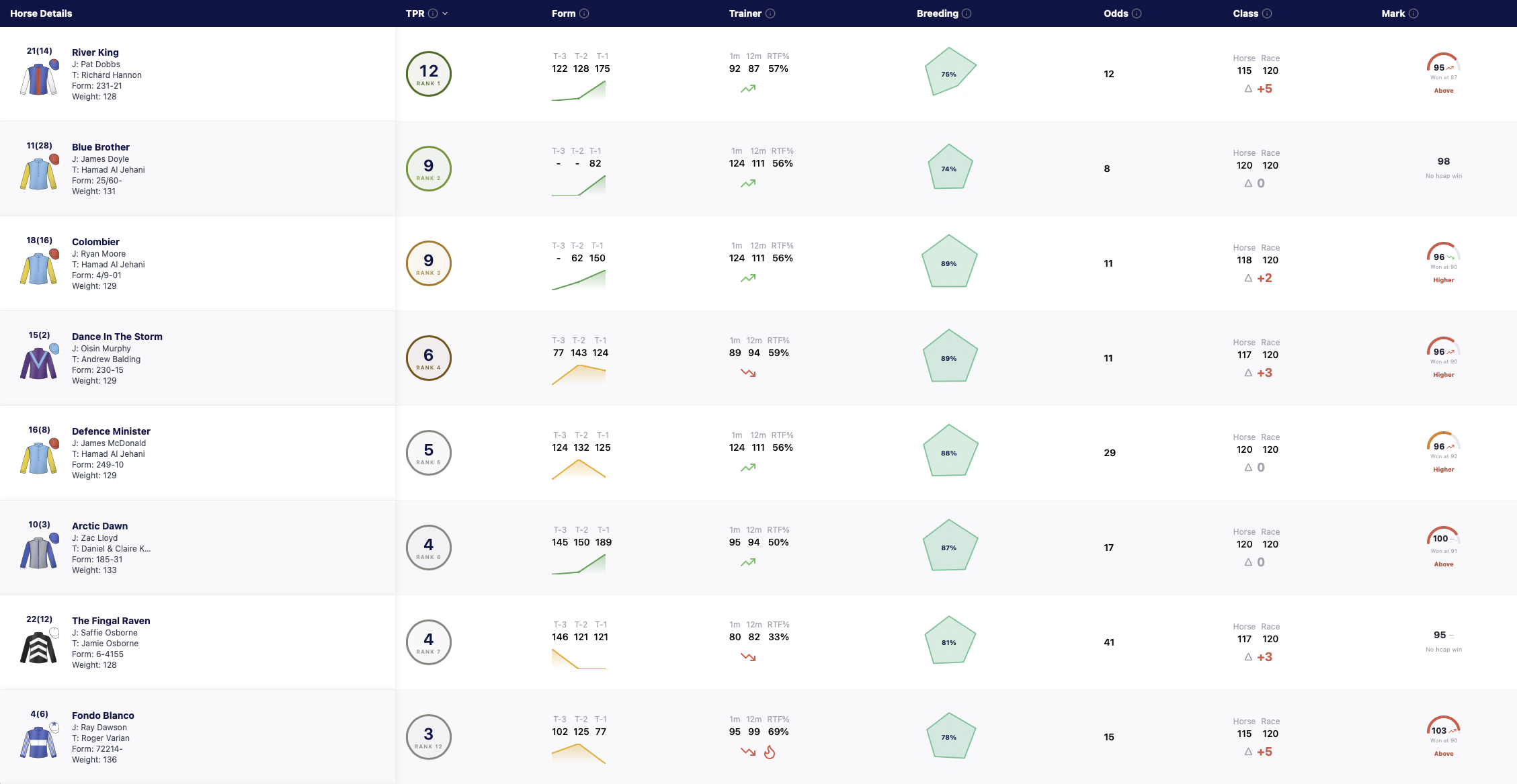
The Buckingham Palace Stakes closes Day 3, a twenty-nine-runner seven-furlong handicap, and the one race on the card outside the Tote Placepot, which covers the first six legs. Like the Britannia before it, this is a big-field handicap where the model spreads its view thinly, RIVER KING its narrow top at just 11.7%, so conviction is low and the draw has a say. The one mercy is the trip: over seven furlongs on Ascot’s round course the draw is less decisive than in the straight-mile cavalry charges, so this is rather more about the horses, though in a field this size it can never be ignored entirely.
RIVER KING is the model’s top, and he has the profile of a horse going the right way. Richard Hannon’s runner posted a class-adjusted speed figure of 175 last time, our rating of how fast he ran adjusted for the class of race and among the best recent numbers in the field, and our trend measure has him right at his peak. His official handicap mark is on the way up, which our system flags as a rising trajectory, and he sits second on our going model for today’s good to firm. He races prominently, Pat Dobbs rides, and from a fair draw in the middle of the field he has the soundest progressive profile in the race.
ARCTIC DAWN is the one our raw figures single out. He owns the single highest recent figure in the entire field, a 189, with a 150 and a 145 behind it, so there is nothing fluky about the number, and like River King he is at his peak right now. He also tops our going model outright for today’s ground. The reason the overall model rates him only sixth is that he is a thoroughly exposed handicapper after eighteen starts, the type who can run well without winning, but on the clock and the conditions data he has as much in his favour as anything here, and he is drawn low for Daniel and Claire Kubler with Zac Lloyd booked.
Hamad Al Jehani saddles a strong team from a yard in red-hot form, its one-month trainer rating (124) well clear of the twelve-month mark (111). COLOMBIER is the best of them on the data, lightly raced and topping our distance model with Ryan Moore booked, though his mark has been easing rather than climbing; DEFENCE MINISTER is the most consistent, a tight run of figures around 125 to 132 on a rising mark, with James McDonald up. Of the rest, DANCE IN THE STORM is another on the upgrade for Andrew Balding and Oisin Murphy from a low draw, ROYAL VELVET carries a 156 and the booking of William Buick, and THE LOST KING holds a big back figure of 178 for Balding. In a race this size, a couple of dozen can be handed some sort of chance.
It is a fittingly open way to end the day, so treat it with the caution a twenty-nine-runner handicap demands. Where the data lands: RIVER KING, the model’s progressive top at his peak on a rising mark, and ARCTIC DAWN, the highest-figure horse in the field whom our going model also rates the best suited to the ground. As this race falls outside the Placepot, both are flagged for the win and place markets rather than the pool.
Access every racecard, live analytics and the complete blog on your phone:
The full field
The day at a glance
Where the data landed, race by race.
More racedays, read by the data
Every runner, every race, every day
Everything this guide runs on, the percentages, the engine readings, the figures, the pace maps, lives on the dashboard for every British and Irish race. From 27p a day.
Explore the dashboard →EquiAnalytix provides horse racing data and analysis only. We do not take bets. 18+ | Please gamble responsibly. GamCare 0808 8020 133.