Introduction
Royal Ascot’s second day brings seven more races and a Group 1 feature, the Prince of Wales’s Stakes, on good to firm ground. This is our race-by-race read of the card, driven by the data rather than the noise. It is free and open this year, so before we get to the races, here is exactly what that data is and how we use it.
How we read a race
At the centre of everything is our TPR, the Total Performance Rating. It is a machine-learning model trained on more than twenty years of racing that turns everything we know about a runner into a single number: its calibrated chance of winning today’s race, shown as a percentage. The higher the figure, the stronger the model’s case. A percentage on its own does not tell you why, though, so underneath it we read a handful of supporting signals, and those are what the write-ups lean on.
What the numbers mean
- TPR (the win probability). Each horse’s calibrated chance of winning, as a percentage. In a wide-open race the leading few may be split by a point or two; in a strong one the best can stand clear.
- Speed figures. The standalone numbers you will see, such as a 173 or a 195. Each is a class and weight-adjusted rating of how fast a horse ran on the day, so figures from different tracks and grades compare directly. Higher is faster, and a horse running close to its best is the one to respect.
- Conditions form. How well a horse has performed on today’s going, over today’s trip and at this track. A high TPR backed by strong conditions form is a sturdier case than one without.
- Pace and run-style. Whether a horse leads, races handily or comes from behind, and how fast the race is likely to be run overall. A race full of front-runners often sets up for closers; a steadily-run one rewards those handy to the lead.
- Draw and course bias. What tens of thousands of past Ascot runs tell us about which stalls and which run-styles over- or under-perform on this ground. We quote these as real figures, for example a run-style that has historically won 28% less often than the market expected, rather than leaning on folklore.
Convergence Analysis
Where multiple independent data points, the TPR rating, recent speed ratings, trip and going profile, course form, trainer momentum, and historical pace-and-draw fit, all point to the same horse, we call that convergence. It is the foundation of everything we do. A horse can top the TPR rating, but if they have never been tested at today’s trip and the trainer’s strike rate has halved in the last month, the convergence is weak. When everything aligns, the signal is strong. We will show you exactly where that happens, race by race.
Let’s get into the card.
Queen Mary Stakes (Group 2, Fillies)
5f · Good to Firm · 28 runners
Model probability % · TPR v2, the engine of the time
Race Analysis
Twenty-eight two-year-old fillies over the minimum five furlongs on good to firm ground: the Queen Mary is bedlam by design, and a field this size leans as heavily on the draw as on the form. Our TPR (the Total Performance Rating, a machine-learning win-probability score built on more than twenty years of racing) cannot split the head of the market, with WILD BLOSSOM and BIG NEGOTIATOR sharing top billing at 15.3% and a knot of others around 10%. When the model is this undecided, the track casts the deciding vote, and our pace map points to a fierce, fast-run race that hands the initiative to a quick beginner.
And over the minimum trip on quick ground, Ascot has firm opinions. Across roughly 1,450 sprint runs here, horses that lead have won about 15% more often than the market expected (an index of 1.15, climbing to 1.42 for a leader drawn high), while hold-up types are punished, down to 0.72 on fast ground over a thousand-plus runs, and the middle of the track is the lowest-returning draw of the lot. The profile to be on, then, is a front-runner breaking from a high or low stall, and two of our principals fit it almost to the letter.
ALTA REGINA is the cleaner fit of the two. One run, one win, over this trip at Lingfield, where she cruised to the front over a furlong out and was eased home, “comfortably, promising”. The clock backed it up with a speed figure of 138, our class-adjusted measure of how fast a horse ran. The model’s supporting signals love her: she ranks third of the 28 on our going model for today’s good to firm, second on track form and third at the trip, a top-three across the board almost nobody else here can match. Add a high draw and a front-running style (that 1.42 profile), a yard in red-hot form (Hamad Al Jehani’s runners are rating well above their twelve-month norm) and James McDonald booked, and for a filly with a single start the pieces fit unusually cleanly.
If the model has a blind spot, it may be PERSHAADA. She sits down the order on raw rating but carries the fastest recent figure in the entire field: a 173 when winning at Goodwood, “led 1f out, kept on well, comfortably”, with nothing else here having run to that level. She is on the upgrade, she too breaks from a high draw and wants to lead, and our distance model rates her fourth of the 28 over five furlongs. Richard Hannon saddles her, Sean Levey rides. The rating undersells her; the stopwatch and her run-style do not.
The market leaders carry questions our numbers can put figures to. BIG NEGOTIATOR was winning at York only last week and owns a flashy 194 from earlier in the spring, but she draws mid-track, and a leader stuck in the middle here returns just 0.77, barely half the high-drawn rate. WILD BLOSSOM bolted up at Carlisle for an in-form yard, yet the clock made little of it, a single modest figure to her name, so she is one to take on faith rather than evidence. Of the rest, HAVANA LIGHTNING made all at Yarmouth and is the obvious low-drawn threat, while KENTUCKY RAIN tops our distance model on the strength of an unlucky Goodwood run, if only her hold-up style didn’t fight the bias.
So the read is simple even if the race won’t be: in a 28-runner stampede the draw and the gallop do the sorting, and the two that best marry a strong figure to the favoured high-drawn, front-running shape are ALTA REGINA and PERSHAADA. Keep HAVANA LIGHTNING and VICTORIOUS as low-side cover, should the far rail prove the wrong place to be.
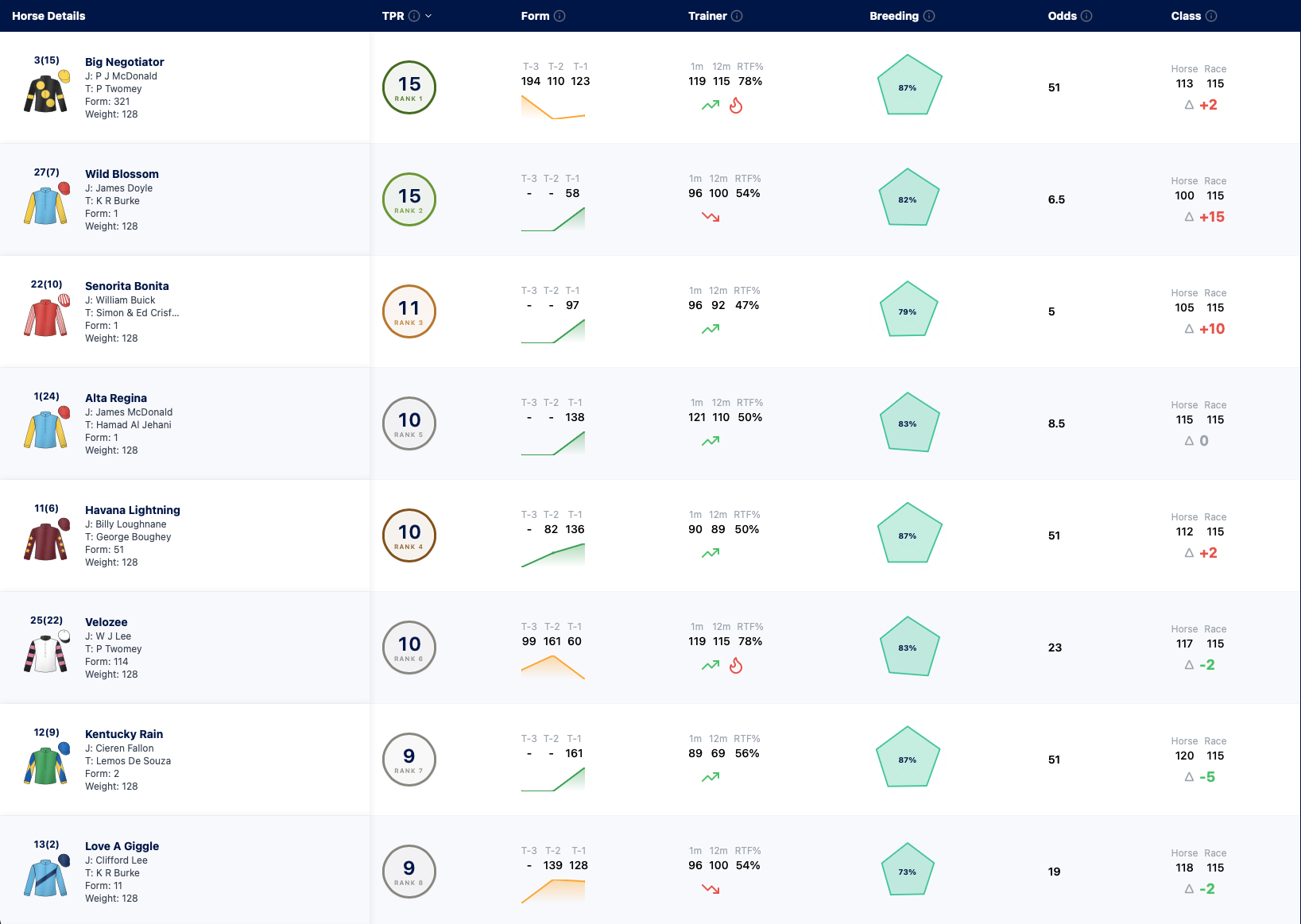
The full field
Queen’s Vase (Group 2)
1m6f · Good to Firm · 11 runners
Model probability % · TPR v2, the engine of the time
Race Analysis
The Queen’s Vase is the staying test of the day, a Group 2 over a mile and three-quarters for three-year-olds, eleven of them on good to firm. After the sprint, the puzzle inverts: stamina, class and tactics matter far more than the stall. Our TPR makes Charlie Appleby’s DEL MARO its clear top at 23.4%, from RAVENSPIRE at 18.0% and GALIYAN at 17.5%, and two pieces of our data shape the read. Ascot’s staying record strongly favours horses ridden close to the lead: front-runners here have won around 16% more often than expected across nearly 900 runs (an index of 1.16), while hold-up horses are heavily marked down, to 0.74. And our pace map forecasts only a moderate gallop, which makes the lead an even better place to be.
GALIYAN carries the standout raw figure on a sound surface. Andrew Balding’s colt won at Chester over twelve furlongs last time, “led inside final furlong, kept on well and won going away”, for a speed figure of 186, our class-adjusted measure of how fast a horse ran, and the best in this field on ground with no give. A couple here have posted bigger numbers, but on much softer going, which is why our going model pulls them back. Crucially, his is the strongest stayer’s pedigree in the race on our sire-distance rating, so the step up to a mile and three-quarters should suit, and Oisin Murphy rides. The one caveat the data flags is tactical: he races midfield, so he wants the gallop to be a genuine one.
RAVENSPIRE is the one the conditions data and the bias both point to. K R Burke’s colt is unbeaten in two, and although his best figure of 144 sits below Galiyan’s, our model rates him the number-one runner in the field on today’s good to firm, top of the going, track and distance lists all at once, because that 144 came on quick ground when he led and went clear “comfortably”. As a genuine front-runner he is exactly the type Ascot’s staying record rewards, the 1.16 profile in the flesh, with Clifford Lee up. The only question is the trip, a first try at fourteen furlongs, but a horse who dictates and stays will take plenty of pegging back.
The model’s clear top, DEL MARO, is trusted on consistency for Appleby and Buick, though our figures put him below his best and he too does his racing midfield. LIMESTONE owns the highest career figure of all, a 239, and is a proven stayer for Joseph O’Brien, but his biggest numbers came with give in the ground that he won’t get today. PORT OF SPAIN brings the O’Brien-and-Moore booking but steps up sharply from a mile and has the trip to prove.
The shape, then, is two ways into the same race: GALIYAN on the best figure, the class and the stamina pedigree, and RAVENSPIRE on the conditions data and a front-running style the track loves. DEL MARO returning to his best is the danger that would catch them both.
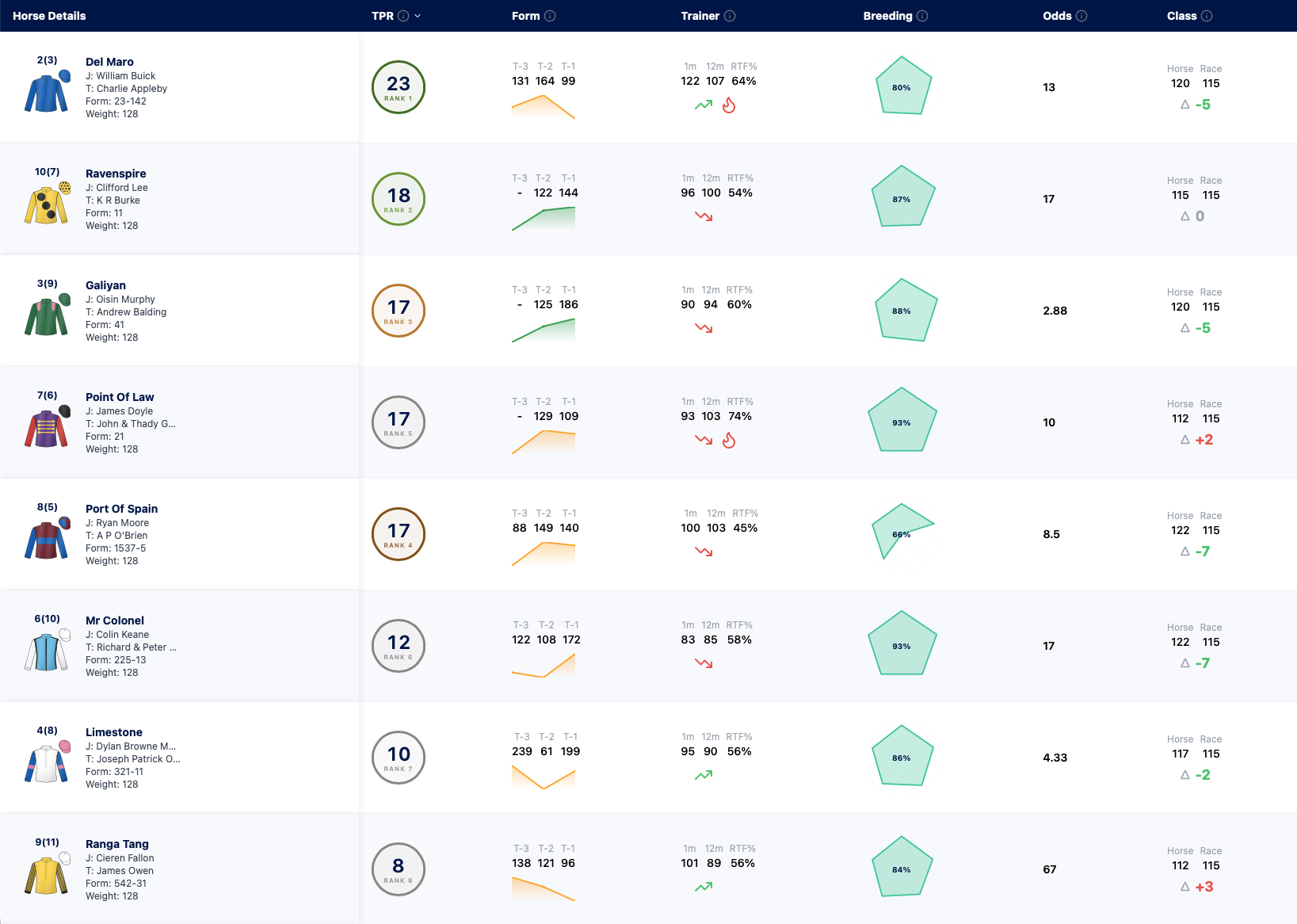
The full field
Duke of Cambridge Stakes (Group 2, Fillies & Mares)
1m · Good to Firm · 15 runners
Model probability % · TPR v2, the engine of the time
Race Analysis
The Duke of Cambridge is a Group 2 for fillies and mares over the straight mile, fifteen lining up on good to firm. Our TPR makes Andrew Balding’s BLUE BOLT its clear top at 17.2%, with a cluster around 12% led by CAROLINA JETSTREAM and CATALINA DELCARPIO. The straight-mile pattern at Ascot is well defined in our data: middle draws fare best, an index of 0.98 against 0.83 to 0.84 for the high and low extremes across thousands of runs, and the one run-style the track marks down hard is the prominent presser, down to 0.77 over more than 2,200 runs, with leaders and hold-up types around par. The gallop looks moderate.
BLUE BOLT tops the model on the strength of the highest ceiling in the race. She posted a speed figure of 205 at Newmarket last autumn (our class-adjusted measure of how fast a horse ran), and although that came in defeat, when her rider briefly dropped his hands, it sits far clear of anything else here; our distance model ranks her second of the fifteen on it. She won at Goodwood last time, “kept on and led towards finish”, and Colin Keane takes over. Two honest notes the data raises: the 205 is months old and she has been running below it since, and she races prominently, the very profile this track marks down, so the case rests on her class outrunning the bias.
CATHEDRAL is the Amo Racing first string, and the figures back the booking. She tops our distance model, the best mile figure in the field, on a profile built around a 172 when second at Newmarket and a steady run of high marks, which makes her one of the most reliable on the page, and she makes her own running, a style that sits around par here rather than against it. Kevin Philippart De Foy trains, David Egan rides. The one thing to weigh is the draw: she is berthed widest of all, in the high section our data rates a shade below the favoured middle, but a consistent profile and a positive ride can offset it.
CATALINA DELCARPIO is the obvious threat on current form: a mile winner at Leopardstown last time, at her peak, for the in-form Twomey yard, and our going and track models both rate her highly. JANCIS in fact tops our going and track lists for today and won at Newmarket, but she is a hold-up type from a smaller stable. NOCHE CLASICA is unexposed and improving, if on lower figures than the principals.
So it splits cleanly: BLUE BOLT has the ceiling and the model’s vote if she can find that old level, and CATHEDRAL the consistency and the best trip figure to back up the Amo number-one billing. CATALINA DELCARPIO, on form and the hottest yard, is the one most likely to upset them.
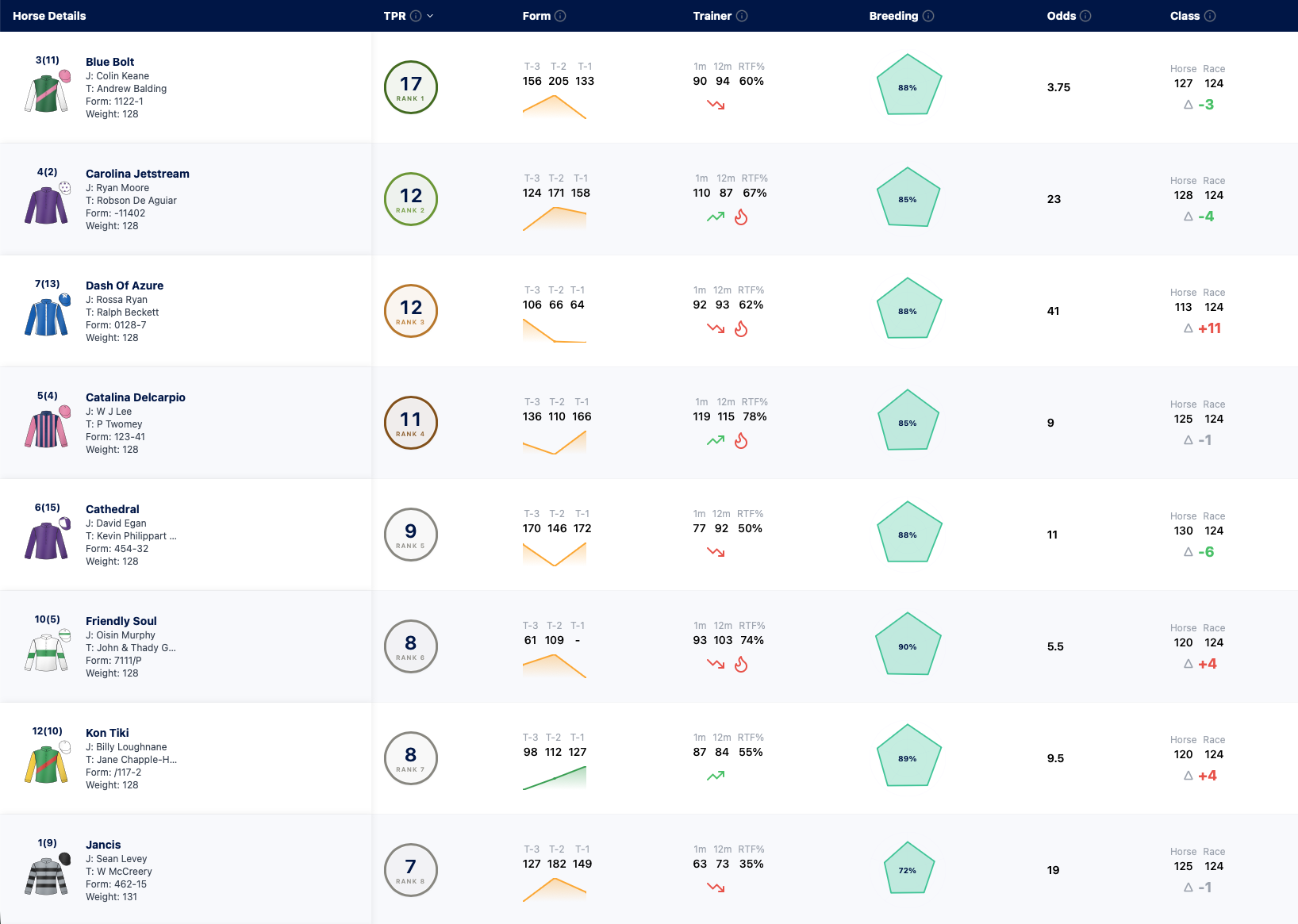
The full field
Prince of Wales’s Stakes (Group 1)
1m2f · Good to Firm · 8 runners · the day’s feature
Model probability % · TPR v2, the engine of the time
Race Analysis
The Prince of Wales’s is the day’s centrepiece: eight high-class older horses over a mile and a quarter on the round course, where the draw counts for nothing and only class and the clock decide. And rarely is our model this certain: the TPR makes OMBUDSMAN a 36.9% chance, more than the next two combined, with SEE THE FIRE at 22.2% and daylight after that.
OMBUDSMAN earns that conviction on the strongest page in the race. John and Thady Gosden’s horse won at Sandown last time, “kept on well” to the line, for a speed figure of 221, our class-adjusted measure of how fast a horse ran, and the best any of these has recorded on current form. The supporting data is just as emphatic: he tops our figures both for this track and this trip, he is at the peak of his career and still climbing, and he has already run well over course and distance. William Buick stays aboard. Pick holes if you can; on the evidence there are precious few, and the model’s nerve looks well placed.
ALMAQAM is the one with the ammunition to test him. Ed Walker’s runner took the Curragh last time, “asserted inside final furlong, ran on well”, for a 197, and there is a career-best 223 from last season on his sheet, so the raw class is there to find. He has been in good heart and races handily enough to suit a steadily-run Group 1, with Kieran Shoemark up. He owes best to OMBUDSMAN on the top line, but on what the rest have actually shown, our figures put him clear of them.
Behind the big two, SEE THE FIRE is the model’s second on a two-race winning streak for Andrew Balding and Oisin Murphy, though our numbers put her well below her best, her last figure a poor one, and she steps up in class on our measure today. MINNIE HAUK tops our going model on today’s ground and won more than once at the top level last year for O’Brien and Moore, but she faded when below par last time and has that run to answer for.
It is hard to frame this as anything but OMBUDSMAN‘s race, a peaking, improving Group 1 horse who heads our figures at the track and the trip, with ALMAQAMthe one most likely to make him work for it. The rest need to find a good deal more than they have lately shown.
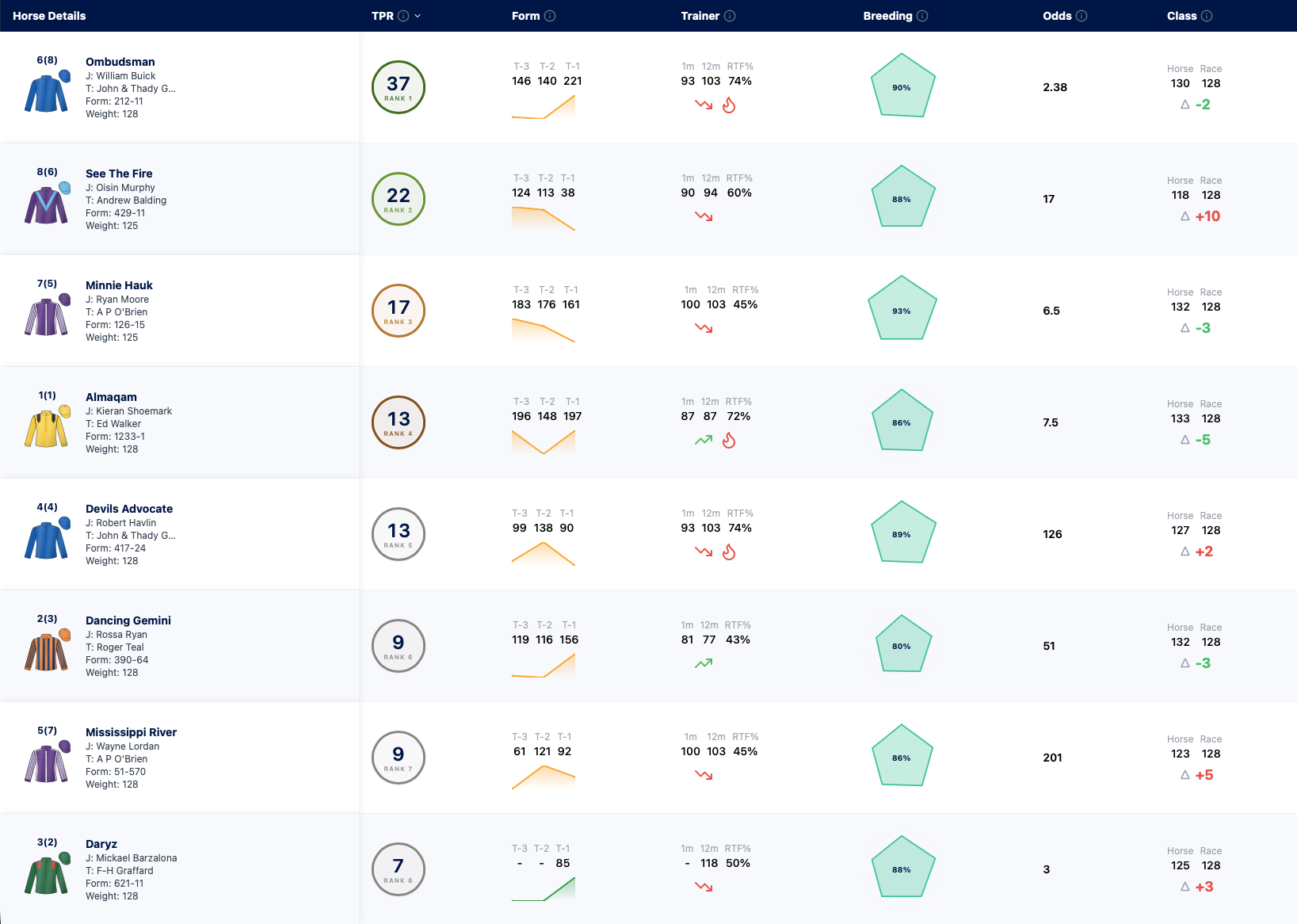
The full field
Royal Hunt Cup (Heritage Handicap)
1m · Good to Firm · 30 runners
Model probability % · TPR v2, the engine of the time
Race Analysis
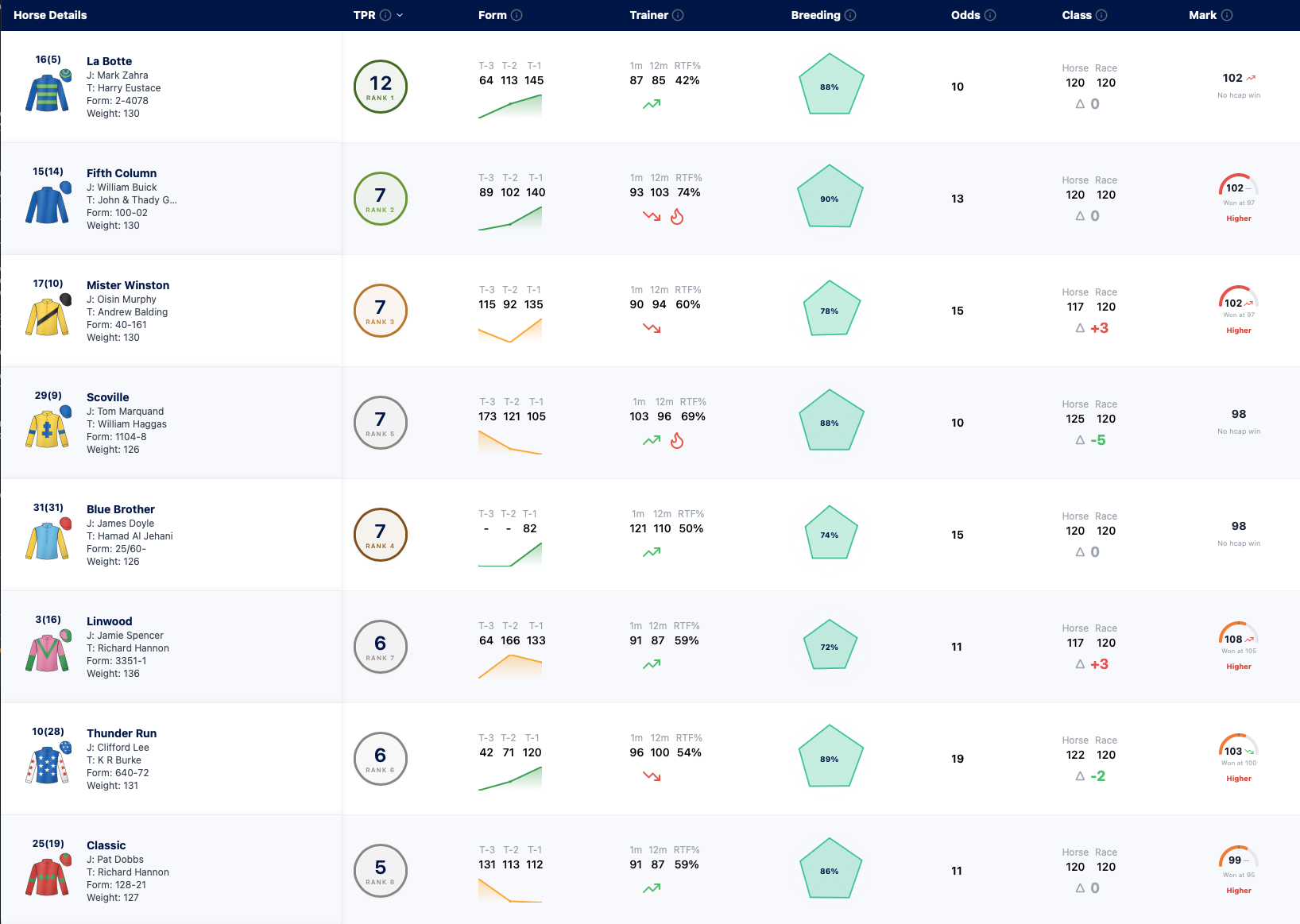
The Royal Hunt Cup is one of the hardest puzzles of the week, a cavalry-charge handicap with thirty going to post over the straight mile, and our model spreads them thin, LA BOTTE its narrow top at just 12.0% above a wall of others. An honest word first: in a field this size the draw can decide it. The runners usually split into two groups across the track, our data has the middle worth an index of 0.98 against 0.83 for the extremes, and which side gets first run is impossible to call in advance. So this is lower-conviction than the Group races, and the sensible steer is towards horses on an upward curve. The run-style to swerve is the prominent presser, marked down to 0.77 here, while leaders and hold-up types sit around par.
LA BOTTE tops the model precisely because the trend is up. His class-adjusted speed figures (our measure of how fast he has run) have climbed steadily across his recent starts, from the sixties to a recent best of 145, and our system flags his official rating as rising, the handicapper still catching up with him. He drops back to a mile today for Harry Eustace and Mark Zahra, and while he finished only midfield last time at Goodwood, the figure was a career best on an improving line. In a race that rewards the upwardly mobile, he has exactly the right shape.
FIFTH COLUMN brings the strongest recent piece of form of the pair. John and Thady Gosden’s runner was a close second at Newmarket last time, “kept on” after leading inside the final furlong, for a figure of 140, and our model has him right at his peak on that evidence as he drops to a mile from nine furlongs. William Buick takes a booking worth noting in a race like this, from a middle draw that is no disadvantage. He has the class to land it with a clear passage.
Plenty can step forward in a race this open. LINWOOD makes his own running, owns a 166 and is another our model has on the upgrade for Richard Hannon; HOLLOWAY BOY has run well twice at this track and holds some of the biggest figures in the field, though he shoulders top weight; MISTER WINSTON won at Epsom only days ago, races up with the pace and is also rising on our ratings for Andrew Balding. The draw will sort many of them out.
In the day’s hardest race the steer is towards the progressive: LA BOTTE on the climbing figures and a rising mark, and FIFTH COLUMN on the best recent run and the Gosden-and-Buick booking. With a thirty-runner draw in play, though, treat the whole leg with caution.
The full field
Kensington Palace Stakes (Fillies Handicap)
1m · Good to Firm · 25 runners
Model probability % · TPR v2, the engine of the time
Race Analysis
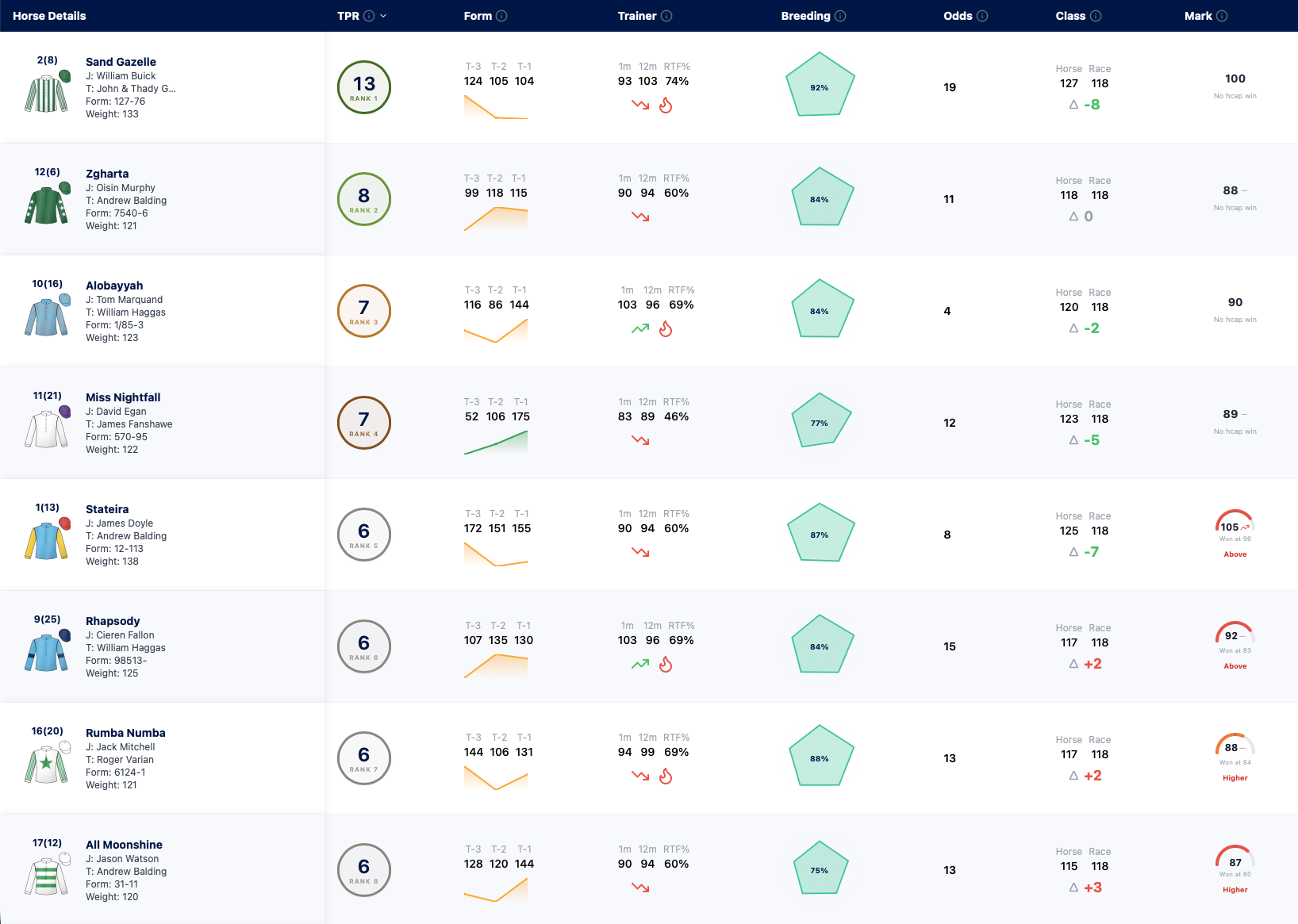
The Kensington Palace Stakes closes the Placepot, a 25-runner fillies’ handicap over the straight mile, where, as in the Hunt Cup, the draw can dominate and our model is flat, SAND GAZELLE its top at 13.4% above a long tail. But there is a strong form line to lean on rather than guess: the same race over this course and distance on 9 May produced several of today’s field, and the winner that day reopposes, which is where our conditions data earns its keep.
RADIANT BEAUTY won that Ascot mile, making all and quickening clear, “kept on well and went clear final 110yds”, for a speed figure of 150, our class-adjusted measure of how fast a horse ran, and the best at this track of anyone here: she tops our track model outright. James Owen’s mare is a confirmed front-runner who can dominate from a workable middle draw, the handicapper has only nudged her mark, and Ryan Moore takes the ride. The model rates her down the order on overall rating, but on the signal that matters most today, proven form over this exact course and trip, nothing can touch her, and that is precisely the edge our data is built to surface.
ALOBAYYAH came out of that same race in third and caught the eye, held up before she “kept on well final furlong” for a 144, having had to switch and find room. Our model has her at her peak, she represents the in-form William Haggas yard (rating well above its twelve-month mark) with Tom Marquand up, and a stronger gallop here should suit a filly who finishes her races. With a cleaner passage she can turn that form around.
The model’s top, SAND GAZELLE, leads our going figures and drops sharply in class on our measure for Gosden and Buick, but her recent efforts have tailed off and she needs to bounce back. ZGHARTA was further back on 9 May but is at her peak for Balding and Murphy. MISS NIGHTFALL owns a flashy 175, though it came in defeat and her form reads patchily.
The soundest form runs straight through that recent Ascot mile, and it points to RADIANT BEAUTY, who won it in front, and ALOBAYYAH, the eyecatcher in behind. In a 25-runner handicap the draw is still the wildcard, so treat the closing leg with the usual caution.
The full field
Windsor Castle Stakes (Listed)
5f · Good to Firm · 25 runners · outside the Placepot
Model probability % · TPR v2, the engine of the time
Race Analysis
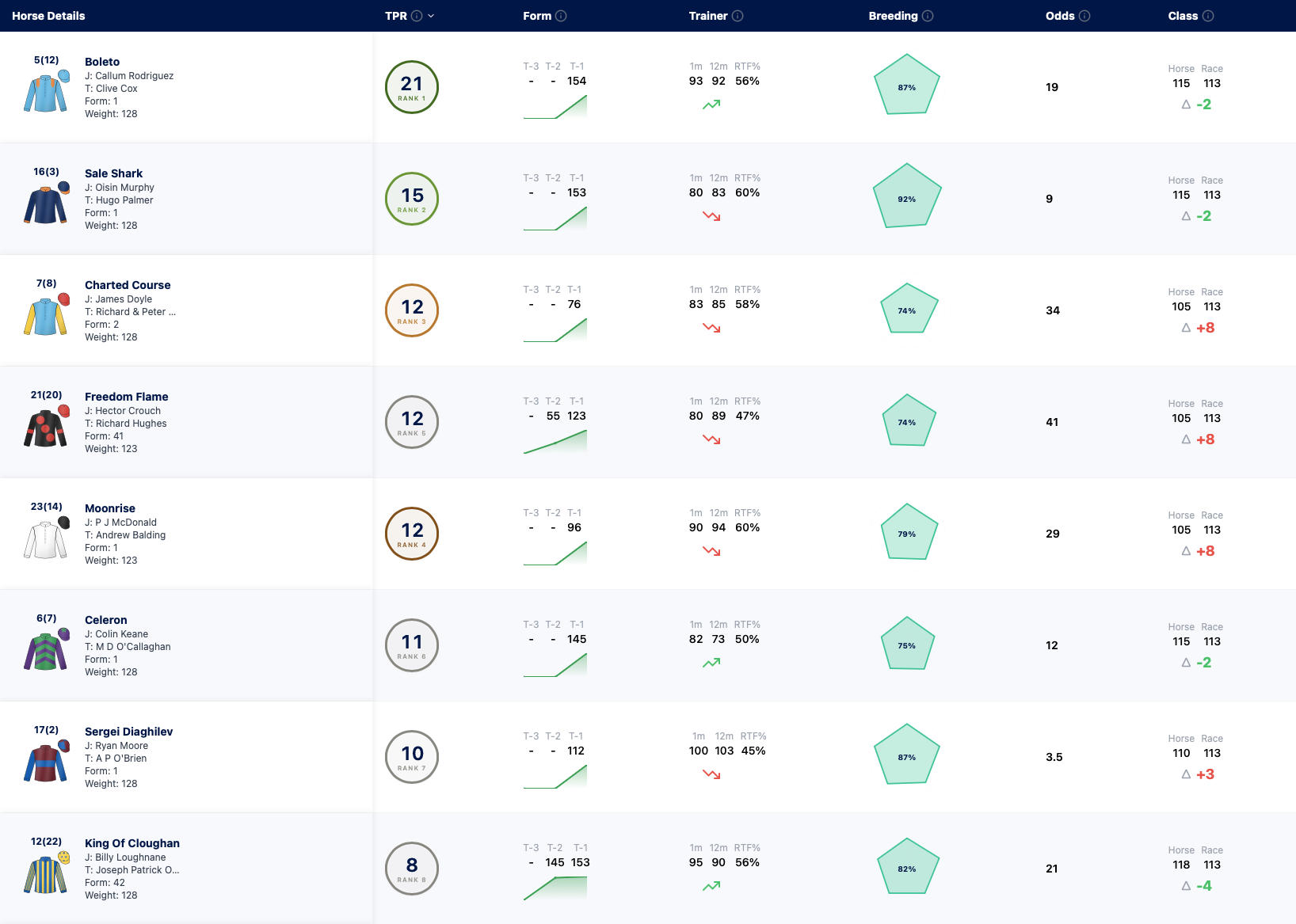
The card signs off with the Windsor Castle Stakes, a Listed sprint for two-year-olds over six furlongs, twenty-five going to post and the one race outside the Placepot. Our TPR makes BOLETO its clear top at 21.2%, from SALE SHARK at 14.8%, and our pace map flags the fastest-run race of the day, which throws the Ascot sprint bias into full force. Leaders here win about 15% more often than expected and a leader drawn high or low returns up to 1.42, hold-up types are punished to 0.72 on fast ground, and the middle of the track is the spot to avoid.
BOLETO heads the model and tops our distance figures, the best six-furlong number in the field. Clive Cox’s colt won on debut at Pontefract, “ran green when led inside final 110yds, promising”, for a speed figure of 154, our class-adjusted measure of how fast a horse ran, and he makes his own running. The one reservation is written into the draw: stall 12 is mid-track, and a front-runner stuck in the middle here returns just 0.77 against the 1.42 of one drawn high, so he gives a little back from there.
SALE SHARK is the one the bias points to. Hugo Palmer’s colt won his debut at Hamilton, “led inside final furlong, soon went clear, comfortably”, for a 153, and our going model rates that the best figure of anyone here on today’s fast ground. Drawn low and racing on the lead, he sits squarely in the profile the track most rewards, with Oisin Murphy booked. The figure and the draw pull the same way.
Several debut winners fit the same template. CELERON won at the Curragh and is another low-drawn front-runner with a strong figure; SERGEI DIAGHILEV took a Curragh maiden too and carries the O’Brien-and-Moore booking from a low draw; KING OF CLOUGHAN brings the experience edge with two solid runs and a 153 of his own, if from a wide, high stall. In a 25-runner sprint the draw and the gallop will do the sorting.
So the figures and the bias frame it: BOLETO has the best number and the model’s vote, with only that middle draw against him, and SALE SHARK is the one whose draw and run-style the track most favours. The low-drawn debut winners give the race real strength in depth.
Access every racecard, live analytics and the complete blog on your phone:
The full field
The day at a glance
Where the data landed, race by race.
More racedays, read by the data
Every runner, every race, every day
Everything this guide runs on, the percentages, the engine readings, the figures, the pace maps, lives on the dashboard for every British and Irish race. From 27p a day.
Explore the dashboard →EquiAnalytix provides horse racing data and analysis only. We do not take bets. 18+ | Please gamble responsibly. GamCare 0808 8020 133.