Introduction
Royal Ascot opens on Tuesday with seven races and three Group 1s on good to firm ground. This is our race-by-race read of the card, driven by the data rather than the noise. It is free and open this year, so before we get to the races, here is exactly what that data is and how we use it.
How we read a race
At the centre of everything is our TPR, the Total Performance Rating. It is a machine-learning model trained on more than twenty years of racing that turns everything we know about a runner into a single number: its calibrated chance of winning today’s race, shown as a percentage. The higher the figure, the stronger the model’s case. A percentage on its own does not tell you why, though, so underneath it we read a handful of supporting signals, and those are what the write-ups lean on.
What the numbers mean
- TPR (the win probability). Each horse’s calibrated chance of winning, as a percentage. In a wide-open race the leading few may be split by a point or two; in a strong one the best can stand clear.
- Speed figures. The standalone numbers you will see, such as a 173 or a 195. Each is a class and weight-adjusted rating of how fast a horse ran on the day, so figures from different tracks and grades compare directly. Higher is faster, and a horse running close to its best is the one to respect.
- Conditions form. How well a horse has performed on today’s going, over today’s trip and at this track. A high TPR backed by strong conditions form is a sturdier case than one without.
- Pace and run-style. Whether a horse leads, races handily or comes from behind, and how fast the race is likely to be run overall. A race full of front-runners often sets up for closers; a steadily-run one rewards those handy to the lead.
- Draw and course bias. What tens of thousands of past Ascot runs tell us about which stalls and which run-styles over- or under-perform on this ground. We quote these as real figures, for example a run-style that has historically won 28% less often than the market expected, rather than leaning on folklore.
Convergence Analysis
Where multiple independent data points, the TPR rating, recent speed ratings, trip and going profile, course form, trainer momentum, and historical pace-and-draw fit, all point to the same horse, we call that convergence. It is the foundation of everything we do. A horse can top the TPR rating, but if they have never been tested at today’s trip and the trainer’s strike rate has halved in the last month, the convergence is weak. When everything aligns, the signal is strong. We will show you exactly where that happens, race by race.
Let’s get into the card.
Queen Anne Stakes (Group 1)
1m (straight) · Good to Firm · 9 runners
Model probability % · TPR v2, the engine of the time
Race Analysis
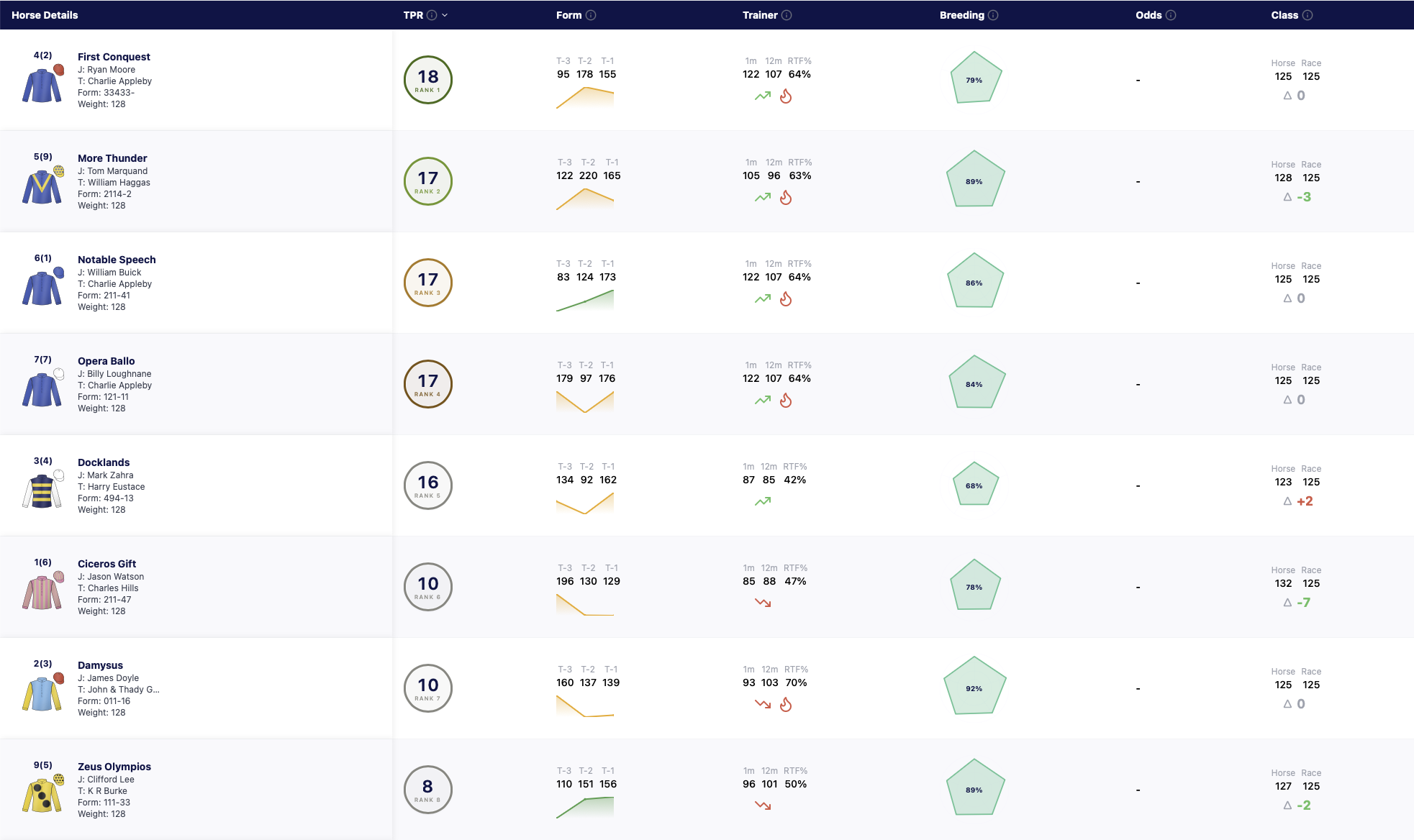
Royal Ascot opens with the Queen Anne Stakes, a Group 1 over the straight mile on good to firm ground, and nine go to post. Every runner here carries a TPR, our Total Performance Rating: a machine-learning model that folds a horse’s form, its class-adjusted speed figures, how well today’s ground, trip and track suit it, and the likely shape of the race into a single calibrated win probability. The higher the number, the stronger the model’s case. What stands out first is how little separates the principals. The model gives FIRST CONQUEST 18.0%, then NOTABLE SPEECH, MORE THUNDER and OPERA BALLO all 17.5%, with DOCKLANDS at 15.8%: five horses inside two and a half points. This is an open Group 1, so the read comes from where the supporting evidence stacks up rather than from the model order alone.
The race should be truly run. Four runners want to be close to the lead, TEN BOB TONY, DAMYSUS, OPERA BALLO and ZEUS OLYMPIOS, which points to a genuine gallop and a finish that falls to something running on late. The course history on this trip and ground agrees. Across more than a thousand historical Ascot runs over a mile on fast ground, horses ridden prominently, pressing the pace without leading, have won around 28% less often than the market expected, a strike rate of 7% against an expected 10%, while hold-up, front-running and mid-division runners have all performed close to par. The draw shows a milder lean: middle stalls have matched expectation across 1,180 runs, high draws have won about 20% below expectation and low draws about 16% below. In a nine-runner field these are light pointers rather than firm biases, but they are worth carrying into the read.
The most persuasive recent evidence belongs to NOTABLE SPEECH. Charlie Appleby’s horse won the 2024 2,000 Guineas, and only 30 days ago he took a Group 1 over this trip on good ground at Newbury, travelling strongly to lead inside the final furlong and, in the words of the form comment, running “on well final furlong, readily”. The class-adjusted speed figure of 173 he posted that day, our measure of how fast he ran with the class of the race factored in and the best recent figure anything here can show, came as he beat MORE THUNDER into second. The model has him improving faster than anything else in the field and running at his career peak, and he has already coped with this exact Royal Ascot mile, fourth here a year ago when his rider lost the whip inside the final furlong. William Buick rides. The one caveat is the track data above: he races handily, the style Ascot’s mile marks down on fast ground, and he is drawn low. In a nine-runner Group 1 that is a footnote rather than a flaw.
If the conditions decide it, the case swings to MORE THUNDER, the horse he beat that day. No other runner ranks top of the field on all three of the things the model weighs for suitability, the best average figure on ground like today’s, over the trip, and at Ascot, and he has the course form to match, second of 21 over six furlongs at this meeting last year, “pressed winner towards finish, just held”. His best figure, a 220 winning at Newbury, is the highest in the race, William Haggas is running at around a 37% strike rate over the past fortnight, and Tom Marquand takes over. He proved he stays the mile when chasing NOTABLE SPEECH home last time, and the strong gallop in prospect plays to his hold-up style, the profile this track rewards. The reservation is simply the draw, high in the stalls, the mild negative the history flags.
Of the others, OPERA BALLO shares that 17.5% and owns the highest recent winning figure in the race, a 176 making all at Sandown, but he needs to control things from the front and there is pace here to take him on, with no course form on his page. FIRST CONQUEST is the model’s narrow top-rated runner at 18.0%, yet he returns from 179 days off, his best form is over nine and ten furlongs rather than a mile, and he has no Ascot form, so the figure flatters a profile with real questions. DOCKLANDS is rated a touch lower at 15.8% but fits the track best of all: a proven Ascot miler with the most consistent recent form in the field, a hold-up style and a middle draw, the exact combination the course data favours on fast ground, where it has won 11% more often than expected. He is the each-way shape of the race at a bigger price.
The race splits along two lines. The figures and the class point to NOTABLE SPEECH, who beat these over course-equivalent conditions only a month ago and is still on the up; the suitability points to MORE THUNDER, on top of the field for ground, trip and track with the course form to support it. The same honest qualifier sits on both, that Ascot’s mile on this ground slightly favours the held-up, middle-drawn runner, which is exactly where DOCKLANDS comes into the picture at a bigger price.
The full field
Coventry Stakes (Group 2)
6f · Good to Firm · 22 runners · two-year-olds
Model probability % · TPR v2, the engine of the time
Race Analysis
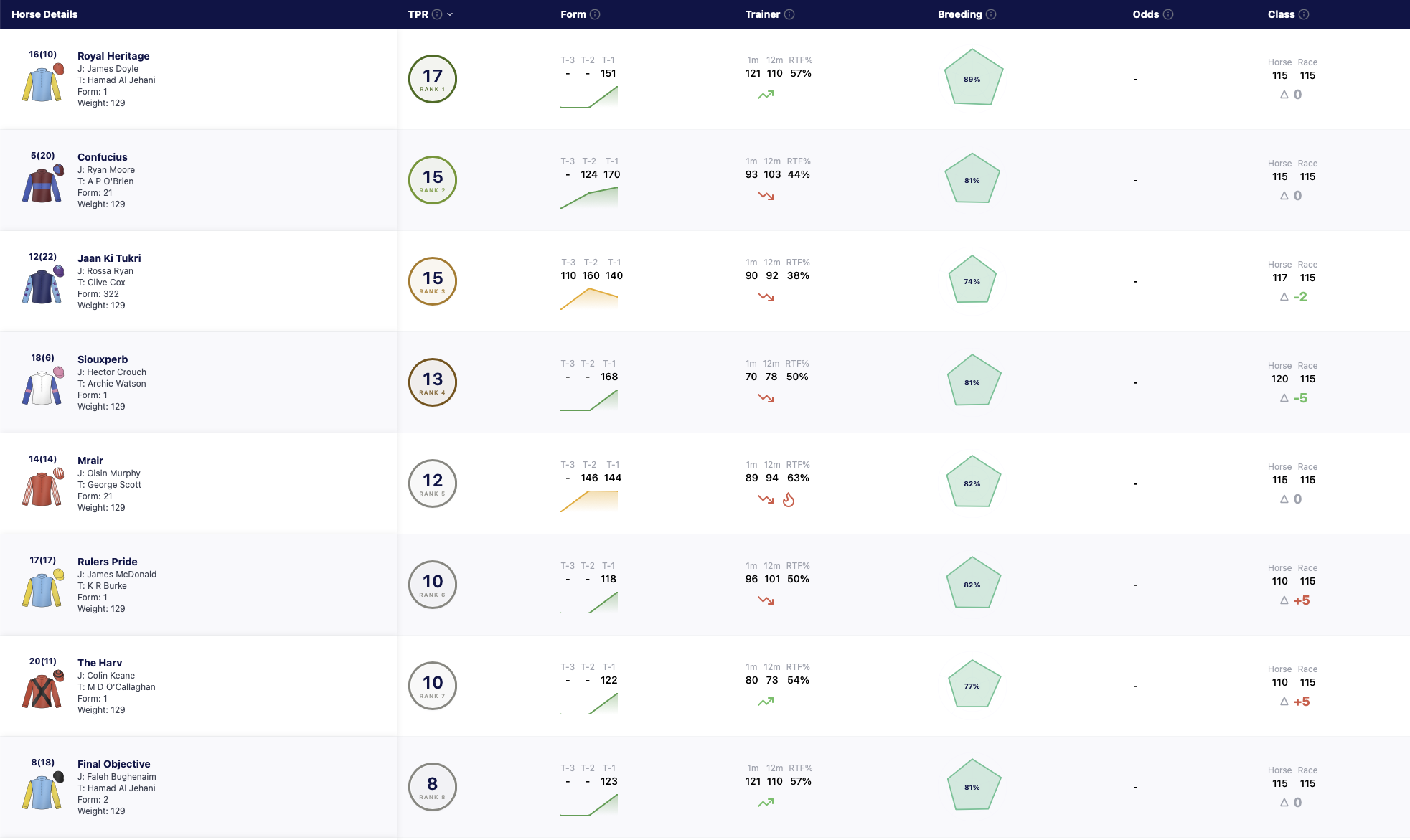
The Coventry Stakes is the week’s first big-field two-year-old test, 22 of them over six furlongs on good to firm ground. With most of these having run only once or twice, our TPR rating, the model’s single win-probability score built from each runner’s form, figures and pedigree, is working from thin evidence, and it shows that by bunching them: ROYAL HERITAGE heads it at 17.2%, then CONFUCIUS and JAAN KI TUKRI at 14.8% and SIOUXPERB at 13.4%. In a race like this the shape of the contest does as much of the work as the ratings.
And the shape is extreme. Nine of the 22 want to lead, so the gallop will be ferocious, which matters more here than almost anywhere because the Ascot sprint track carries one of the firmest patterns in our database. Across these six-furlong races on fast ground, horses that lead have won 12% more often than the market expected, while hold-up runners have won 28% less across more than a thousand historical runs and mid-division horses 24% less. Split it by draw as well and it sharpens: a leader drawn high is the strongest single profile on the course, a leader drawn low close behind, while a leader caught in the middle of the track loses that edge. The template is simple, lead from a high or low draw, and it reorders the model’s list.
ROYAL HERITAGE meets most of that and tops the model on merit. He won his only start over this trip at Hamilton six days ago, leading over a furlong out and going clear before being eased close home, a debut “promising” enough to be worth a speed figure of 151, our class-adjusted measure of how fast he ran. He returns quickly for a Hamad Al Jehani yard in good order with James Doyle up, and he does his racing where the track wants it, on the lead. The single reservation in the data is the draw: stall 10 sits in the middle third, the one place the course does not reward a front-runner, so he gives back a little of the edge his style would otherwise earn.
SIOUXPERB brings the strongest conditions evidence of the lot, likely at a bigger price. He also won on his only outing, over this exact six furlongs on fast ground at Yarmouth, and he did it the hard way, making all and finding more when pressed, “ridden and clear inside final furlong, ran on, promising”. The 168 he earned that day is the best figure any of these has posted on today’s ground and trip. A front-runner drawn low, he sits in the track’s second-favoured profile, and a fierce gallop holds no fear for a horse that dictates. The marks against him are honest ones: 56 days since that run, and a yard not firing at full tilt right now.
Of the rest, CONFUCIUS is the one to fear if the pace folds. Aidan O’Brien’s colt owns the highest distance figure in the field, a 170 won with plenty in hand at Naas, and the booking of Ryan Moore speaks for itself; the catch is that the model expects him ridden midfield, so he needs the leaders to cut each other down. JAAN KI TUKRI has the textbook draw-and-style profile, a front-runner from the widest stall, and is the most experienced runner here, but he is a maiden placed three times at five furlongs and steps up in trip for the first time. GREAT BARRIER REEF is the eye-catcher the model distrusts: unbeaten, and his 187 at the Curragh is the highest single figure in the race, yet he won it from off the pace, the one running style this track punishes, and the model rates him well down the field.
Where the data lands: ROYAL HERITAGE is the model’s pick and a six-furlong winner doing his racing on the pace, the middle draw the lone caveat to weigh. SIOUXPERB is the value beside him, a proven course-and-distance winner from a favoured draw with the best conditions figure in the field. The shape of the race is the thing to hold onto: in a 22-runner cavalry charge the track rewards those bold enough to be there from the start.
The full field
King Charles III Stakes (Group 1)
5f · Good to Firm · 26 runners
Model probability % · TPR v2, the engine of the time
Race Analysis
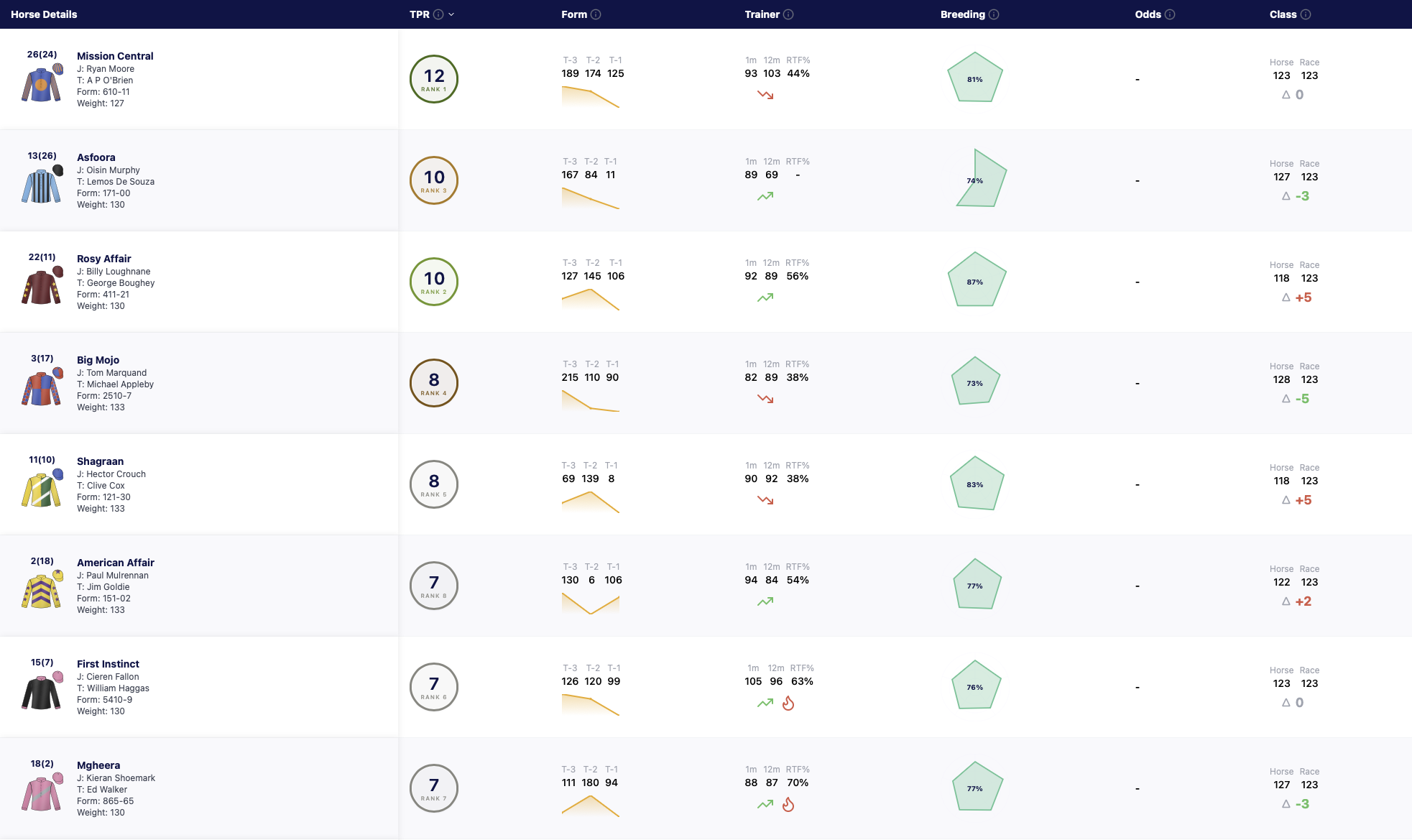
The King Charles III Stakes, the King’s Stand by its older name, is a 26-runner Group 1 dash over the minimum five furlongs and the most open race on the card. Our TPR rating, the model’s single win-probability figure, cannot lift any runner above 12%: MISSION CENTRAL heads it on that mark, from ROSY AFFAIR and ASFOORA. With a field this size and this much early speed declared, the track’s own bias does as much sorting as the ratings. On the Ascot sprint course on fast ground, horses that lead win around 12% more often than the market expects while those held up win around 28% less, and the sharpest profile of all is a leader drawn high or low. The middle of the track, and anything dropping out the back, is where races like this are lost.
Read through the figures and MISSION CENTRAL stands up best. The model’s flags hint at a horse going the wrong way, but that is a quirk of the numbers: he is unbeaten in his last three. The pick of them came over six furlongs on this very track last autumn, a win worth a speed figure of 189, our class-adjusted clock, “led over 1f out, always doing enough”, and he has since completed a Naas double over today’s five furlongs. He is a three-year-old still going forward for Aidan O’Brien, Ryan Moore takes over, and he breaks from a high draw to race up with the pace, the profile this track rewards most. The one quibble is that his Ascot win came over six furlongs, so the bare five may be sharp, though he has been winning at the trip.
BEHIKE carries the best recent form line of anything here. His latest start brought a speed figure of 191, the highest current figure in the race, won with authority at Lingfield, “led over 2f out, kept on well, comfortably”, and the model reads him as improving and at his peak. He has course experience too, having led and finished third over seven furlongs here as a juvenile, and as a front-runner from a low draw he fills the other half of the favoured profile. The honest reservation is class: this is a steep rise from a Lingfield conditions race to a Royal Ascot Group 1, and the figure has to travel. If it does, he is well placed to make it count.
The bigger price that fits the bias is JAKAJARO, a consistent front-running sprinter with the best ground figure in the field and a high draw to use it from; the model is cold on him, the profile is not. AMERICAN AFFAIR won this race twelve months ago and keeps the course form, though his current figures are in and out and his midfield style is the one the track marks down. Two to treat with care are the model’s own third pick ASFOORA, whose recent runs read “in rear throughout”, and BIG MOJO, who owns a 215 from last season but has been well beaten on both starts since; the reputations are bigger than the current form.
Where the data lands: in a race this wide open the safest ground is a horse in form, well drawn and ridden bold. MISSION CENTRAL fits on every count, unbeaten, an Ascot winner, drawn high for Moore and O’Brien. BEHIKE is the improving form-horse beside him, the best recent figure in the race from the favoured low-draw lead, with only the class rise to forgive.
The full field
St James’s Palace Stakes (Group 1)
1m (straight) · Good to Firm · 6 runners · the day’s feature
Model probability % · TPR v2, the engine of the time
Race Analysis
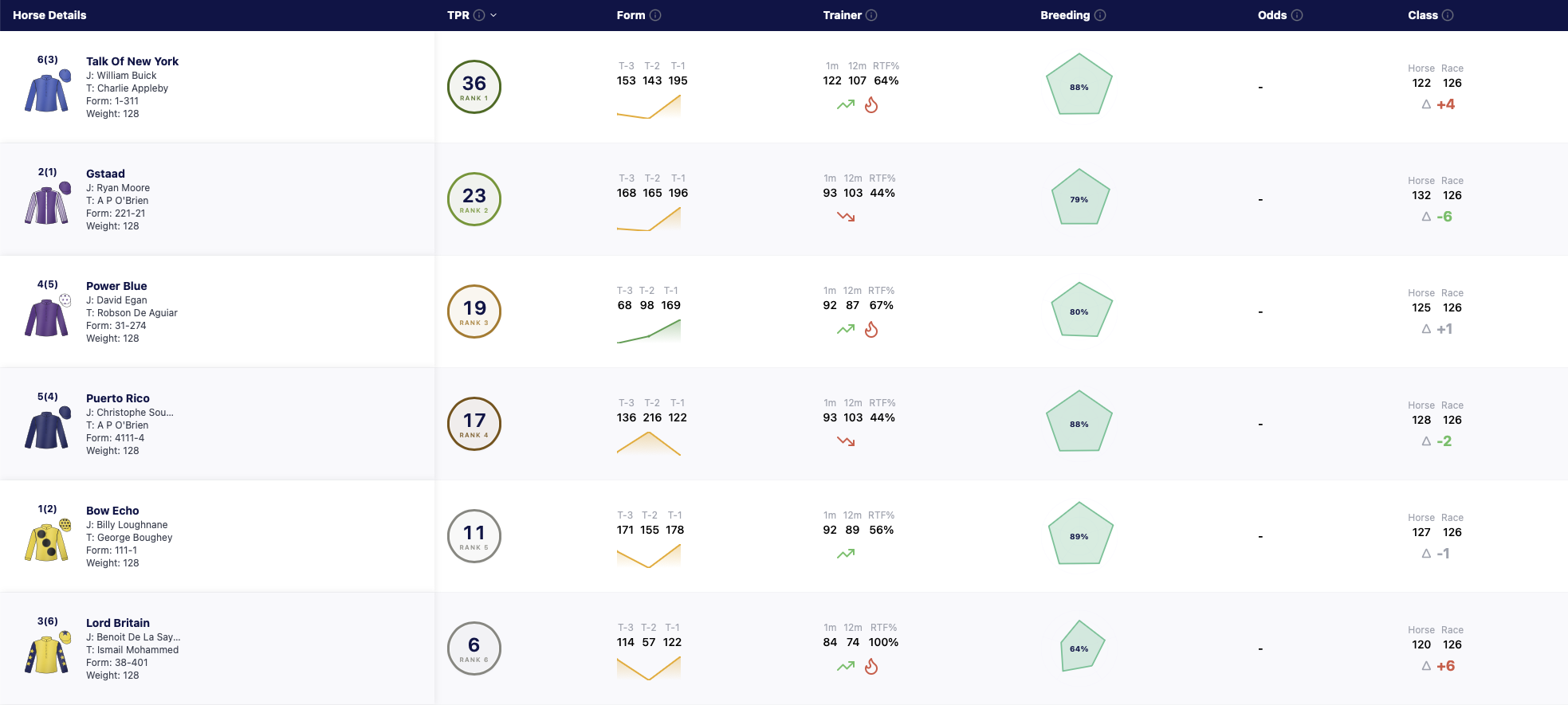
After three big-field puzzles, the St James’s Palace Stakes gives the model an easier task. Six three-year-old colts go to post over the straight mile, and our TPR rating, the model’s win-probability score, makes TALK OF NEW YORK a clear favourite at 36% from GSTAAD at 23%, the pair well clear of the other four. With a small field and a modest pace likely, this is a tactical, class-and-figures contest in which the draw counts for nothing.
TALK OF NEW YORK earns top billing on the cleanest profile in the race. He is unbeaten in three, improving and at his peak, and his latest win brought the joint-best recent figure of these, a 195 over today’s trip at Sandown, where he made smooth progress from midfield to “lead over 1f out, soon went clear, ran on well”. Charlie Appleby’s yard is in excellent order and William Buick rides. He is lightly raced and still going forward, the kind of unexposed Classic-generation colt this race tends to reward.
GSTAAD is the one to fear, and the form book makes the gap look smaller than the prices will. He recorded the highest recent figure in the race, a 196 winning at the Curragh, and he tops the field on his figures over this trip, on this ground and at this track. He is also the most tested runner here, holding a level line between 159 and 196 across six starts in strong company, and he actually drops in grade today having been placed behind smart rivals at a higher level. Aidan O’Brien and Ryan Moore team up in a race they have made their own. On the bare figures he has as much to offer as the favourite.
Beneath the pair, BOW ECHO is the each-way shape of the race. He is unbeaten in four, owns the best ground figure in the field and the steadiest profile, and won going away at Newmarket last time; a model rating of fifth looks harsh, the only knock that he wins from off the pace and may want a stronger gallop than a six-runner field provides. POWER BLUE carries the highest single figure anyone here has recorded, a 245 as a juvenile, but he has been well held in pattern company since and must find that level again. PUERTO RICO, O’Brien’s second runner, has a big figure of his own on file but has not been seen for over a month and is below his best.
Where the data lands: this is a two-horse race on the figures. TALK OF NEW YORK is the unbeaten, peaking colt the model rates a clear top, and GSTAAD is the proven high-class danger dropping in grade with the single best recent figure in the field. The two are closer than the market will make them, and BOW ECHO is the unexposed each-way alternative if the principals fail to fire.
The full field
Ascot Stakes (Heritage Handicap)
2m4f · Good to Firm · 20 runners
Model probability % · TPR v2, the engine of the time
Race Analysis
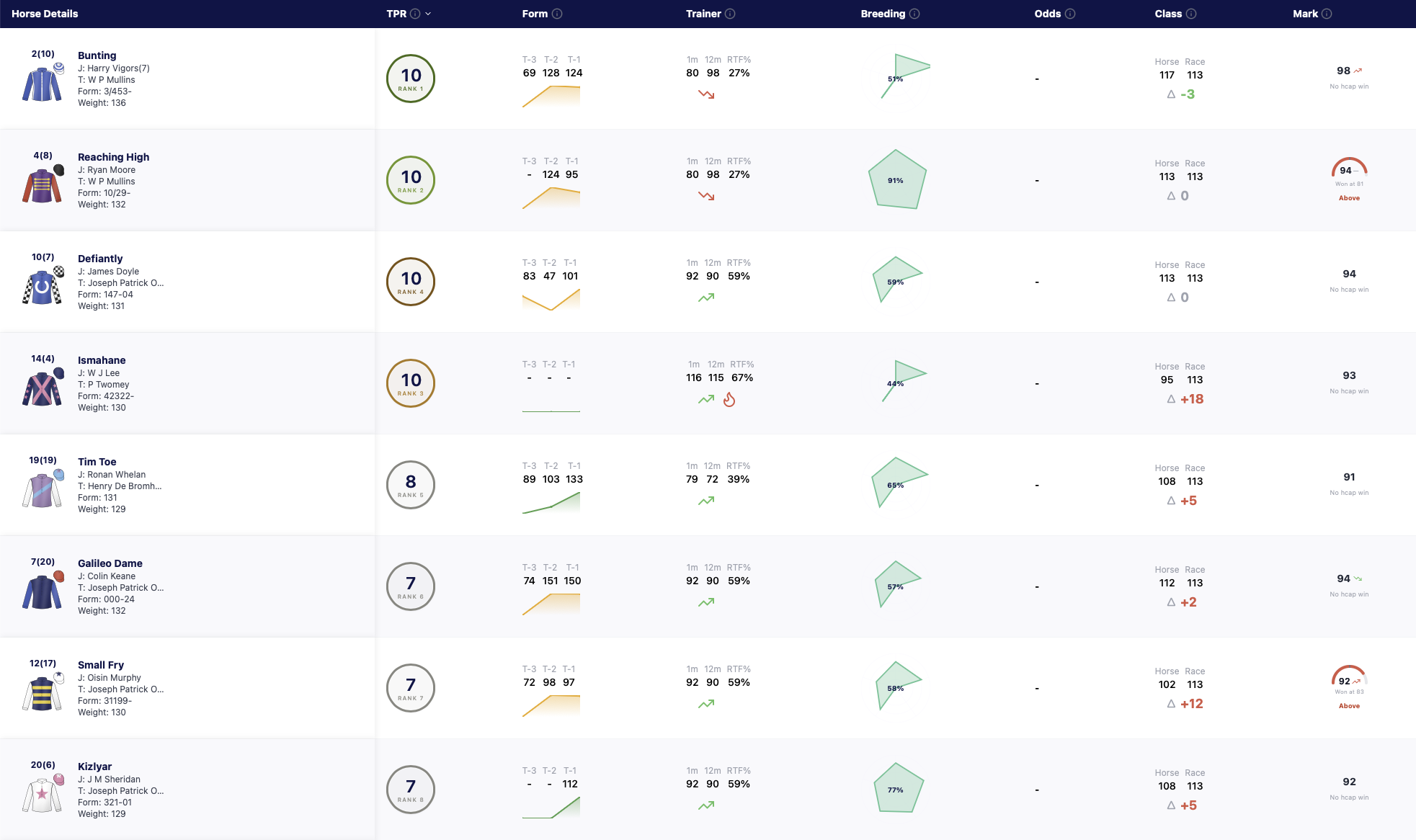
The Ascot Stakes is the first of the day’s staying handicaps, 20 runners over two and a half miles, and the model treats it as the puzzle it is: nothing rates above 10%, with seven of the field from Joseph O’Brien and two from Willie Mullins. Many of these have spent the spring over hurdles, where the figures do not read across cleanly, so the most reliable guide is recent form on the flat at around this trip. One pattern is worth carrying in: even over this distance, the Ascot stayers’ record favours horses ridden close to the pace, with hold-up runners winning around 22% less often than the market expects, and a modest gallop is forecast.
BUNTING is the model’s narrow top-rated runner and a typical Willie Mullins pointer at this meeting. His best flat figures, a 124 and a 128, are among the strongest in the field on today’s ground, he is running close to his peak with the shape of his work on the up, and he returns to the level off a recent jumps campaign, so he is race-fit for a yard that has long made this race a target. The honest mark against him is that his visible recent form is over hurdles and unremarkable, the better figure coming from further back, so there is a little faith required that he reproduces it today.
GALILEO DAME brings the best recent flat form of the staying brigade. She ran to a 150 at Chester over an extended trip last time, “headway over 1f out, prominent final 110yds”, and a 151 at Navan before that, and she is close to her peak on a sharply rising curve. The trip looks ideal on that Chester effort, Colin Keane takes a good ride, and although she is one of seven for Joseph O’Brien she is the pick of them on current figures, with the handicapper easing her mark rather than raising it.
The one to respect at a price is REACHING HIGH, last seen in this very race a year ago, when he was repeatedly denied a clear run through the straight and the bare ninth is best forgiven. Ryan Moore partners him for Willie Mullins, the kind of booking these Irish raids turn on; the doubts are a year off the track and a mark above his last winning one. ISMAHANE is the speculative improver, a prominent type the track rewards from the hottest yard in the race, though stepping up sharply in class. SIEMPRE ARTURO owns the best ground figure in the field with some Ascot course form and sits at his peak, but he is a hold-up horse, the profile the track and a steady gallop are set against.
Where the data lands: in a wide-open heritage handicap the figures point to two Irish-trained stayers, BUNTING on the strongest underlying flat numbers and a Mullins target profile, and GALILEO DAME on the best recent flat form around the trip for the meeting’s dominant yard. The shared caveat is an honest one: both race from midfield, and this is a track that rewards being handy, so each needs the race run to suit.
The full field
Wolferton Stakes (Listed)
1m2f · Good to Firm · 16 runners
Model probability % · TPR v2, the engine of the time
Race Analysis
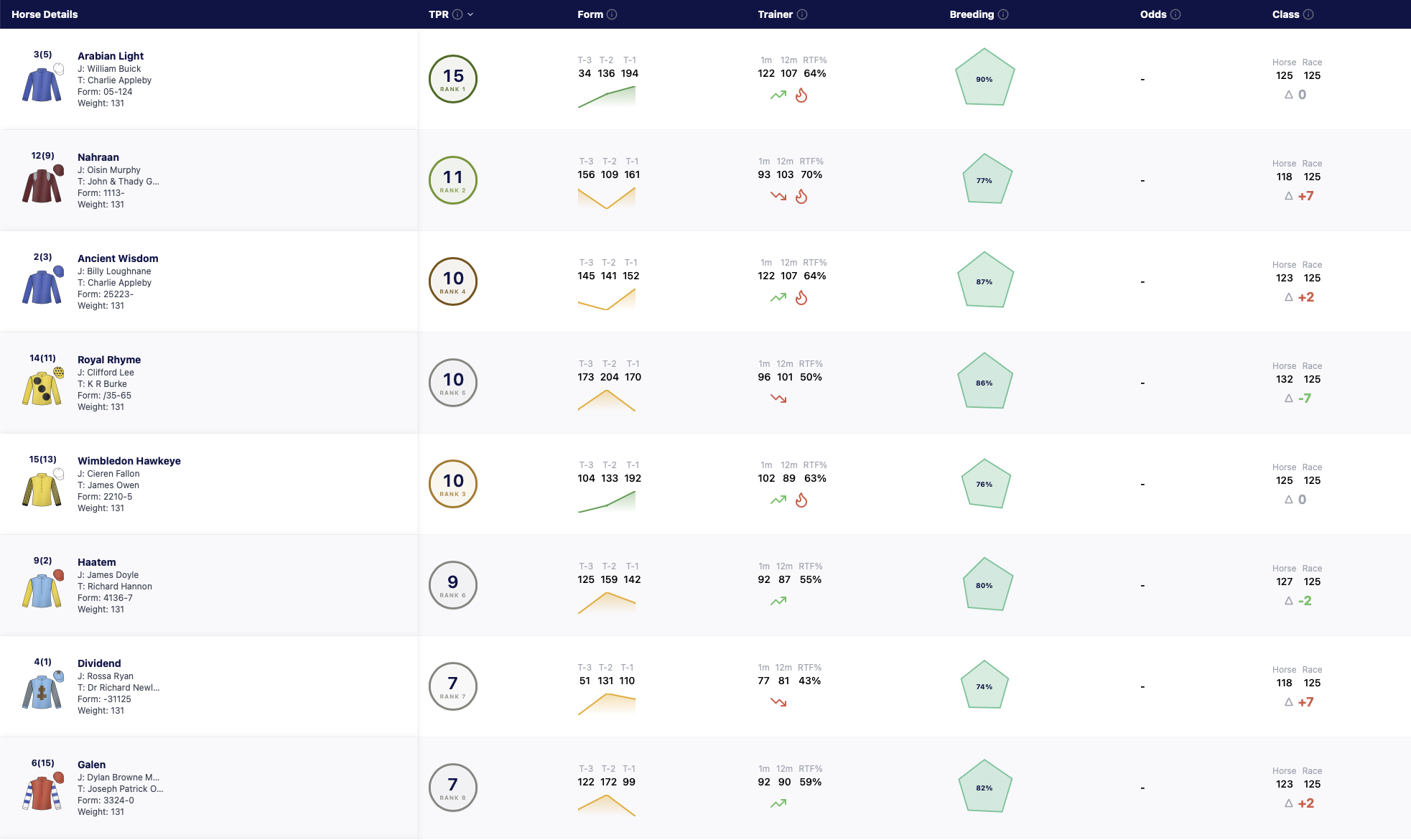
The Wolferton Stakes is a competitive Listed prize over a mile and a quarter, 16 declared, and it closes the Placepot. Our TPR rating makes ARABIAN LIGHT the 15% favourite from NAHRAAN and WIMBLEDON HAWKEYE, with several others in the mix. It is run on the round course, so the draw barely matters; what counts is that a modest pace is forecast, which favours anything able to dictate, and Ascot’s middle-distance record marks down the prominent pressers more than the genuine leaders or the closers. The form pointer to hold onto is a single race: the Sandown mile-and-a-quarter contest on 28 May produced the two fastest figures in today’s field, and both horses came out of it with an excuse.
ARABIAN LIGHT ran the fastest of the lot. His 194 at Sandown is the highest figure anyone here has recorded, our class-adjusted clock, and it came despite a near-impossible start, “dwelt start, in rear”, before he stormed home late. The model reads that as a horse transformed, the sharpest upward jump in the race, and now at his peak. Charlie Appleby and William Buick are a powerful pairing and the yard is in excellent form. The honest counter is consistency: two runs back he managed only a 34 and trailed in, so he is not the most reliable, and as a strong-finishing closer he needs the race run to suit. On his Sandown running, though, he is the best horse in here.
WIMBLEDON HAWKEYE came out of that same Sandown race with the second-fastest figure, a 192, and arguably the better excuse: he was “denied a clear run 2f out” when going well. He owns the best distance figure in the field, he is at his peak and improving, and he drops back to a mile and a quarter from recent starts over a mile and a half. Crucially he is a front-runner, so in a steadily-run race he controls things and avoids the trouble that cost him last time. James Owen’s yard is in good order, and he makes plenty of appeal as the one who makes his own luck.
Among the rest, ROYAL RHYME is the most consistent on figures, a string of high marks of 170, 204 and 173 and a drop in grade today, though his runs tend to read “led then weakened”, so he can find less than the clock suggests. NAHRAAN is an unbeaten, lightly raced John and Thady Gosden three-year-old with weight-for-age on his side, the questions a 275-day absence and a sharp rise in class. GHOSTWRITER holds the best ground and track figures in the race but has not been seen for a year, a lot to ask on a reappearance.
Where the data lands: the Sandown pair ran clear of the rest on the clock and both have more to offer. ARABIAN LIGHT posted the fastest figure of all and is the model’s pick, the volatility the price of his upside; WIMBLEDON HAWKEYE ran nearly as fast with the cleaner excuse and the more reliable profile from the front. ROYAL RHYME, consistent at a high level and dropping in grade, is the obvious widen for the closing leg.
The full field
Copper Horse Stakes (Handicap)
1m6f · Good to Firm · 16 runners
Model probability % · TPR v2, the engine of the time
Race Analysis
The card closes with the Copper Horse Stakes, a competitive staying handicap over a mile and three-quarters and the one race of the day outside the Placepot. Here the model has a clear preference: VALIANCY heads it at 17%, more than two points clear of GAMRAI and ERNST BLOFELD. A modest pace is forecast, and the Ascot staying record favours horses ridden close to the front, so a handy pitch is worth having.
VALIANCY is the standout on the figures and the one going the right way. William Haggas’s four-year-old is unbeaten in his last two, the latest a 173 winning at Hamilton over thirteen furlongs, a figure well clear of anything else here and earned the hard way: “not clear run repeatedly” before he switched out and led close home “cosily”. He is at his peak and improving, he clearly stays this sort of trip, and although the handicapper keeps raising his mark he keeps defying it. The yard is in fine form and James Doyle rides. He is the obvious choice and the data does nothing to argue against it.
GAMRAI is the chief threat on raw ability. The John and Thady Gosden runner recorded a 179 winning at Kempton, going clear “comfortably”, a figure second only to Valiancy’s best, and he is on a similar upward curve with Oisin Murphy booked. As a front-runner he fits the track’s lean towards handy types and a slow gallop would suit. The query is stamina: he steps up to a mile and three-quarters for the first time, beyond anything he has yet proven, so he must see the trip out as well as he shows the speed.
ERNST BLOFELD is the other improver, a recent winner for the in-form Hamad Al Jehani yard, though he too is up in trip. TOO SOON brings the most relevant stamina and course form, a recent Epsom win over twelve furlongs and a creditable fourth here at Ascot in the spring, and stays this far well, but his figures sit a notch below the principals.
Where the data lands: VALIANCY is the clear top-rated and the most progressive, a proven stayer in top form for a powerful yard, and the figures back him without reservation. GAMRAI is the talented alternative on his Kempton figure and front-running style, the step up in trip the one thing left to prove.
Access every racecard, live analytics and the complete blog on your phone:
The full field
The day at a glance
Where the data landed, race by race.
More racedays, read by the data
Every runner, every race, every day
Everything this guide runs on, the percentages, the engine readings, the figures, the pace maps, lives on the dashboard for every British and Irish race. From 27p a day.
Explore the dashboard →EquiAnalytix provides horse racing data and analysis only. We do not take bets. 18+ | Please gamble responsibly. GamCare 0808 8020 133.