Introduction
We are not going to pretend this has been the week we wanted. Day 1 was brilliant, with winners flowing and the convergence model doing exactly what five years of data said it should. Days 2 and 3 have not followed the same script. No winners across either day. Some near misses, JADE DE GRUGY finishing second in the Mares Hurdle, REGENTS STROLL third in the Golden Miller, but near misses do not pay the bills. We owe our readers honesty about that, and we owe ourselves a clear-eyed look at what went wrong before we approach the final day.
The most instructive error of Day 3 was Race 3, the Mares Hurdle, where we selected JADE DE GRUGY over WODHOOH. WODHOOH was the Filter E qualifier. We chose to override it based on trainer momentum, breeding angles, and the Mullins/Townend combination. WODHOOH won. The filter was right. We were wrong. That is a lesson we carry into today with absolute clarity: when Filter E fires, it is the selection. No overrides, no narrative-driven pivots, no second-guessing. The historical dataset exists for a reason, and the reason is to protect us from exactly the kind of overthinking that cost us on Wednesday.
Today is Gold Cup day. The final day of the festival, seven races, and the centrepiece is the race that defines the entire jumps season. From a data perspective, we could not ask for a better setup. The Gold Cup is a Grade 1 Chase with 11 runners, which sits in the exact category where our convergence model has been most profitable: Filter A in Grade 1 chases has historically won 52.0% of the time at +145.8% ROI. Alongside it, the Mares Chase at 14:40 offers a Filter E qualifier in a Grade 2 Chase with just 9 runners, the small-field sweet spot. These are the races where the model earns its keep, and after two difficult days, we need them.
🏇 Today’s Card at a Glance
Seven races across Friday, with the Gold Cup and Mares Chase as the data-driven highlights:
- 13:20 – JCB Triumph Hurdle (Grade 1) – 2m1f, 20 runners
- 14:00 – William Hill County Handicap Hurdle – 2m1f, 24 runners
- 14:40 – Mrs Paddy Power Mares Chase (Grade 2) – 2m4½f, 9 runners
- 15:20 – Albert Bartlett Novices Hurdle (Grade 1) – 3m, 22 runners
- 16:00 – Boodles Cheltenham Gold Cup Chase (Grade 1) – 3m2½f, 11 runners
- 16:40 – Princess Royal Hunters Chase – 3m2½f, 24 runners
- 17:20 – Martin Pipe Conditional Jockeys Handicap Hurdle – 2m4½f, 24 runners
The card has a clear shape. The Triumph Hurdle opens with a Filter A qualifier carrying the highest speed figure in the field. The County Hurdle is the festi-val’s hardest race type and we approach it accordingly. The Mares Chase is maximum confidence, Filter E in a small-field Grade 2 Chase. The Albert Bartlett is a 22-runner puzzle with no strong convergence signal. The Gold Cup is the bet of the week. The Hunters Chase has a wonderful story. And the Martin Pipe is where we look for one last big-priced data hook to close the festival. Different races, different frameworks, different stakes. We are transparent about all of it.
🎯 How We Approach The Data
For readers joining us for the first time on Day 4, our analysis is built around the TPR (Total Performance Rating), a machine learning-derived metric that combines a horse’s speed figures, going preferences, track record, and trainer momentum into a single forward-looking score. Across our database, horses ranked in the top three on TPR win approximately 55% of all races. The top four account for around 67%. At five consecutive Cheltenham Festivals, the convergence filters built on TPR have returned positive ROI in every graded race category except heavy ground and handicap hurdles. The full methodology is explained in Race 1’s analysis below.
The supporting metrics you will see throughout:
- T-1 through T-5 – Class-adjusted speed figures from the last five runs. T-1 is the most recent and carries the most weight. Where a figure was posted matters as much as what it says.
- GoingTPR – Average speed rating on today’s ground conditions. A GoingTPR of 0 means a horse is unproven on this going.
- TrackTPR – Cheltenham-specific performance. This track asks questions that not every horse can answer, and TrackTPR tells us who has answered them before.
- Trainer Momentum – Comparing a trainer’s 1-month average against their 12-month baseline. When the 1-month figure exceeds the 12-month, the yard is running hot and horses are arriving in peak condition.
The going is Good To Soft, which is the standard Cheltenham surface and the going on which the vast majority of our five-year dataset was collected. After Day 3’s shift to Good ground stripped GoingTPR of its discriminatory power for much of the card, a return to Good To Soft is welcome. The convergence filters are built for this ground. Let’s put them to work one last time.
Let’s get into the card.
JCB Triumph Hurdle (Grade 1)
2m1f | Hurdle | Good To Soft | 20 runners
Race Analysis
The festival opener on Gold Cup day is the Triumph Hurdle, the championship race for four-year-old hurdlers. It is a Grade 1, which means it sits in the category where our convergence model has historically performed best, but the 20-runner field injects a level of unpredictability that tempers confidence. Juvenile hurdle form is inherently fragile, and many of these runners arrive with just one or two runs over obstacles to their name. This is a race where the data we do have carries enormous weight.
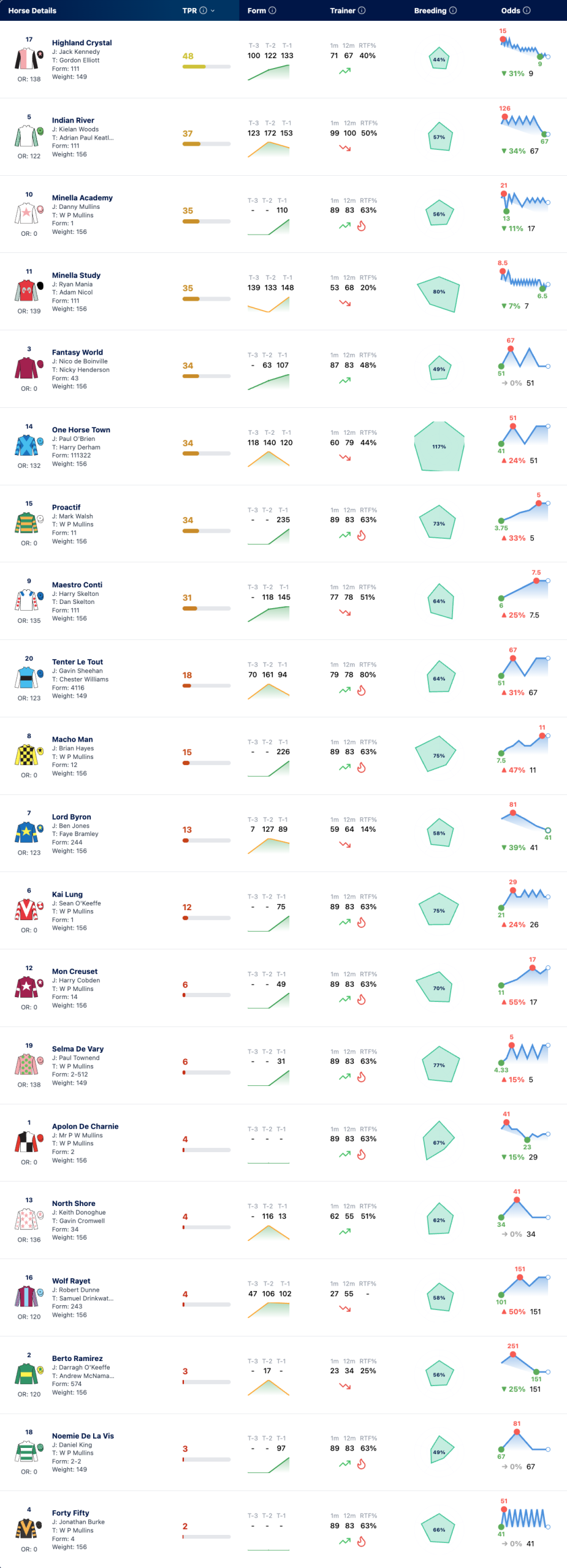
TPR is our machine learning-derived rating that synthesises all available data, including form, track preferences, breeding, and trainer momentum, into a single predictive score between 0 and 100. The higher the number, the stronger the chance. Across our entire database, horses ranked in the top three on TPR win approximately 55% of all races, while the top four account for around 67%. Here, HIGHLAND CRYSTAL leads on TPR at 48, followed by INDIAN RIVER at 37 and MINELLA STUDY at 35. However, the TPR leader triggers our Market Veto, a hard rule born from five years of Cheltenham data showing that when a horse ranks first on TPR but fourth or worse in the betting, it wins just 2.3% of the time. HIGHLAND CRYSTAL is 15/2 (SP rank 5). The market rates this horse but not at the head of affairs, and the veto applies. The second-ranked horse INDIAN RIVER also triggers the veto at 31/1 (SP rank 14).
That leaves PROACTIF as the headline selection, and the case is built on the single most powerful data point in this race. T-1 represents a horse’s most recent speed figure, adjusted for the class of race in which it was recorded. Think of 100 as the standard benchmark for a given level. Anything above is above par. PROACTIF posted a T-1 of 235 at Fairyhouse on Good To Soft in January, which is not just the highest last-time-out figure in this field but the highest by a clear nine points. The form comment from that run reads: “pressed leaders – led narrowly after 1st – clear with one other halfway – faced challenge 2 out – pushed along and went clear approaching last – ridden and ran on well run-in – comfortably.” That is a thoroughly convincing victory on similar going to what we expect today. GoingTPR, which shows how a horse performs on today’s ground conditions, confirms the picture: PROACTIF’s GoingTPR of 235 ranks first in the race by a distance. Willie Mullins’ yard is running hot, with a 1-month average speed rating of 89 against a 12-month baseline of 83, and a Runs To Form percentage of 63%, which tells us horses from this operation are arriving in peak condition. Mark Walsh, who has a 16.1% festival strike rate across the last five years, takes the ride at around 5/1.
The obvious concern is that PROACTIF has had just one run over hurdles. One run, however brilliant, is still one data point. The TPR rating reflects this limited exposure, ranking PROACTIF fifth on TPR at 34, behind horses with more established form profiles. But we have seen enough this week to know that ignoring the highest speed figure in the field is a costly mistake. Three of the five completed Day 3 races were won by the horse with the best recent figure, and our biggest error was failing to even mention such horses. The T-1 of 235 and the GoingTPR of 235 are the dominant data signals in this race, and they both point to PROACTIF.
The market’s favourite is SELMA DE VARY at around 4/1, ridden by Paul Townend for Mullins. On stable reputation alone, this is a serious runner. But the data cupboard is almost bare: a T-1 of just 31 from a second at Leopardstown on Heavy in February, where the comment notes “kept on but no match for winner.” TPR rank of 13th. GoingTPR of 0. This is a pure market confidence play, and while Mullins/Townend combinations deserve respect, we cannot justify selecting a horse ranked 13th on TPR with a speed figure of 31 when the alternative from the same yard carries a figure of 235.
HIGHLAND CRYSTAL deserves serious attention as a danger. The TPR rank of 1 (48) is the highest in the field, reflecting three wins from three hurdle starts with an improving trajectory: 100, then 122, then 133. All three victories came on Soft or Soft to Heavy ground. If the going deteriorates from Good To Soft towards Soft following overnight rain, HIGHLAND CRYSTAL becomes an even more compelling proposition, as those conditions are precisely where all the winning form was produced. The T-1 of 133 at Naas on Soft to Heavy in February drew the comment: “pushed along and hung right from 2 out – ridden approaching last – edged right but kept on well run-in – always doing enough.” The hanging right is worth noting at a left-handed track like Cheltenham. Gordon Elliott’s yard is running slightly hot (1m: 71, 12m: 67) and Jack Kennedy rides at 15/2. The GoingTPR of 0 reflects the fact that none of those wins were on Good To Soft specifically, but should the ground turn genuinely Soft, that zero becomes a strength rather than a weakness.
MINELLA STUDY is the one to consider for place claims. The T-1 of 148 was posted at this course on Good To Soft in December, where the comment reads: “led before last – ridden and went clear run-in – readily.” TrackTPR, which measures how a horse has performed at today’s specific course, gives MINELLA STUDY the top rank at 148. That is proven Cheltenham form, and it matters on this unique track. But trainer Adam Nicol’s yard is deeply concerning: a 1-month speed rating of 53 against a 12-month baseline of 68, and a Runs To Form of just 20%, meaning only one in five of the stable’s runners is performing to expectations. Add a 90-day absence and this is a horse whose credentials are undermined by the connections’ current trajectory.
MAESTRO CONTI won at this course on Soft in January, posting a T-1 of 145 with the comment: “ridden to lead run-in – ran on.” Dan Skelton’s yard sits around its baseline (1m: 77, 12m: 78), and Harry Skelton rides. This is a solid contender with proven course form, and if the ground turns Soft, the GoingTPR would activate from zero to around 145, making MAESTRO CONTI a live threat with both course and going credentials. MACHO MAN, who finished second to PROACTIF at Fairyhouse with a T-1 of 226, is the live outsider at 11/1 for those wanting a saver in the same race. That comment, “kept on and went clear with winner run-in,” confirms the Fairyhouse form is strong, though PROACTIF had the measure of this one on the day.
The selection is PROACTIF. The highest speed figure in the field by a clear margin, the best GoingTPR, a Mullins hot yard, and a decisive winning comment on similar going to what we expect today. After a chastening Day 3 where we twice failed to back the horse with the best figure, we are not making that error again. If the ground turns Soft, keep a close eye on HIGHLAND CRYSTAL (TPR rank 1, all wins on Soft) and MAESTRO CONTI (course winner on Soft).
🎯SELECTION
PROACTIF
The full field
William Hill County Handicap Hurdle
2m1f | Hurdle | Good To Soft | 24 runners | Class 1
Race Analysis
Time for a reality check. The County Hurdle is a 24-runner Class 1 handicap hurdle, and our five-year Cheltenham data on this race type is sobering. SP favourites have won just 1 from 18 attempts (5.6%). Our convergence filters, which thrive in graded races, essentially break down in big-field handicap hurdles. No filter we have tested produces reliable, repeatable profit here. This is the festival’s hardest race type, and the honest approach is to acknowledge that, adjust expectations, and focus on the horses with the strongest raw data hooks rather than pretending the system has an edge it doesn’t.
With the convergence framework largely neutralised, we fall back on the lesson that Day 3 hammered home: pay attention to the highest speed figures in the field. In three of five completed races on Wednesday, the horse with the best recent figure won. In a race where no systematic filter works, raw form and class may be the most reliable compass we have.
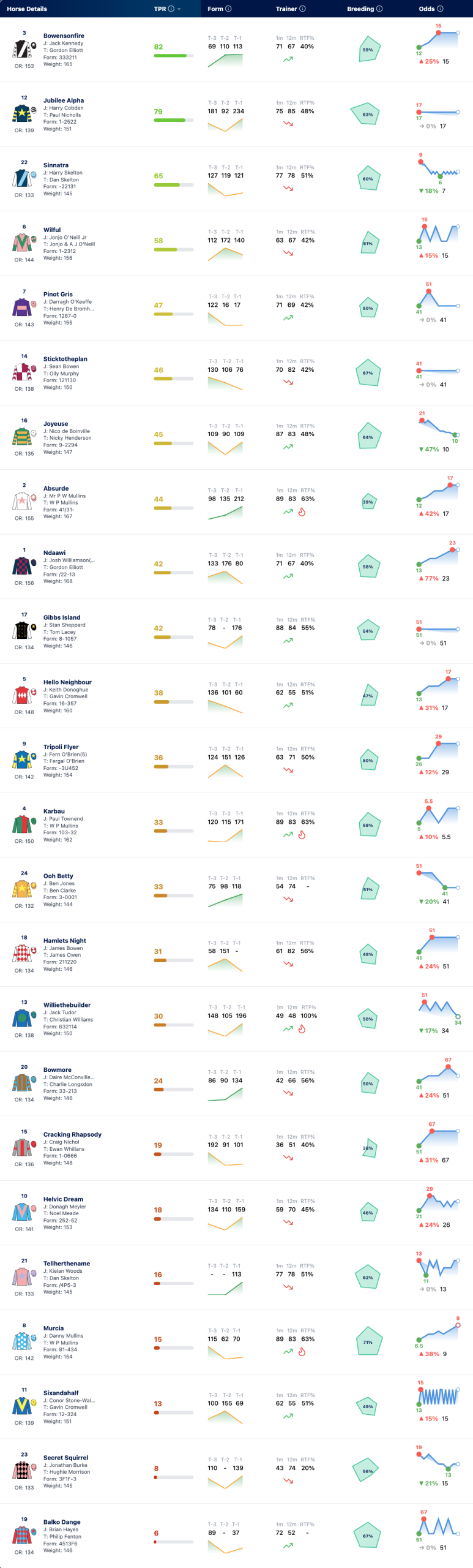
JUBILEE ALPHA has the highest T-1 in this field by a distance. The figure of 234, posted at Warwick on Heavy in February, towers over everything else here. Now, that came in a second-place finish where the comment reads: “chased clear leader – headway before 6th – weakened run-in.” The weakening pattern is a recurring theme. At Cheltenham in December on Good To Soft (T-3 of 181), the comment notes “mistake last – weakened run-in.” At Sandown in January on Good (T-2 of 92), “headed run-in – weakened inside final 110yds.” There is clearly a question about whether JUBILEE ALPHA can sustain the effort through the finish. But the raw ability is exceptional. Paul Nicholls sends the horse here off an official rating of 139, which is a handicap mark, the number the British Horseracing Authority assigns to reflect a horse’s estimated ability level, with higher numbers indicating better horses. In a 24-runner field where chaos is the default, a horse carrying a mark of 139 with the highest speed figure in the race has every right to be competitive, and at around 15/1 the market is giving us a generous price for that ability. Harry Cobden, one of the best jump jockeys in Britain, takes the ride. The Nicholls yard is slightly below its 12-month baseline (1m: 75, 12m: 85, RTF: 48%), which is a mild negative, but in a race where no filter reliably works, we are backing the figure. If the ground turns Soft following overnight rain, that actually helps: the T-1 of 234 was posted on Heavy, which is closer to Soft than Good To Soft, suggesting JUBILEE ALPHA handles testing conditions.
ABSURDE adds a second string from the Mullins yard and attacks this race from a different angle. Where JUBILEE ALPHA leads on raw speed, ABSURDE leads on conditions credentials. A GoingTPR of 137 ranks first in the field, meaning no horse has a stronger proven record on today’s ground. The T-1 of 212, the second highest in the race, was posted at Plumpton on Good in April 2025 where the comment reads: “shaken up to lead approaching last – ridden and ran on well run-in – comfortably.” ABSURDE also has festival experience, having finished third at Cheltenham on Good To Soft in March last year, posting a figure of 135 with a comment of “midfield – headway after 2 out – went third approaching last – kept on.” That is directly relevant course form on today’s going. The concern is the layoff. The last hurdle run was 327 days ago, with three flat outings since. Patrick Mullins, who rides as an amateur, takes the mount. Off the top weight of OR 155, ABSURDE is being asked to carry more than anything else in the race. But the Mullins yard is running hot (1m: 89, 12m: 83, RTF: 63%), and the combination of the best GoingTPR, the second-best T-1, and proven festival form at a price of around 17/1 makes the case.
The market favourite KARBAU at 5/1 with Townend is hard to support with data. TPR rank 13, GoingTPR of just 76 (rank 20 out of 24), and a previous run at Cheltenham in March where the comment reads: “tailed off after 2 out.” The T-1 of 171 from Naas on Heavy ended with “no extra inside final 110yds.” The market is pricing Mullins/Townend and the potential for improvement, not established form. In a race type where favourites win 5.6% of the time, we are happy to let KARBAU go. SINNATRA at 11/2 is the horse where TPR and SP most closely agree (TPR rank 3, SP rank 2), and the consistent figures of 121-141 across four recent runs make this the most solid each-way alternative. WILLIETHEBUILDER at 26/1 has the third-highest T-1 in the field (196 at Musselburgh on Good To Soft) and Cheltenham course form (TrackTPR 107), but the comment from that Musselburgh run, “hung left before 3 out,” introduces a question mark.
This is a minimum-confidence race by design. We are not pretending to have cracked the handicap hurdle code. But if two horses at big prices carry the highest speed figures in the field and the best going credentials respectively, those are the data hooks worth backing in a race where nothing is certain. The selections are JUBILEE ALPHA and ABSURDE.
🎯SELECTION
JUBILEE ALPHA
ABSURDE
The full field
Mrs Paddy Power Mares Chase (Grade 2)
2m4½f | Chase | Good To Soft | 9 runners | Class 1
Race Analysis
After the chaos of a 24-runner handicap hurdle, the Mares Chase offers something far more manageable: a Grade 2 chase with just nine runners. This is our convergence model’s natural habitat. Grade 2 chases have historically returned a 44.4% strike rate at +90.3% ROI with Filter E, and a nine-runner field sits in the small-field bracket where class differentials are most exposed. After the painful lesson of Day 3, where we overrode a Filter E qualifier in Race 3 and watched it win, we are not making that mistake again. When Filter E fires, it is the selection. No debate.
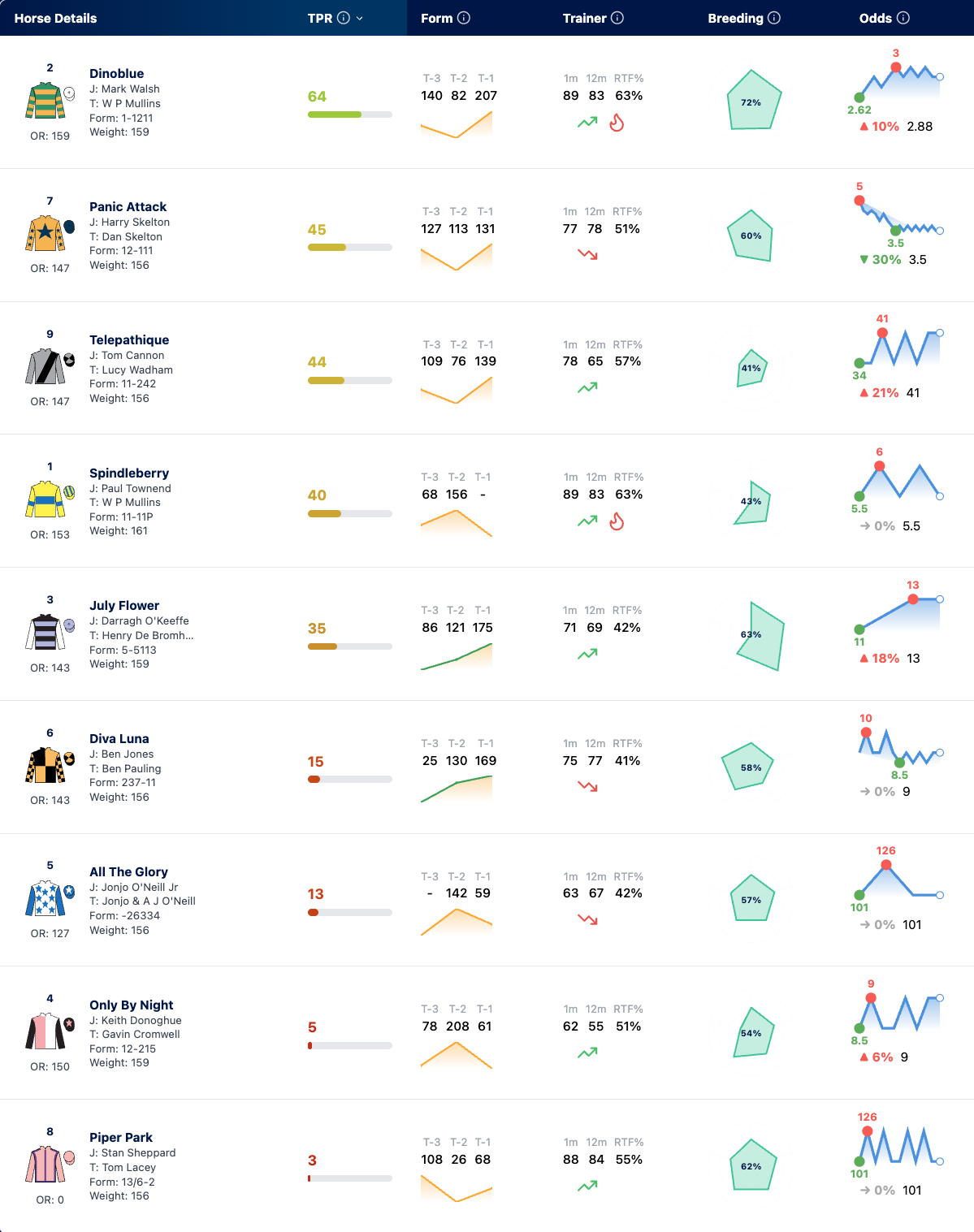
DINOBLUE fires Filter E emphatically. TPR rank 1 (64), GoingTPR rank 1 (131), TrackTPR rank 2 (105), SP rank 1 at around 11/4. Every layer of the convergence model points to the same horse. The T-1 of 207, the highest in the field, was posted at Naas on Heavy in February where the comment reads: “made all – nudged along and went clear last – easily.” That is as dominant a winning comment as you will find, and if the ground turns Soft following overnight rain, the fact that the T-1 was posted on Heavy only strengthens the case. The T-4 of 177 came at Punchestown on Good To Soft where the comment notes “eased run-in – canter,” and DINOBLUE has proven Cheltenham form too, winning at the festival on Good To Soft in March last year with a figure of 190 and the comment: “led just before 2 out – 1 length ahead going best when left clear last – kept on well.” The running style is consistent: front-running or prominent, controlling the race from the front, and putting the field to sleep with jumping precision. Willie Mullins’ yard continues to run hot (1m: 89, 12m: 83, RTF: 63%), and Mark Walsh takes the ride. There is one blip in the form, the T-2 of 82 at Fairyhouse on Good To Soft in January, but the comment from that run reads: “made all – clear when bad mistake last – shaken up briefly run-in – easily.” The figure undersells the performance. DINOBLUE won that race by a wide margin despite a bad mistake at the last fence.
PANIC ATTACK is the principal danger and the second favourite at around 13/4. TPR rank 2 (45) and three consecutive wins tell a strong story. The most relevant of those came at Cheltenham on Soft in November, posting a figure of 127 with the comment: “towards rear – midfield with one circuit to go – headway before 2 out – led last – kept on well final 110yds – won going away.” That is proven course form with a strong finishing kick, and if the ground deteriorates towards Soft, PANIC ATTACK’s Cheltenham credentials become even more relevant. The most recent win at Newbury on Good To Soft (T-1 of 131) was a demolition: “jumped well – soon led – clear 5 out – canter.” Dan Skelton’s yard sits on its baseline (1m: 77, 12m: 78), and Harry Skelton rides. The issue for PANIC ATTACK is that the figures (131, 113, 127) consistently sit a level below DINOBLUE’s best. This is a good horse being asked to beat a very good one.
ONLY BY NIGHT demands a mention because of a T-2 of 208 from Naas on Soft in November, the second-highest individual figure in the field, where the comment reads: “went second going easily 2 out – challenging last – ridden and ran on well to lead towards finish.” That is a quality performance. ONLY BY NIGHT also has the best TrackTPR in the race at 132, earned from a second at the festival on Good To Soft where the comment notes “challenging approaching last – led narrowly run-in – kept on but headed towards finish.” But the T-1 of just 61 at Leopardstown is explained by an excuse: “badly hampered after 2nd – outpaced after 3 out.” The ability is clearly there, and this one is interesting at around 8/1, but the inconsistency between T-1 and T-2 makes it hard to prefer over the Filter E qualifier.
SPINDLEBERRY carries Townend for Mullins at around 5/1, which always commands attention, but the most recent run is a pulled up at Leopardstown: “weakening when pulled up after 5 out.” The T-1 of zero from that run is impossible to overlook. Before that, the T-2 of 156 at Doncaster on Good was comfortable, “pushed out run-in – comfortably,” but a pulled up last time out, even with the vet reporting normal post-race, is a significant concern at a short price. JULY FLOWER has a T-1 of 175 from Leopardstown on Good To Soft, the second-highest last-time-out figure in the field, but the comment ends “no extra run-in – no match for first two,” and at 23/2 the market reflects a horse who may not quite have the class for this level. The De Bromhead yard is running near baseline (1m: 71, 12m: 69, RTF: 42%).
The selection is DINOBLUE with maximum confidence. Filter E in a Grade 2 Chase with nine runners, TPR rank 1, the highest T-1 in the field, the best GoingTPR, proven Cheltenham form including a festival win on today’s going, and a Mullins hot yard. This is the strongest convergence case on the entire card.
🎯SELECTION
DINOBLUE
The full field
Albert Bartlett Novices Hurdle (Grade 1)
3m | Hurdle | Good To Soft | 22 runners | Class 1
Race Analysis
The Albert Bartlett is the championship three-mile novice hurdle, a test of stamina and jumping for the staying hurdlers of the future. It sits in the novice graded category where our convergence model historically performs best, but the 22-runner field pushes this into large-field territory where the edges shrink. No horse fires Filter E or Filter A here. The data is fragmented, many of these runners have limited form over hurdles, and no strong convergence qualifier emerges. This is a race to approach with eyes open.
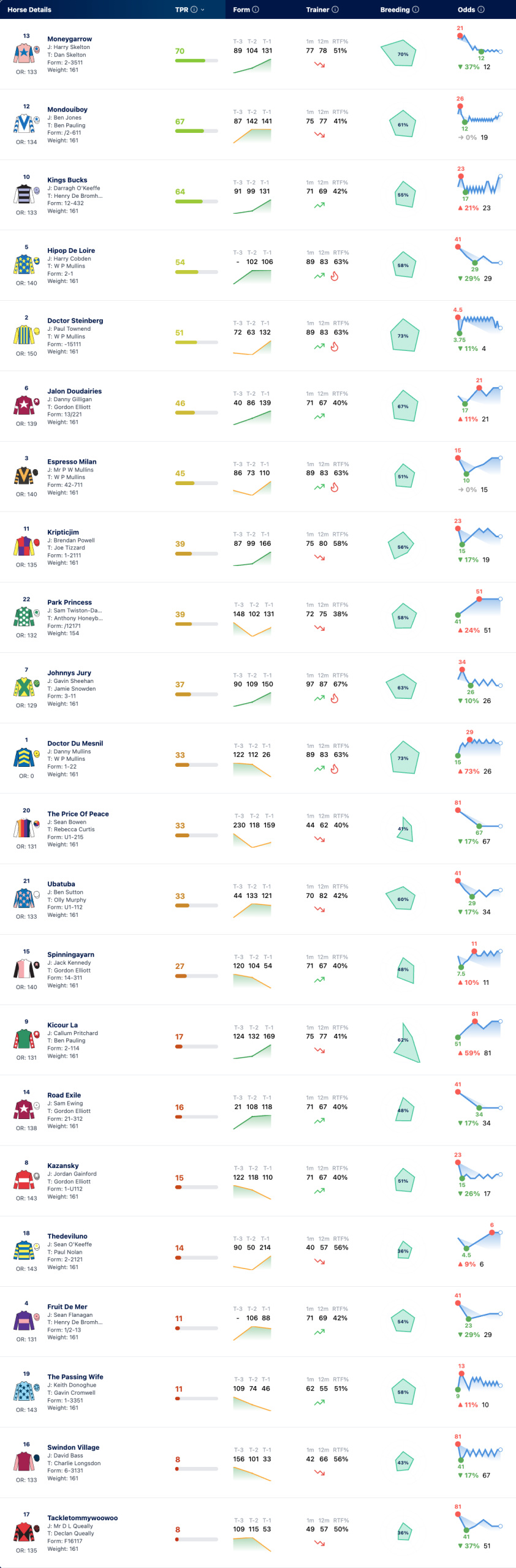
The TPR hierarchy is topped by MONEYGARROW at 70, but the Market Veto applies: TPR rank 1 at 10/1 (SP rank 4). The Skelton runner won at Windsor on Soft in January (T-1 of 131, “switched right approaching last – soon led – ridden and kept on run-in”) but the Cheltenham form reads less well, finishing fifth on Soft in November where the comment notes “no impression when lost fourth inside final 110yds.” The market respects this horse more than earlier in the week, but not enough to sit inside the top three in the betting, and our veto rule says trust that signal.
KRIPTICJIM holds the best TrackTPR in the entire 22-runner field at 166 (rank 1), earned from a win at Cheltenham on Soft in January. That T-1 of 166 is also the highest last-time-out figure posted at this course by any runner in the race, and the comment reads: “led – headed and prominent after 1st – led again 3 out – joined 2 out – pushed along when jumped left and mistake last – sustained duel with runner-up run-in – just prevailed.” That is a horse who made a mistake at the last fence, was locked in a battle through the run-in, and still found enough to win. Courage at Cheltenham counts for a lot in a three-mile novice hurdle where the hill sorts out the pretenders. The concern is GoingTPR of 75 (rank 15), which means the broader going record across all runs is modest, and the T-2 of 99 at Newbury on Good To Soft was a more workmanlike effort where the comment notes “novicey jumping.” But the Cheltenham-specific performance is the standout, and in a race where course form is rare across a field of novices, having the best of it is a genuine edge. Crucially, if the ground turns Soft following overnight rain, that only helps: the Cheltenham win that anchors this selection was posted on Soft. Joe Tizzard’s yard is near baseline (1m: 75, 12m: 80, RTF: 58%) and Brendan Powell rides. At 18/1, the market has underestimated the value of that Cheltenham win.
THEDEVILUNO attacks this race from a completely different angle. The T-1 of 214 at Doncaster on Soft in January is the highest last-time-out figure in this field by 48 points. That is not a marginal gap. The comment from that run tells the story: “towards rear – dropped to last 3rd – steady headway from 3 out – in touch with leaders going easily 2 out – pushed along to lead approaching last – ridden and kept on well run-in – won going away.” THEDEVILUNO came from the back of the field, cruised into contention, and pulled clear under hands-and-heels riding. It was a performance of pure class over three miles on testing ground, and it is directly relevant to today’s conditions and distance. The second favourite at 6/1, the market clearly respects this form. The concern is the trainer. Paul Nolan’s yard is running cold, with a 1-month speed rating of 40 against a 12-month baseline of 57. That is a significant negative. But the Day 3 debrief was unambiguous: when we failed to back or even mention horses with the best speed figures in the field, we paid the price. THEDEVILUNO’s 214 cannot be ignored, and if the ground has turned Soft, the relevance of that Doncaster figure only increases, as it was posted on exactly that going.
DOCTOR STEINBERG is the 7/2 favourite with Townend for Mullins. Three hurdle wins from three starts, all in Ireland, with a GoingTPR of 133 (rank 2) and the Mullins hot yard behind (1m: 89, 12m: 83, RTF: 63%). But the hurdle figures themselves (132, 63, 72) are a significant drop from bumper heights, and the market price reflects the Mullins/Townend combination as much as the form. MONDOUIBOY at 15/1 has surged to TPR rank 2 (67) overnight and is the most interesting outsider beyond the two selections. Two recent wins with remarkably consistent figures, both on Good To Soft: 141 at Ascot (“went clear before last – comfortably”) and 142 at Ludlow (“kept on well run-in”). GoingTPR of 123 ranks third. SPINNINGAYARN is 11/1 with Elliott and Kennedy, but a T-1 of just 54 from Punchestown on Heavy offers nothing to justify that price on figures.
The selections are KRIPTICJIM on the strength of the best Cheltenham form in the field and an 18/1 price that undervalues a course winner, and THEDEVILUNO on the highest T-1 in the field by a distance from a devastating Doncaster performance. Proven course form at a big price paired with the standout speed figure at a shorter one. In a 22-runner novice Grade 1 with no strong filter signal, these are the two strongest data hooks available.
🎯SELECTION
KRIPTICJIM
THEDEVILUNO
The full field
Boodles Cheltenham Gold Cup Chase (Grade 1)
3m2½f | Chase | Good To Soft | 11 runners | Class 1
Race Analysis
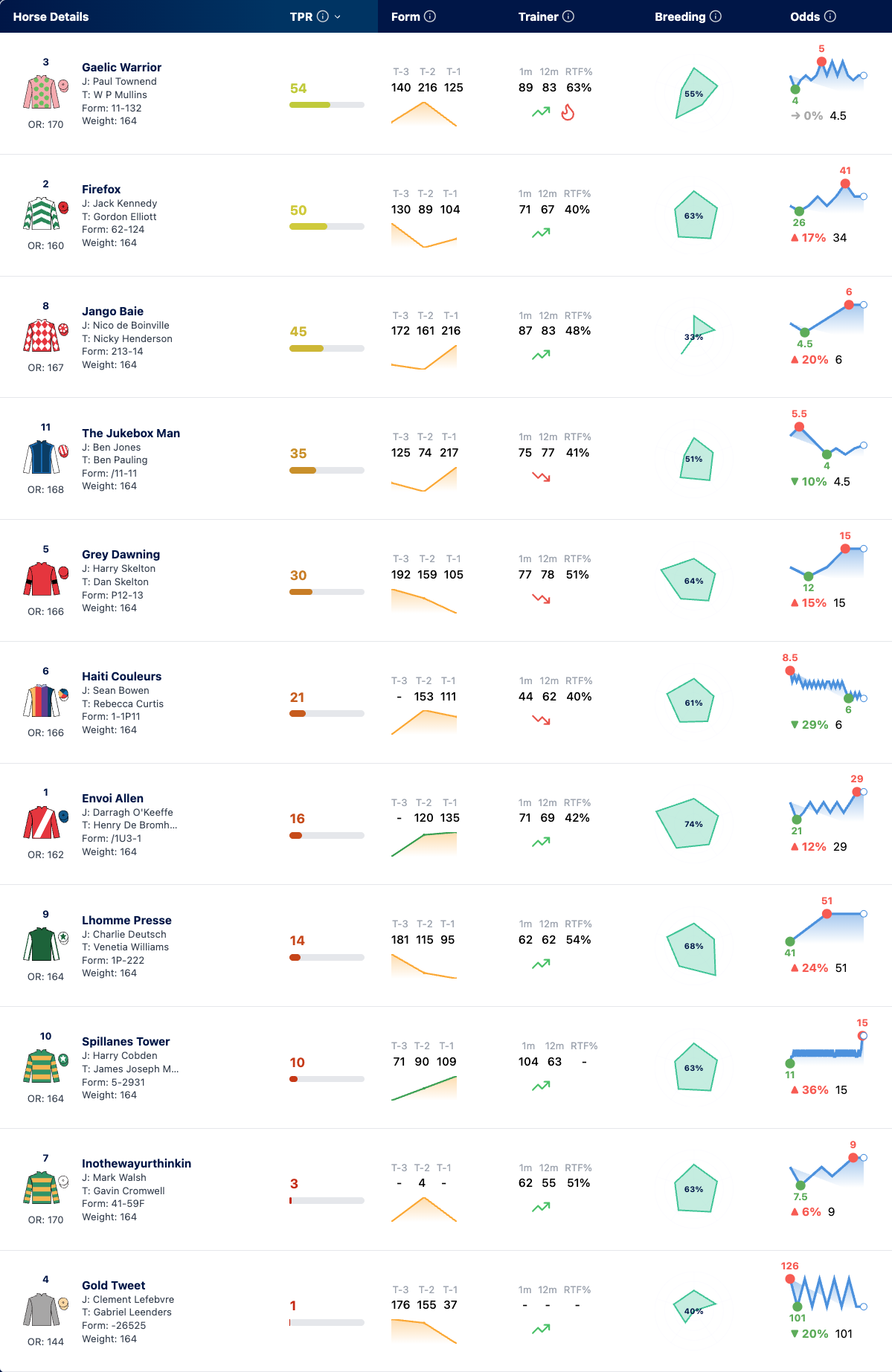
This is it. The Gold Cup. The race that defines the entire jumps season. And from a data perspective, this is exactly where we want to be. A Grade 1 chase with 11 runners sits in the category where our convergence model has been most profitable across five years of Cheltenham data: Filter E qualifiers in Grade 1 chases have won 61.1% of the time at +180% ROI, and Filter A qualifiers have won 52.0% at +145.8% ROI. Small fields, elite chasers, and a race type where proven class on the ground is the ultimate differentiator. If the model has a single best application at the entire festival, it is this race.
Three of the leading contenders clashed at Kempton on Good in the King George in December, and the figures from that race set the scene. THE JUKEBOX MAN won with a T-1 of 217, GAELIC WARRIOR was third with a T-2 of 216, and JANGO BAIE was fourth with a T-1 of 216. Separated by a single point across the top three. But the King George was run on Good ground on a flat, right-handed track. Today’s test is a different animal entirely: Cheltenham’s undulating left-handed track on testing ground, with a stamina-sapping uphill finish. Overnight rain has added further moisture to an already softening surface, and the question is not who ran fastest at Kempton. It is who handles these specific conditions best.
That question has a clear answer. JANGO BAIE fires Filter A, the only convergence qualifier in the race. TPR rank 3, GoingTPR of 144 (rank 2), and critically, a proven festival winner. JANGO BAIE won at Cheltenham on Good To Soft at last year’s festival with a T-4 of 145, and the comment from that run tells the story of a horse with extraordinary courage: “outpaced after 4 out – mistake 3 out – some headway when mistake 2 out – ridden and rallied approaching last – ran on well run-in – led towards finish.” Read that again. JANGO BAIE was outpaced four from home, made mistakes at the third-last and the second-last fences, and still rallied to win. On this track, on this ground, under maximum pressure. That is the raw determination you need to win a Gold Cup. The form beyond that festival win only strengthens the case. T-5 of 211 came at Sandown on Heavy where the comment reads: “sustained duel with winner – kept on well final 110yds – just failed.” T-2 of 161 at Ascot on Good where the comment notes: “pushed along and led before 2 out – ridden and went clear after 2 out – good jump last – impressive.” This is a horse who has run big figures across multiple going conditions and has proven the ability to dig deep in a finish. If the ground has turned Soft, the case only strengthens: the Sandown run on Heavy produced a massive 211, confirming JANGO BAIE thrives when conditions get testing. Nicky Henderson’s yard is running hot, with a 1-month speed rating of 87 against a 12-month baseline of 83. Nico de Boinville, Henderson’s number one jockey, takes the ride.
THE JUKEBOX MAN is the market favourite at around 15/4 and the King George winner. The T-1 of 217 from Kempton is a remarkable figure, and the comment, “headed last – rallied and led again final strides – gamely,” shows guts under pressure. But the going data is where the doubts creep in. GoingTPR of 98 ranks ninth out of eleven runners. In a field of this quality, being ninth on the going metric is a significant vulnerability, and overnight rain has only amplified that concern. Both of THE JUKEBOX MAN’s highest figures (217 at Kempton on Good, 125 at Kempton on Good) came on flat tracks on fast ground. The question of how this translates to testing ground at Cheltenham’s hills is the defining uncertainty. TrackTPR of 123 (rank 6) is mid-field. Ben Pauling’s yard sits near its baseline (1m: 75, 12m: 77). This is a very good horse, but the conditions profile is the weakest of the three King George principals.
GAELIC WARRIOR at 4/1 has Mullins and Townend, the most potent combination in festival history, and leads the field on TPR at 54. The T-2 of 216 from the King George was right there with the winner, and the T-5 of 200 at Aintree on Good To Soft shows a proven big-race performer on softer ground: “soon led – won going away.” But the T-1 of 125 at Leopardstown on Soft is a clear step backwards, with the comment reading “kept on but no match for winner.” GoingTPR of 132 ranks fourth. TrackTPR of 117 ranks ninth. The Mullins hot yard (1m: 89, 12m: 83) is a positive, but this is not the strongest conditions profile from the Mullins squad this week, and the Leopardstown regression on soft ground is hard to dismiss before a Gold Cup on testing going.
GREY DAWNING is the horse the going data loves most. GoingTPR of 157 ranks first in the field. TrackTPR of 153 ranks second. The T-4 of 225 at Kelso on Good To Soft is the single highest figure any horse in this field has posted in their last five runs. The T-2 of 159, won at Haydock on Good To Soft, drew the comment: “eased into lead run-in – impressive.” But there is a declining trajectory that cannot be ignored: 225, then 192, then 159, then 105. The most recent run at Cheltenham on Soft produced just 105 as favourite, where the comment reads: “2.5 lengths down when mistake 2 out – kept on but not recover.” There is an excuse in the mistake, and 13/1 reflects the market’s awareness that the best of GREY DAWNING might be behind. The conditions profile is tantalising but the direction of travel is the wrong way.
INOTHEWAYURTHINKIN won at the festival on Good To Soft with a huge figure of 209, and holds the third-best TrackTPR in the race at 149. Mark Walsh takes the ride. But the last three runs are disqualifying: fell at Leopardstown, eased and beaten by a distance at Leopardstown, never on terms at Punchestown. Three consecutive figures of 0, 4, and 0. Whatever happened at the festival last year, this is not the same horse now. HAITI COULEURS at 11/2 has TrackTPR of 145 (rank 4) and two recent wins, but the form history includes a pulled up at Haydock in November where the comment reads “jockey said gelding was never travelling,” and the T-1 of 111 from Newbury on Heavy is modest for this level. The trainer is running cold (1m: 44, 12m: 62). SPILLANES TOWER won at Cheltenham on Soft in January and trainer James Joseph Mangan is running exceptionally hot (1m: 104, 12m: 63), but figures of 109, 90, and 71 across the last three runs are a class below.
The selection is JANGO BAIE with maximum confidence. Filter A in a Grade 1 chase, the most profitable race type in our entire five-year dataset. TPR rank 3. King George form of 216 confirming the horse competes at the highest level. GoingTPR of 144 confirming proven credentials on testing ground. A festival winner on today’s going at today’s course who showed extraordinary heart to rally from two late mistakes and still prevail. A Henderson hot yard. And 11/2, a price that sits in the value band where our data shows the strongest returns. If the ground has turned Soft, this horse’s credentials only improve: the T-5 of 211 on Heavy tells us JANGO BAIE relishes testing conditions. This is the bet of the week.
🎯SELECTION
JANGO BAIE
The full field
Princess Royal Challenge Cup Open Hunters Chase
3m2½f | Chase | Good To Soft | 24 runners | Class 2
Race Analysis
The Hunters Chase is a different beast to everything else on the card. Amateur jockeys, long layoffs, horses with stories that transcend form figures. This is a race where the narrative matters alongside the numbers, and we have one of the best festival stories in years.
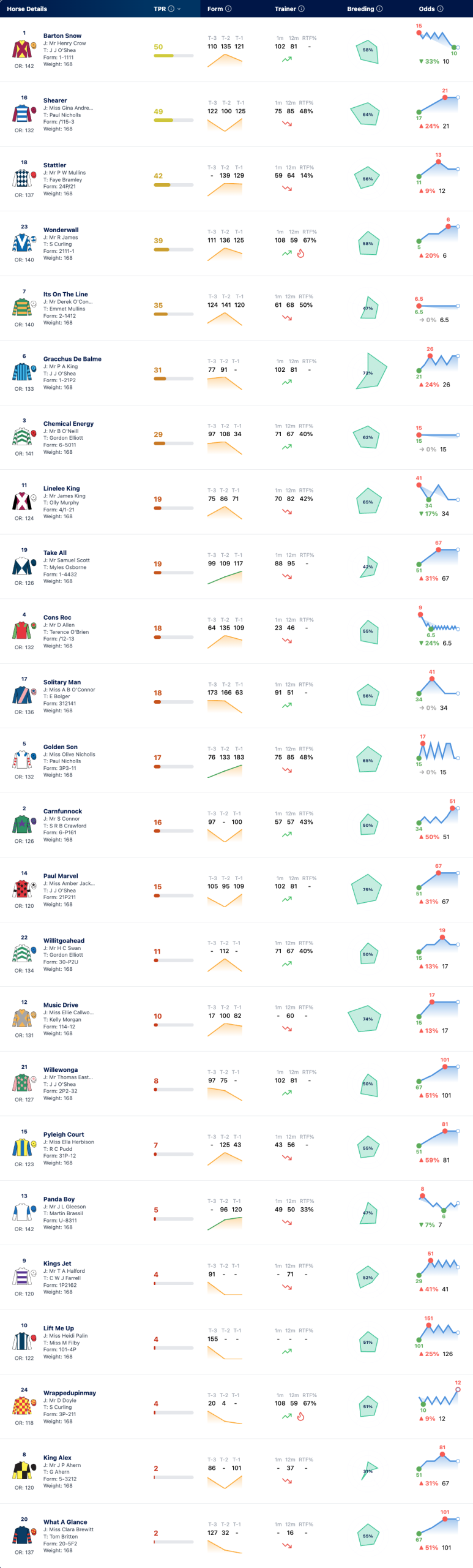
STATTLER was retired from racing in 2024 to begin a second career in showing. Formerly trained by Willie Mullins, who sent out some of the best chasers of the last decade, STATTLER went on to win the Tattersalls Retraining of Racehorses amateur qualifier at the 2025 Scone Palace International Horse Trials. The competitive fire clearly never dimmed, because STATTLER has since returned to racing, and the form from two recent qualifying runs is genuinely strong. The T-1 of 129 came at Fakenham on Soft in February, where the comment reads: “raced in last – headway before 3 out – ridden and led and went clear before last – not fluent last – readily.” Coming from behind and putting the race to bed before the last fence. The T-2 of 139 at Hereford on Soft in January was even better on the figures, though STATTLER was caught on the line: “led clearly 3 out – 3 lengths ahead last – headed final strides.” The data matches the story. GoingTPR of 123 ranks first in this 24-runner field, meaning no horse has a stronger proven record on testing ground. If the going has turned Soft following overnight rain, both qualifying runs were posted on exactly that surface, making STATTLER even more relevant. TrackTPR of 94 (rank 5) confirms previous Cheltenham experience. And the jockey is Patrick Mullins, one of the most accomplished amateur riders in the sport, who knows STATTLER from the Mullins yard days. At 12/1, this is the kind of price that makes the festival special. A horse with a story, figures that stack up, the best going credentials in the field, and one of the best amateur jockeys available.
WONDERWALL and ITS ON THE LINE head the market as joint favourites at 6/1. WONDERWALL won at the festival on Good To Soft (T-1 of 125, “just did enough”) and the trainer is running hot (1m: 108, 12m: 59), but 364 days off is the longest absence of any runner in the race. ITS ON THE LINE has strong Cheltenham form, having finished second at the festival on Good To Soft with a figure of 124 and the comment: “pressed winner final 110yds – stayed on.” Derek O’Connor, one of Ireland’s finest amateur riders, takes the mount for Emmet Mullins. TrackTPR of 105 ranks third. At 6/1 as joint favourite, ITS ON THE LINE would be the systematic pick in a race without such a compelling alternative. LINELEE KING at 25/1 has attracted support based on point-to-point form, but the data is hostile: TPR rank 8, T-1 of just 71, GoingTPR of 85 (rank 8), and no Cheltenham form. BARTON SNOW leads on TPR at 50 but triggers the Market Veto at 19/2 (SP rank 5).
GOLDEN SON carries the highest T-1 in the field at 183, posted at Taunton on Heavy in February where the comment reads: “jumped well – led narrowly or disputed lead – led clearly after 11th – went further clear before 4 out – easily.” That is a dominant front-running victory with a massive figure. The T-2 of 133 at Warwick on Good To Soft was also a comfortable win: “left in lead 12th – went clear approaching last – kept on well – comfortably.” Two wins on the bounce, both authoritative. The concern is GoingTPR of 59 (rank 14), which suggests previous form on today’s going has not been strong, and no Cheltenham course form. Miss Olive Nicholls rides for her father Paul. At around 13/1, the raw figures demand inclusion, though the going credentials are clearly weaker than STATTLER’s.
The primary selection is STATTLER. A horse who retired, excelled in a completely different equestrian discipline, came back to racing and qualified for the Cheltenham Festival with two strong runs, and now reunites with Patrick Mullins on the biggest stage. The GoingTPR of 123 ranking first in the field is the data backbone, the two qualifying runs provide the form evidence, and 12/1 is a price that rewards the risk. GOLDEN SON adds the highest T-1 in the field at 183 from two consecutive wins, providing a different angle at a similar price for those who want to cover the raw speed option.
🎯SELECTION
STATTLER
GOLDEN SON
The full field
Martin Pipe Conditional Jockeys Handicap Hurdle
2m4½f | Hurdle | Good To Soft | 24 runners | Class 2 | 0-145
Race Analysis
The final race of the Cheltenham Festival. The Martin Pipe is a 24-runner handicap hurdle restricted to conditional jockeys, and it is the race our filter guide describes as the archetype of everything that makes handicap hurdles difficult: huge field, young horses stepping into the unknown, and riders with less experience navigating the most demanding track in British racing. SP favourites have won just 1 from 18 handicap hurdles at the festival across our five-year dataset (5.6%). There is no sugar-coating that. But after a week of highs and lows, we want to close on a positive note, and two horses in this field carry data profiles that demand attention.
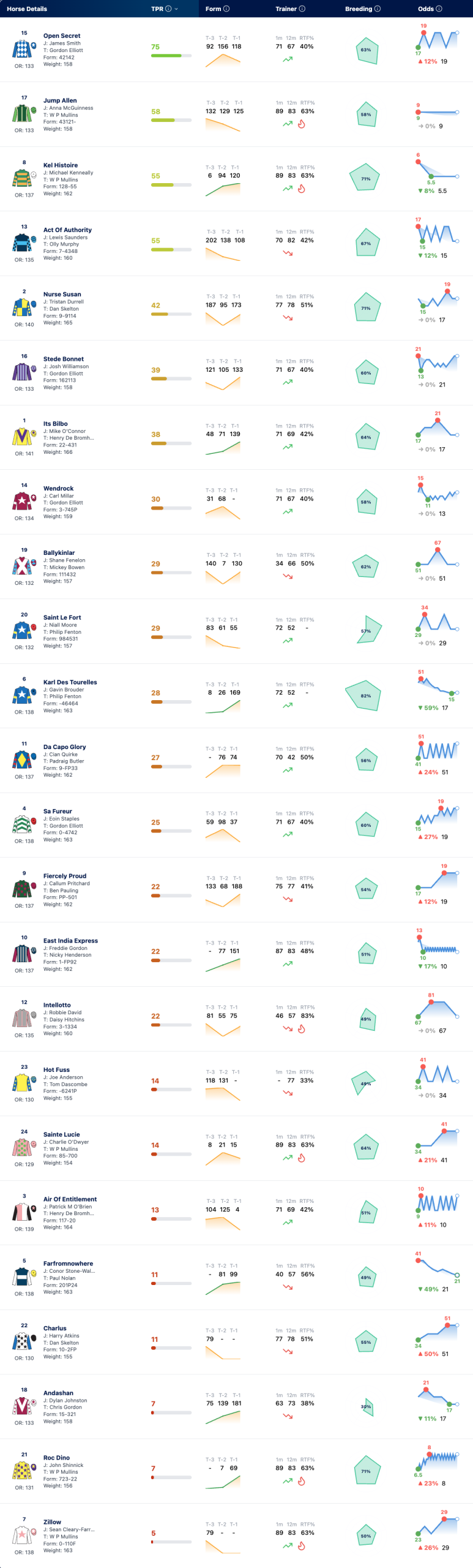
FIERCELY PROUD has the best GoingTPR in this 24-runner field at 137 (rank 1) and the highest T-1 at 188, posted at Ascot on Good To Soft in February. That is the strongest combination of going credentials and raw recent form of any horse in the race. The comment from that Ascot win reads: “in touch with leaders – headway after 3 out – led run-in – kept on and always doing enough,” with the trainer noting that the horse “appeared to appreciate step up in trip from 2 miles half a furlong to 2 miles 3 furlongs on occasion.” That trip observation is directly relevant. Today’s race is over 2 miles 4 and a half furlongs, the same step up that produced the career best. There is also Cheltenham form to lean on: a T-3 of 133 on Soft in November where the comment reads “prominent – outpaced before 2 out – rallied run-in – not pace to challenge.” Fifth, but staying on at the finish at a course where stamina through the final hill sorts the field out. If the ground has turned Soft following overnight rain, that Cheltenham run on Soft becomes even more relevant, and the best GoingTPR in the field takes on greater significance. The form history is not without concern. The T-2 of 68 at Ascot on Good To Soft in December shows what happens when things go wrong: “weakened before 2 out.” And earlier in the career there were two pulled ups, including one where the vet reported an irregular heartbeat in February 2025. That is over a year ago, and the recent 188 suggests whatever the issue was has been resolved, but it exists in the record and readers should know. Ben Pauling’s yard sits near baseline (1m: 75, 12m: 77). At around 19/1, this is the kind of data-backed outsider that can close a festival on a high.
NURSE SUSAN attacks from the course form angle. A winner at Cheltenham on Good To Soft in December with a T-3 of 187, which is the highest figure any horse in this race has posted at this course. The comment from that run reads: “headway approaching last – went second last – ridden and led run-in – kept on well,” with the trainer noting improvement after a break. That is a strong staying performance on today’s going at today’s track. TrackTPR of 132 ranks third in the field, confirming the course credentials are genuine and not a one-off. The T-1 of 173 at Fontwell on Heavy is the third-highest last-time-out figure in the race, though the comment introduces a question: “rallied and went third before 2 out – soon hung badly left – weakened approaching last.” The hanging left is worth noting at a left-handed track like Cheltenham. GoingTPR of 64 (rank 14) looks weak on the surface, but the 187 at Cheltenham on Good To Soft tells us that this specific combination of course and going is where NURSE SUSAN excels, even if the broader going record is inconsistent. Dan Skelton’s yard runs at baseline (1m: 77, 12m: 78). At around 16/1, this is another live outsider with proven festival credentials.
The market favourite KEL HISTOIRE at 5/1 for Mullins has a GoingTPR of 56 (rank 19 out of 24) and a TrackTPR of just 6, earned from a previous run at the festival where the comment reads: “weakened 2 out.” TPR rank 3 and the Mullins hot yard (1m: 89, 12m: 83) are the positives, but in a race type where favourites win at 5.6%, those going and course figures are disqualifying at a short price. ROC DINO at 8/1, also for Mullins, sits TPR rank 22 with a T-1 of 69 and GoingTPR of 0. The market sees the Mullins name. The data sees nothing. JUMP ALLEN at 9/1 has surged to TPR rank 2 (58) with GoingTPR of 99 (rank 4) for the Mullins yard, but 321 days since the last hurdle run is an enormous absence that undermines confidence at the festival.
ANDASHAN at 13/1 deserves a mention as the third-highest T-1 in the field at 181, posted at Newbury on Good in December: “led after 3 out – faced challenge last – kept on inside final 110yds – ridden out.” Two wins and a second from three recent starts is an improving profile. But GoingTPR of 61 (rank 17) and no Cheltenham form are significant negatives. STEDE BONNET at 18/1 has GoingTPR of 120 (rank 3) and three competitive recent runs, but no course form and figures that sit below the two selections. EAST INDIA EXPRESS at 17/2 has Henderson’s hot yard behind it (1m: 87, 12m: 83) and a T-1 of 151 at Windsor on Good, but GoingTPR of 46 (rank 20) and a recent history that includes a fall and a pulled up at Cheltenham make this one hard to trust.
The selections to close the festival are FIERCELY PROUD and NURSE SUSAN. The best GoingTPR and highest T-1 in the field paired with a proven Cheltenham winner who posted a figure of 187 at this course on this going. Two outsiders, both at double-figure prices, both with specific and verifiable data reasons to be there at the finish. If one of them can deliver, it would be the perfect way to end the week.
🎯SELECTION
FIERCELY PROUD
NURSE SUSAN
The full field
The day at a glance
Where the data landed, race by race.
📋 Day 4 Summary: Selections at a Glance
Conclusion
That wraps up our coverage of the 2026 Cheltenham Festival. All four days, all 28 races, every selection backed by the same convergence framework we have spent years building and testing. Day 4’s card is built around two maximum-confidence selections: DINOBLUE in the Mares Chase, a Filter E qualifier in a Grade 2 Chase with just 9 runners, and JANGO BAIE in the Gold Cup, a Filter A qualifier in the race type where our model has historically returned 52.0% winners and +145.8% ROI. Those are the bets of the day. PROACTIF opens the card with the highest speed figure in the Triumph Hurdle and a Filter A classification of its own. KRIPTICJIM and THEDEVILUNO offer contrasting angles in the Albert Bartlett. And STATTLER’s story in the Hunters Chase is one that will stay with us regardless of the result.
It has been an honest week. Day 1 was everything we hoped for. Days 2 and 3 reminded us that no model eliminates variance, and that the market finds ways to humble you just when you think you have it figured out. We made mistakes, the WODHOOH override chief among them, and we have tried to learn from every one of them in real time across this blog. The framework is not perfect. But it is transparent, it is data-driven, and over five years of Cheltenham evidence it has returned positive ROI in the race types where we push hardest. Today’s card gives us two of those races, and we approach them with full conviction.
Thank you for following along this week, whether you have been with us since Day 1 or are joining for the first time on Gold Cup day. Through our partnership with Tote UK, we have tried to bring something different to festival coverage: not tips, not hunches, but a system you can interrogate, challenge, and hold to account. We hope it has been useful. Stay disciplined, stay data-led, and enjoy the final afternoon of the festival.
Access every racecard, live analytics and the complete blog on your phone:
More racedays, read by the data
Get the next raceday guide, free
Every big raceday we read the whole card with the model: ratings, speed figures, pace and draw. We send the next one to your inbox the morning it is published. No charge, and you can unsubscribe in one click.
We use your email to send racing guides and occasional news about EquiAnalytix. We never share it. 18+ | Please gamble responsibly.
Every runner, every race, every day
Everything this guide runs on, the percentages, the engine readings, the figures, the pace maps, lives on the dashboard for every British and Irish race. From 27p a day.
Explore the dashboard →EquiAnalytix provides horse racing data and analysis only. We do not take bets. 18+ | Please gamble responsibly. GamCare 0808 8020 133.