Introduction
Day 2 was painful. No winners from seven races, and after a storming start to the festival, we were left scratching our heads this evening. We are not going to dress that up. Majborough jumped badly in the Champion Chase and never gave himself a chance. Romeo Coolio pulled up in the Brown Advisory after similarly failing to jump. Favori De Champdou ran second in the Cross Country, beaten by a front-runner nobody challenged. The results were bad. But the honest question is whether the framework failed or whether the day was an outlier, and the answer matters for how we approach Day 3.
Majborough was a Filter E qualifier in a Grade 1 Chase at 4/5. That filter has a 61.1% strike rate across 18 bets over five festivals, meaning roughly seven of those 18 lose. Tuesday was one of the seven. Romeo Coolio’s pulling up was a physical failure on the day, not a form failure. These are not results that tell us the model is broken. They are results that tell us variance exists, which we already knew. What did emerge across the first two days is a pattern we cannot ignore: the Mullins/Townend combination has been winning from outside the primary filter zones all week. Il Etait Temps in the Champion Chase, Kargese in the Arkle, King Rasko Grey in the Turners. That is a signal worth carrying into today.
Day 3 brings the race we have been waiting for. The Ryanair Chase at 16:00 features a Filter E qualifier in a Grade 1 Chase, the single most profitable race type and filter combination in the entire five-year dataset. The defending champion, the market leader, and the model’s top-rated horse are all the same animal. After a difficult Day 2, this is where the data says to push hardest. Alongside it, the Mares Hurdle at 14:40 presents a genuinely fascinating puzzle between two Filter E qualifiers and a Mullins/Townend runner that the model rates highest in the field, and the Stayers Hurdle at 15:20 asks a question about whether the hottest jockey-trainer combination at the festival can overcome a confirmed stamina concern.
🏇 Today’s Card at a Glance
Seven races across Thursday, with two Grade 1 championship races leading the way:
- 13:20 – Ryanair Mares Novices Hurdle (Grade 2) – 2m1f, 22 runners
- 14:00 – Golden Miller Novice Handicap Chase (Grade 2) – 2m4f, 20 runners
- 14:40 – Close Brothers Mares Hurdle (Grade 1) – 2m4f, 7 runners
- 15:20 – Paddy Power Stayers Hurdle (Grade 1) – 3m, 11 runners
- 16:00 – Ryanair Chase (Grade 1) – 2m4f, 9 runners
- 16:40 – Pertemps Network Final Handicap Hurdle – 3m, 24 runners
- 17:20 – Kim Muir Amateur Riders Handicap Chase – 3m2f, 24 runners
The Ryanair Chase is the centrepiece, and the day is built around it. The Mares Hurdle and Stayers Hurdle either side of it offer two of the most analytically complex puzzles of the entire festival. The opening Mares Novices is a 22-runner minefield where no convergence filter fires. The closing two races are handicaps where we reduce stakes and follow the market. The card has a clear shape: survive the early races, back the data in the middle three, and stay disciplined late.
🎯 How We Approach The Data
For readers joining us for the first time on Day 3, our analysis is built around the TPR (Total Performance Rating), a machine learning-derived metric that combines a horse’s speed figures, going preferences, track record, and trainer momentum into a single forward-looking score. Across our database, horses ranked in the top three on TPR win approximately 55% of all races. The top four account for around 67%. At five consecutive Cheltenham Festivals, the convergence filters built on TPR have returned positive ROI in every graded race category except heavy ground and handicap hurdles. The full methodology is explained in Race 1’s analysis below.
The supporting metrics you will see throughout:
- T-1 through T-5 – Class-adjusted speed figures from the last five runs. T-1 is the most recent and carries the most weight. Where a figure was posted matters as much as what it says.
- GoingTPR – Average speed rating on today’s ground conditions. A GoingTPR of 0 means a horse is unproven on this going.
- TrackTPR – Cheltenham-specific performance. This track asks questions that not every horse can answer, and TrackTPR tells us who has answered them before.
- Trainer Momentum – Comparing a trainer’s 1-month average against their 12-month baseline. The Mullins yard (87 vs 82) has been the dominant force across Days 1 and 2. We apply this overlay rigorously throughout Day 3.
One strategic note before we begin. Our five-year dataset draws a sharp distinction between race types. Grade 1 chases return 61.1% winners for our highest-confidence filter. Novice graded races return 66.7%. Handicap hurdles return 5.6% for SP favourites and barely more for anything else. Day 1 confirmed those findings in real time, and Day 2’s results, while painful, did not contradict them. The Filter E qualifier that lost did so through a jumping failure, not a form failure. We apply different frameworks to different races and we tell you which is which throughout. Day 3’s card has clear structure: one maximum-conviction race, two analytically complex puzzles, and four where stakes should be reduced or the data says pass. We are transparent about all of it.
Let’s get into the card.
Ryanair Mares Novices Hurdle (Grade 2 – Dawn Run)
2m1f | Mares Novices Hurdle | Good To Soft | 22 runners
Race Analysis
Before we get into this race, a quick word on how EquiAnalytix works, because we will be referencing the same set of metrics throughout the day. Our headline figure is the TPR (Total Performance Rating), a machine learning score between 0 and 100 that synthesises everything we know about a horse into a single predictive number. The higher the score, the stronger the expected performance. Alongside TPR, we track speed figures from each horse’s last five runs, labelled T-1 (most recent) through to T-5. These are class-adjusted, meaning 100 is the benchmark for the level. Above 100 is above average, and a figure well north of that represents a genuinely strong piece of form. We also track condition-specific ratings: GoingTPR measures how a horse performs on today’s ground, TrackTPR measures their record at today’s course, and DistTPR at today’s distance. A figure of 0 in any of these simply means the horse has no proven data under those conditions. Finally, we monitor trainer momentum by comparing a yard’s average performance rating over the past month against their 12-month baseline. When the one-month figure is higher, the yard is running hot, with horses arriving in peak condition and outperforming expectations.
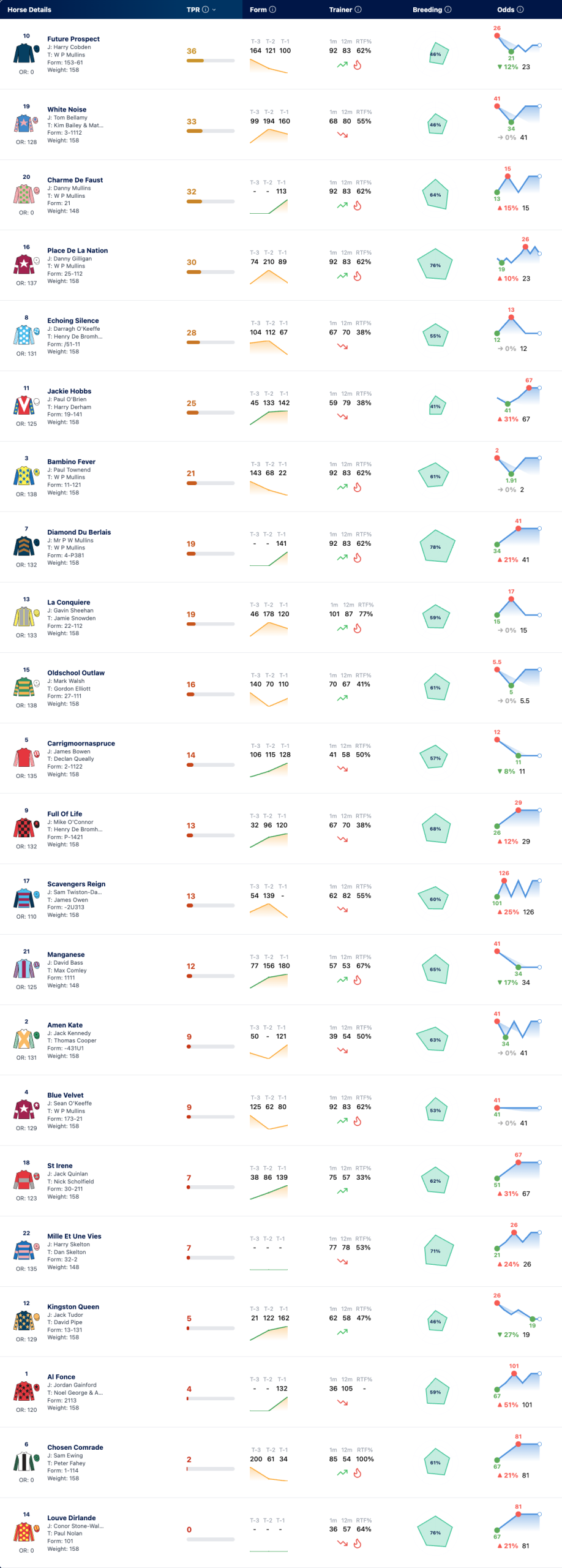
With that framework in place, let us be honest about this race from the outset. Twenty-two mares novice hurdlers going to post on Good ground, after the going was changed overnight from Good To Soft, is one of the most difficult puzzles on the card. The drying ground reshuffles GoingTPR ranks across the field, with the majority of runners now showing no formal rating on Good, and makes this an even more open contest than it was 24 hours ago. Our convergence model, which looks for horses simultaneously ranked in the top three on TPR, going form, course form, and market price, does not fire a qualifier here. The horses with the strongest TPR ratings are priced well outside the value range our backtesting supports, and the market has settled on a short-priced favourite whose underlying speed figures are, frankly, hard to use. Rather than follow a single metric to an uncomfortable conclusion, we are pointing readers towards two mares whose speed figures and trainer credentials tell a genuinely interesting story at big prices. Stakes should reflect the speculative nature of both selections.
The market favourite BAMBINO FEVER demands addressing first, because readers will want to know why we are not siding with a Mullins-Townend Festival winner. She won this race twelve months ago, posting a T-4 of 89 at this course on Good To Soft. That is genuine Cheltenham form. The problem is what has happened since. The trajectory reads 150, 143, 68, 22 across the last four runs, and while her most recent outing at Fairyhouse on Good To Soft was a comfortable victory, the T-1 of 22 is the lowest figure in the top half of this field. The model has her at TPR rank 7 with a GoingTPR of zero on today’s Good ground, meaning she has no formal rating on this surface. Her Cheltenham win came on Good To Soft, not Good. That is not a profile our data supports at odds-on, regardless of the jockey booking. The market is pricing reputation and connections rather than recent performance.
The standout speed figure case in the entire field belongs to MANGANESE. The four-year-old trained by Max Comley has run just three times over hurdles, which is why her TPR sits at only rank 14, as the model has a limited sample to work with. But the actual speed figures she has posted are the best in this field by a clear margin. Her T-1 of 180 came at Doncaster on Soft ground in January, where she “made all, faced challenge 2 out, pushed along approaching last, ridden and kept on well.” Her T-2 of 156 arrived at Catterick on Good to Soft in December, “led before 2 out, went clear when pushed along run-in, easily.” Three runs, three wins, a trajectory of 77 to 156 to 180. Her GoingTPR formally registers as zero on today’s Good ground, as all three wins came on Soft or Good To Soft. The overnight going change removes the statistical edge she held yesterday when the ground was Good To Soft. However, Good To Soft and Good are separated by a single classification, and a mare who has won on Good To Soft at Catterick and dominated on Soft at Doncaster is not suddenly unsuited by a surface that has only marginally dried. The speed figures remain the standout case in this field regardless of the going label. David Bass takes the ride for a trainer whose one-month rating of 57 sits close to the 53 twelve-month baseline, essentially neutral on trainer momentum. The market prices her at 23/1, primarily because of the small sample and her relatively modest official rating of 125. That scepticism is understandable. What is harder to dismiss is a T-1 of 180. No other mare in this field comes close to that figure.
Our companion selection is LA CONQUIERE, and the primary reason is her trainer. Jamie Snowden’s yard is running with a one-month rating of 101 against a twelve-month baseline of 87, the hottest trainer momentum figure among all 22 connections in this race, and not close. His Runs To Form percentage of 77% confirms this is a yard where horses are consistently delivering to expectation. The mare herself brings a GoingTPR of 86 on today’s Good ground, ranking seventh in the field, with her stronger figures posted on softer surfaces. As with MANGANESE, the overnight going change formally downgrades the going metric, though the difference between Good To Soft and Good is marginal in practical terms. Her T-2 of 178 came at Newbury on Soft in November, where she “led run-in, kept on well and went clear final 110 yards,” a substantial figure. Her T-1 of 120 at Ascot on Soft in January looks like a step back, but the form comment explains it: “hung left run-in, kept on.” A steering issue on the run-in, not a fitness concern, and she still finished second. Her DistTPR of 137 confirms she handles today’s trip. At 15/1, the market has some respect without going overboard. For a yard this hot, at a price this big, that feels like an oversight.
We gave serious consideration to PLACE DE LA NATION, the Mullins mare who holds TrackTPR rank 1 in the entire field at 130, the only horse here with meaningful Cheltenham course form. That figure came from a fifth-place finish at last year’s Festival, where she posted a speed figure of 130 despite “not fluent last, no extra run-in” at 125/1. Her GoingTPR registers as zero on today’s Good ground, with all her form built on Good To Soft or softer, and the T-2 of 210 at Fairyhouse on Good To Soft in January was eye-catching. But context matters: that figure came in a canter at 1/20, beating a field that offered essentially no resistance, which makes it hard to calibrate against today’s Grade 2 company. The T-1 of 89 from her most recent outing, beaten by OLDSCHOOL OUTLAW at Fairyhouse on Heavy, is a sharp drop, and the wider trajectory of 89, 210, 74 is too volatile for us to build a confident case. The course form is real and readers backing at the price should know the data supports it, but the inconsistency keeps her off our card.
The remaining market principals can largely be set aside. OLDSCHOOL OUTLAW is the market second-favourite and has won her last three starts, but all three came on Heavy or Soft-to-Heavy ground: Fairyhouse on Heavy in February, Naas on Soft-to-Heavy in December, and Navan on Heavy in November. Today’s Good ground, even drier than the Good To Soft declared yesterday, makes the surface argument against her even stronger. She has zero GoingTPR on Good. CARRIGMOORNASPRUCE sits third in the market with consistent figures of 128, 115, 106 but a GoingTPR of zero on today’s Good ground, and the Declan Queally yard is running cold at 41 against a 58 baseline. The TPR top-rated horse, FUTURE PROSPECT, sits at 19/1 with SP rank 8th, and our data shows that when TPR’s top-rated horse sits fourth or worse in the market, the historical win rate drops below 8%. We are not interested.
The selections are MANGANESE for the speed figure case, and LA CONQUIERE as the trainer momentum play. Both are speculative at a meeting where this race type is notoriously difficult to crack. Treat accordingl
🎯SELECTIONS
MANGANESE
LA CONQUIERE
The full field
Jack Richards Novices Limited Handicap Chase (Grade 2) (The Golden Miller)
2m4f | Novice Handicap Chase | Grade 2 | Good To Soft | 20 runners
Race Analysis
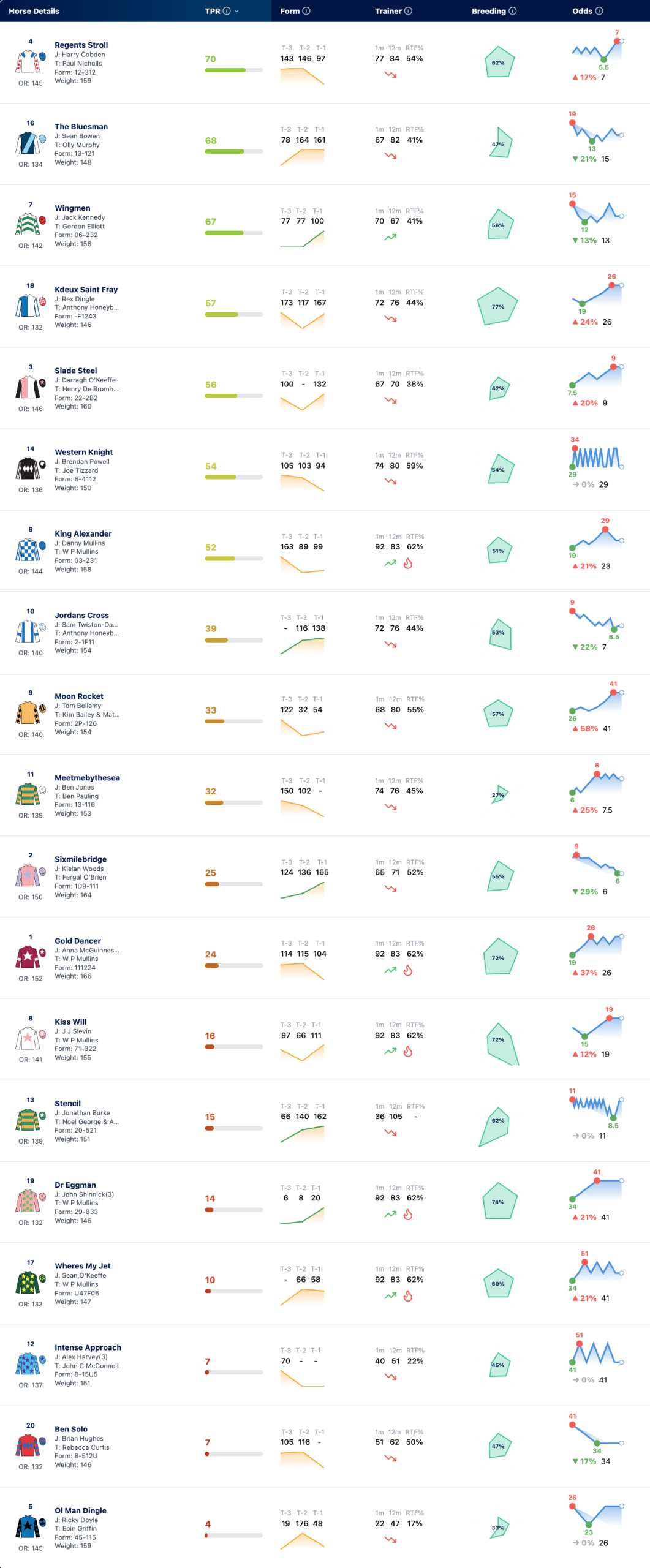
The Golden Miller is one of the festival’s most competitive novice chasing puzzles, a Grade 2 in name but a handicap in structure, which means the convergence model does not fire cleanly here. No Filter E or Filter A qualifier exists in a field of 19, which tells you something important about the nature of this race: it is wide open, the ability spread is compressed, and the winner is unlikely to come from a horse the data overwhelmingly endorses. Three horses fire the looser TPR4_SP filter, including REGENTS STROLL. For handicap chases, the Cheltenham guide inverts the normal hierarchy: lead with the market, confirm with going and course credentials. SP favourites in handicap chases at the Festival have won at 37% and returned +53% ROI across five years, the strongest single predictor in the category. We have applied that approach and arrived at two selections: one market-led, one speed-figure-led.
TPR rank 3 belongs to WINGMEN, but the market veto applies immediately. TPR ranked third with a starting price rank of seventh is a combination that sits outside the convergence zone. GoingTPR of zero on today’s Good ground and a form history of repeated jumping errors make this easy to dismiss. We are not interested.
The best speed figures in the entire field belong to KDEUX SAINT FRAY, and that is where our primary selection sits. The T-1 of 167 came at Kempton on Good To Soft in February, a third-place finish where the comment confirms two jumping errors in the closing stages: “not fluent 9th, not fluent 2 out, lost second approaching last, kept on.” Despite those mistakes, the speed figure tells you this horse was running to a level well above the field. The T-3 of 173 came at Aintree on Soft in December, a second-place run where the comment again mentions a hit at the fourth-last. And the T-4 of 100 came right here at Cheltenham on Soft in November, winning the race: “jumped left throughout, prominent, joined leader 3 out, led before last, ridden and kept on well run-in.” That Cheltenham win came on Soft rather than today’s Good, so the surface is different, but the course credentials and the winning experience at this trip are genuine regardless. The GoingTPR of 102 ranks fifth in the field on today’s Good ground, a significant step down from where it sat when the going was Good To Soft, but the raw speed figures of 167 and 173 in the last three runs are unmatched by anything else in this race. Anthony Honeyball’s yard runs at 72 against a 12-month baseline of 76, neutral. Rex Dingle rides.
The reservation is real and worth naming directly. Multiple form comments reference jumping left, a consistent tendency that becomes more significant at a left-handed course like Cheltenham where it pulls the horse off the racing line on bends. The January return to Cheltenham produced a T-2 of 117 where the note reads “bit short of room when outpaced on turn after 3 out, rallied approaching last, stayed on and went fourth run-in,” not a disaster, but also not the dominant performance those raw speed figures might suggest. We include this selection on the basis that the speed figures are the strongest in the field, the Cheltenham winning form is recent and genuine, and the price of 19/1 compensates adequately for the jumping concern and the going shift.
Our second selection follows the guide’s primary handicap chase approach: the market leader confirmed by going and course form. REGENTS STROLL is near the top of the market, now sits at TPR rank 1 in the field, and the TPR4_SP filter fires. GoingTPR of 104 ranks fourth on today’s Good ground, TrackTPR of 97 ranks second, and there is genuine quality in the recent form. The T-2 of 146 at Wincanton on Soft in December is a strong figure: “made all, eased when clear final 110yds.” The T-3 of 143 at Newbury on Good To Soft shows the ability is not a one-off. There is a pattern of keenness across the form comments that needs acknowledging honestly. At Newbury: “took keen hold, pulled hard and went further clear 5th, much reduced lead 5 out, headed 3 out, outpaced from 2 out.” At Cheltenham on New Year’s Day, the T-1 of 97 came with: “headed approaching last, no extra towards finish.” That day was on Good ground, the same surface as today, and the stamina gave out. That is a direct concern. But the guide’s data is clear: SP favourites in handicap chases at Cheltenham win more than one in three. The Paul Nicholls yard runs at 77 against an 84 baseline, slightly below peak. Harry Cobden takes the ride. We side with the framework rather than against it, while flagging the keenness as the principal risk.
SIXMILEBRIDGE has moved to market favourite overnight and JORDANS CROSS has shortened significantly, both worth a mention for readers looking beyond our two. SIXMILEBRIDGE has won three consecutive chases on soft or good-to-soft ground, the most important a course win here in December: “led, headed 8th, led again 11th, went clear before last, easily.” The T-1 of 165 at Sandown on Soft in January continued the upward trajectory. No convergence filter fires (TPR rank 11, GoingTPR zero on today’s Good ground), and all three wins came on softer surfaces than today, which is a legitimate question mark given the drying ground. A strong narrative case, but one that sits outside our validated framework. JORDANS CROSS won at Cheltenham on Soft just seven weeks ago (T-1 of 138, “kept on well and led final stride”) with three wins from four chase starts, and his GoingTPR of 123 ranks second in the field on today’s Good ground. The one blot was a fall at the last when challenging at this course in November, so the ability and course form are genuine.
The remainder can largely be set aside. SLADE STEEL’s GoingTPR of zero on today’s Good ground reflects a horse who has done all winning on genuinely testing ground, and Good is too quick. The De Bromhead yard runs below baseline. MEETMEBYTHESEA was tailed off at Newbury last time and the T-1 is 0. STENCIL has T-1 and T-2 figures of 162 and 140 that look spectacular in isolation, both chase wins on Soft at Chepstow and Ascot respectively. But the GoingTPR of zero on today’s ground and back-to-back Cheltenham runs where the jockey reported the horse “ran too free in the early stages” tell a different story. The Noel George yard is running at 36 against a 105 twelve-month baseline, the steepest cold-yard drop in the entire field. THE BLUESMAN now holds GoingTPR rank 1 in the field at 140 on Good ground with the best recent speed figures among the unselected (T-1 161 at Haydock Soft, T-2 164 at Leicester Good To Soft) but the Olly Murphy yard runs at 67 against an 82 baseline, 15 points below, and that is too big a downgrade to ignore in a race this competitive.
Two selections, two different data stories. KDEUX SAINT FRAY brings the best speed figures in the field and a genuine Cheltenham winning run to underpin them, at a price that accounts for both the jumping question and the going shift. REGENTS STROLL is the market-led pick the guide’s handicap chase framework supports, now TPR rank 1, with course form to confirm the market’s opinion, though the keenness pattern on today’s exact ground is a genuine concern readers should factor into their staking.
🎯SELECTIONS
REGENTS STROLL
KDEUX SAINT FRAY
The full field
Close Brothers Mares Hurdle (The David Nicholson) (Grade 1)
2m4f | Grade 1 Mares Hurdle | Good To Soft | 7 runners
Race Analysis
Seven runners for one of the most prestigious mares contests in the National Hunt calendar, and the convergence model produces a genuinely interesting picture, one that requires careful reading rather than a simple filter application. Two horses fire our most selective signal, Filter E, which requires a horse to rank in the top three on TPR, GoingTPR, TrackTPR and starting price simultaneously. Both are worth naming. But our selection sits on a different and equally compelling case, and the breeding data elevates it further.
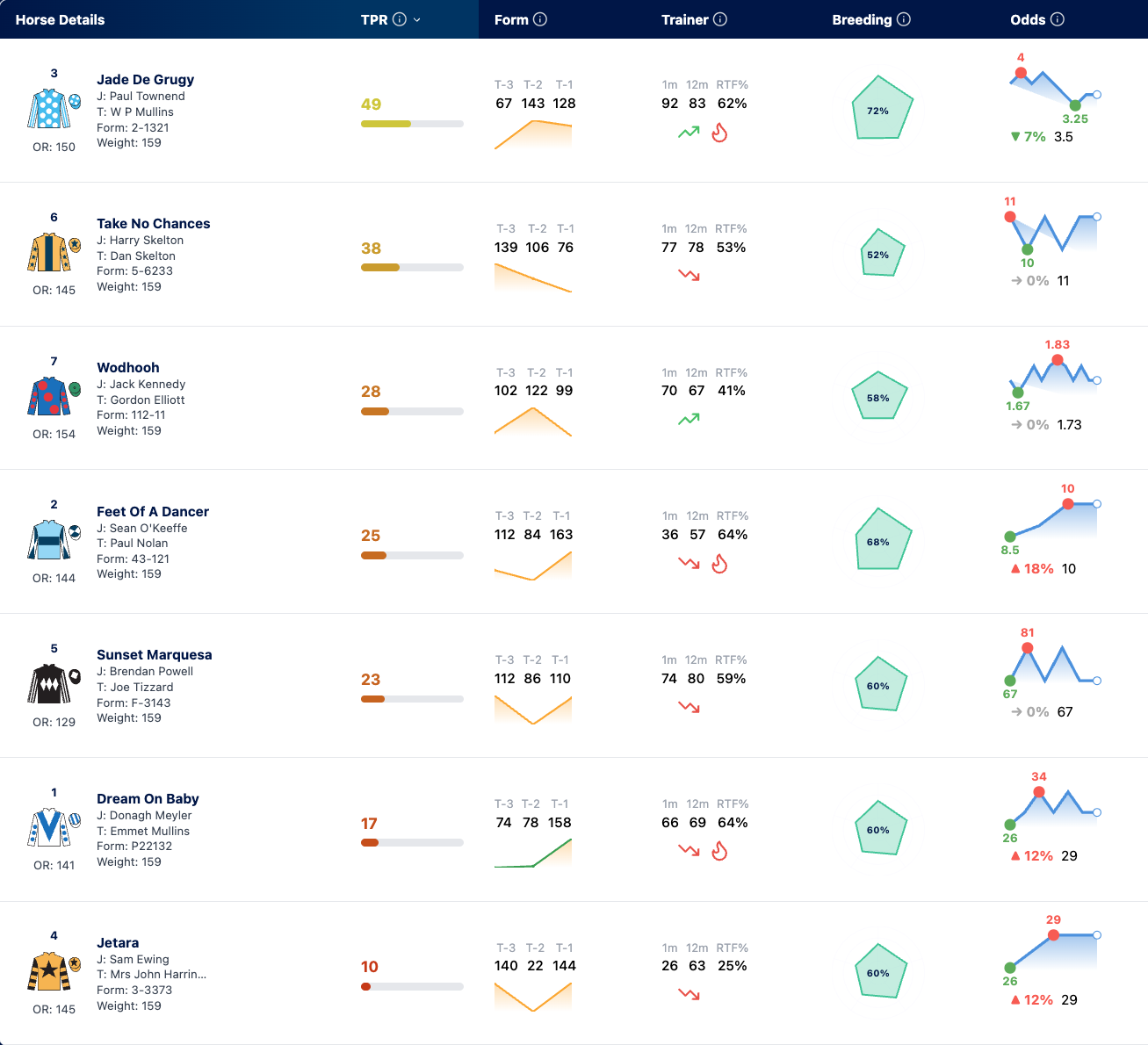
The current market leader WODHOOH fires Filter E. GoingTPR of 153 and TrackTPR of 126 are rank 1 in the field on both metrics, and no other runner in this race has better proven credentials for this course and ground combination. The overnight going change to Good has actually strengthened WODHOOH’s going figure, which rose from 138 to 153 on the faster surface. The T-4 of 150 came here at Cheltenham on Good To Soft in March 2025: “midfield, headway 2 out, pushed along home turn, led before last, ridden and ran on well run-in.” That was at this Festival, twelve months ago, and WODHOOH won it. A T-5 of 101 also came at Cheltenham on Good To Soft in December 2024, another win. The market has priced the defending champion at 1.67 and it is not hard to see why. TAKE NO CHANCES also fires Filter E and carries genuine each-way claims. Where does that leave our selection? Read on.
The case for JADE DE GRUGY rests on four pillars, and when you lay them out together the picture becomes clear. The first is TPR. JADE DE GRUGY holds rank 1 in this field on our Total Performance Rating, the machine learning model’s overall assessment of likely performance today. A TPR of 49 against WODHOOH’s 28 is a significant gap, and it is worth noting that the model itself ranks the defending champion only third in this field. The machine learning has weighed the recent trajectory and drawn its own conclusion. The second pillar is the trainer and jockey combination. Willie Mullins’ yard is the hottest at this entire festival, a 1-month average of 92 against a 12-month baseline of 83, with an RTF of 62%. That momentum has been validated across the first two days, with Mullins winners coming from positions the primary filters did not always predict. Paul Townend takes the ride. Townend’s five-year festival strike rate of 25.8% is the highest of any senior jockey at this meeting, and his partnership with Mullins at Cheltenham is the most formidable in the sport. When the model’s top-rated horse in a small-field Grade 1 comes from the hottest yard at the festival with Townend booked, the signal is as strong as anything our framework produces.
The third pillar is DistTPR. JADE DE GRUGY’s figure for today’s distance of 2m4f is 180, rank 1 among all seven runners and 63 points clear of the next horse. The T-4 that underpins much of this metric came at Punchestown on Good To Soft in May 2025: “pressed leader after 3rd, led 7th, shaken up and went clear approaching last, ridden briefly run-in, comfortably.” That is a performance of genuine class over today’s trip. The T-2 of 143 came at Limerick on Soft-Heavy in December, “led, disputed lead before 2 out, ridden after 2 out, no extra run-in,” a solid effort in testing conditions against strong opposition. The T-1 of 128 at Thurles on Good To Soft in January is a canter at 1/6 and the figure reflects the quality of opposition rather than any limitation in the horse. Cheltenham form exists from last year’s renewal, second, “led, headed approaching last, stayed on but no match for winner,” with a figure of 72 that looks modest in isolation but came in a race won by the horse we are now trying to beat. The one concern is the T-3 of 67 at Cork on Good To Soft in November, where she “was not fluent 3 out, soon headed, no extra from 2 out” at 1/4. That looks like a below-par run at a time when the mare was finding her feet over hurdles, and the subsequent figures of 143 and 128 suggest she has left it behind. A going note: JADE DE GRUGY’s GoingTPR formally registers as zero on today’s Good ground, with all her form posted on Good To Soft or softer. As with several races on today’s card, the overnight surface change means many horses lack formal going credentials. The difference between Good and Good To Soft is a single classification, and a mare with proven form on Good To Soft is not automatically disadvantaged by a marginal drying.
The fourth pillar is the breeding data, and this is where the numbers genuinely stand out. The sire is Doctor Dino, and the SireCourseTPR, which measures how Doctor Dino’s progeny perform specifically at Cheltenham, is 88. That is the highest course-specific sire figure among all seven runners in this race by a considerable margin, nearly 50% higher than WODHOOH’s Le Havre at 60. SireGoingTPR for Doctor Dino’s progeny on today’s Good ground is 79, SireDistTPR at today’s distance is 73, and SireTypeTPR for hurdle races is 74, all strong, well-rounded figures. The breeding metrics tell a consistent story of a sire whose offspring are built for precisely these conditions. For a horse whose personal Cheltenham form amounts to a single run one season ago, the sire’s Cheltenham record provides meaningful supporting evidence that the track should suit.
The principal danger is clearly WODHOOH, and that cannot be said plainly enough. The Filter E qualification, the defending champion status, the two Cheltenham wins in the form book, and a GoingTPR of 153 that is the strongest in the field on today’s Good ground are not things to wave away. The counter-argument rests on the trajectory: T-1 of 99 at Leopardstown in December, T-2 of 122 at Ascot in November, both wins, but figures that sit well below the 150 posted in this race twelve months ago. The Leopardstown win came despite a bandage coming loose at the last, which excuses some of the modest figure, but the downward trend across recent outings is real. Gordon Elliott’s yard runs at 70 against a 12-month baseline of 67, marginally warm. Jack Kennedy rides. The concern is not that WODHOOH cannot win, but that the price of 1.67 demands a level of certainty the trajectory does not fully support.
TAKE NO CHANCES is the value Filter E qualifier, with GoingTPR of 122 (rank 2) and TrackTPR of 87 (rank 3) providing genuine credentials. But the form comments reveal a consistent pattern of running out of gas late. The T-1 of 76 from Windsor on Soft: “outpaced 2 out, rallied last, went third final strides.” The T-2 of 106 at Newbury on Soft: “in rear, detached 3 out, headway after 2 out, kept on and went third.” The T-5 of 89 at Sandown on Good: “outpaced before last, weakened run-in.” In a seven-runner Grade 1 where the pace will be genuine from the start, a horse that gets outpaced two out in ordinary company is at real risk of being found wanting. The Dan Skelton yard is running at 77 against a 78 baseline, marginally below peak. Place interest only. FEET OF A DANCER posted a striking T-1 of 163 at Doncaster on Soft in January, “ridden to lead run-in, ran on well,” and the TrackTPR of 121 ranks second in the field from a fourth-place finish at last year’s Festival. Her GoingTPR of 112 ranks third on today’s Good ground, a meaningful improvement from where she sat on yesterday’s going. The data would be interesting if the Paul Nolan yard were not running at 36 against a 57 baseline, a 21-point drop that is the largest cold-yard signal in this field. At that level of decline, the risk outweighs the speed figure.
Our selection is JADE DE GRUGY. TPR rank 1 by a clear margin, DistTPR rank 1, Paul Townend in the saddle for the hottest yard at the entire festival, and a Doctor Dino sire profile that is built specifically for Cheltenham. The GoingTPR formally reads zero on today’s Good ground, and we are transparent about that, but the TPR model already accounts for surface suitability in its headline rating, and at 49 it rates JADE DE GRUGY nearly twice as highly as anything else in this field. The breeding tells you the course suits, the TPR tells you the model rates this horse most highly, and the trainer-jockey combination tells you the Mullins operation believes this is the one they want running.
🎯SELECTION
JADE DE GRUGY
The full field
Paddy Power Stayers Hurdle (Grade 1)
3m | Grade 1 | Good To Soft | 11 runners
Race Analysis
The Stayers Hurdle is the race on this card where the convergence model produces the most complex picture of the day, and we are going to be completely transparent about why. The overnight going change to Good has reshuffled the entire GoingTPR picture, with several leading contenders, including our selection, now registering zero formal going form on today’s surface. No Filter E fires. The Filter A qualifier from yesterday no longer qualifies on the revised going. And the market is pricing a horse with an unproven stamina profile as joint-second favourite. We will walk through all of it.
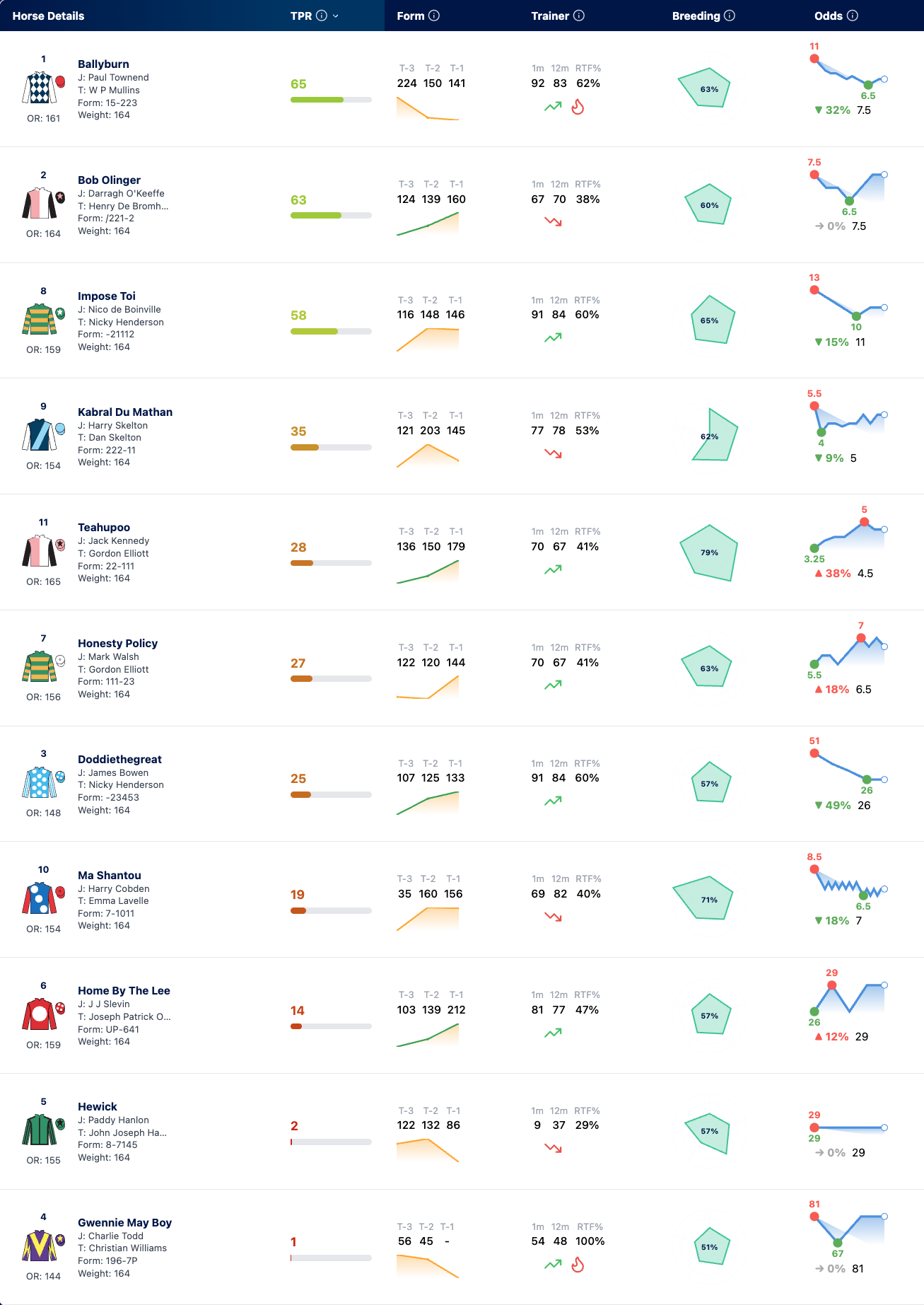
BALLYBURN holds TPR rank 1 in the field at 65, the highest figure in the race by some margin, and the Mullins-Townend combination has been the story of this festival. Mullins’ yard is the hottest at the meeting at 92 against an 83 baseline. The T-5 of 169 from Leopardstown on Good To Soft in February 2025, “took keen hold, pressed leaders, went second 3rd, led 2 out, ridden and went clear final 110yds,” shows a horse with genuine class. All of this argues for BALLYBURN. Here is what argues against. The DistTPR is zero, meaning no proven rating at today’s 3m trip. The form comments are more damaging than the headline figures suggest. At Leopardstown in December, the T-1 of 141 came with: “took keen hold, outpaced and no chance with winner approaching last, lost second and weakened from last.” Not just keen, but weakened. At Fairyhouse in November: “took keen hold, dropped to rear before 4 out.” Last year’s festival entry in a chasing context at this track produced a T-4 of 112: “pulled hard, bad mistake at 7th fence, jockey lost iron briefly, thereafter never travelled and jumped with a lack of fluency.” Four of the last five runs contain “took keen hold” or “pulled hard.” Today BALLYBURN wears a hood for the first time, clearly an attempt to address the keenness. Whether headgear solves the problem in a Grade 1 over 3m at Cheltenham is a question the data cannot answer. The GoingTPR of zero on today’s Good ground and the TrackTPR of 105 ranking 8th in this field add further caution. Readers will note the Mullins/Townend pattern has been winning from outside the primary filter zones on both Day 1 and Day 2. We respect the pattern, but patterns have limits, and backing it into a horse whose last five form comments contain “took keen hold” four times, whose DistTPR is zero at 3m, and who weakened from the last at Leopardstown in December is asking the pattern to overcome a form profile that actively argues against the trip.
Our selection is TEAHUPOO, the market leader at 4/1. We should be transparent: the overnight going change means no convergence filter formally fires here. TEAHUPOO’s GoingTPR registers as zero on today’s Good ground, with all recent form posted on Good To Soft, and the TPR rank has shifted to fifth after the overnight recalculation. Those are facts we cannot gloss over. But the case rests on fundamentals that have not changed. The T-1 of 179 posted at Leopardstown on Good To Soft in December is comfortably the best recent performance number in this entire field: “in touch with leaders, headway 3 out, led just after 2 out, pushed along and went clear approaching last, kept on well, comfortably.” That is a performance of authority, not flattery. The T-2 of 150 came at Fairyhouse on Good To Soft in November, “pressed leader before 2 out, ridden to lead before last, just did enough.” And the T-5 of 175 at Fairyhouse on Good To Soft in December 2024 shows the high-end ability is not new. The trajectory across five runs reads 175, 136, 136, 150, 179, a horse that has run to a consistent level throughout the season and peaked at exactly the right time. The DistTPR of 149 is rank 1 in the field, and no horse in this race has better proven credentials at today’s 3m trip. The TrackTPR of 124 reflects genuine Cheltenham form, including a second in this exact race twelve months ago: “led before last, headed just after last, kept on well but no match for winner.” TEAHUPOO knows the race, knows the track, knows the trip, and arrives in the best form of its life. The going formally reads zero but, as with several races today, the surface has only marginally dried from the Good To Soft on which all this form was produced. Gordon Elliott’s yard runs at 70 against a 12-month baseline of 67, and we acknowledge that Elliott runners have underperformed across the first two days of this festival. We side with the form profile, the staying credentials, and the market’s judgement over the yard signal in this instance.
The principal concern about KABRAL DU MATHAN is worth naming plainly, because the going change has strengthened this horse’s formal credentials. GoingTPR of 145 is now rank 1 in the field on today’s Good ground. TrackTPR of 145 is rank 2. Those are the best combined going-and-course numbers in the race. But the DistTPR is still zero. Every one of the last five runs has been at 2m4f or shorter: Cheltenham 2m4f, Haydock 2m3f, Ayr 2m, Windsor 2m, Ascot 2m. The longest trip in the form book is 2m4f at Haydock in November, where the T-2 of 203 came, an impressive performance but at a trip nearly half a mile shorter than today. The market is pricing this horse as though the stamina question is already answered. It is not. The T-1 of 145 at Cheltenham on Good in January, “smooth headway to lead just after last, shaken up and went clear, impressive,” was over 2m4f. Stepping up to 3m at Cheltenham in a Grade 1 is a very different proposition, even with the strongest going credentials in the field.
IMPOSE TOI has risen to TPR rank 3 overnight and demands more attention than it received 24 hours ago. GoingTPR of 92 ranks fourth on today’s Good ground, TrackTPR of 120, DistTPR of 146. Nicky Henderson’s yard is running at 91 against an 84 baseline, the hottest trainer signal in this field alongside Mullins. The T-2 of 148 at Ascot on Good To Soft in December, “led last, ridden out,” was a win of substance. The T-4 of 142 at Aintree on Good To Soft, “held up in rear, headway going easily over 2f out, readily,” shows a horse that can quicken at the end of a staying trip. The concern is the T-1: 146 at Cheltenham on Soft in January, “went second before last, weakened final 110yds,” beaten by MA SHANTOU in a race at today’s trip. A horse that weakened over 3m at Cheltenham seven weeks ago carries a question into a Grade 1 over the same course and distance. At 9/1 the price partially compensates, and readers who want each-way cover beyond our primary selection could do worse.
BOB OLINGER holds TPR rank 2 in the field at 63 and TrackTPR of 161, the highest Cheltenham figure of any runner. He won this race in March 2025. Those facts command respect. They cannot overcome a hard market veto: TPR rank 2 at SP rank 6 has the market looking elsewhere. The De Bromhead yard registers 67 against a 12-month baseline of 70, slightly below par. At 11 years old, on a marginally cold yard, the market is right to be cautious.
MA SHANTOU is the horse most improved by the going change. GoingTPR has jumped to 127, rank 2 in the field on today’s Good ground, alongside TrackTPR of 131 rank 3 and DistTPR of 131. Two impressive Cheltenham wins in recent months still stand: T-1 of 156 on Soft in January (“led on turn before last, ridden and ran on well, won going away, impressive”) and T-2 of 160 on Good on New Year’s Day (“led before last, kept on well, pushed out”). The going case is now significantly stronger than it was yesterday. But Emma Lavelle’s yard registers 69 against a 12-month baseline of 82, a 13-point gap that puts this firmly in cold-yard territory, and the unexplained T-3 of 35 at Haydock in November, “trainer could offer no explanation for the poor form shown,” is too recent to dismiss. At 6/1 the price is shorter than yesterday and does not offer enough compensation for those two concerns combined. HONESTY POLICY at 7/1 now holds GoingTPR of 122 rank 3 on today’s Good ground, but a TrackTPR of zero and no Cheltenham form make this a market-perception play rather than a data case.
The selection is TEAHUPOO. The T-1 of 179 is the best recent form figure in this race, the DistTPR of 149 confirms it stays 3m better than any runner in the field, and it ran second in this race last year. No convergence filter formally fires on today’s revised going, and we are transparent about that. But in a Grade 1 where BALLYBURN’s keenness is a confirmed problem over shorter trips let alone 3m, where KABRAL DU MATHAN has never been asked to stay this far, and where the going change has left the majority of the field without formal going credentials, the weight of evidence still points to the most battle-hardened stayer in the field arriving in career-best form. The market agrees.
🎯SELECTION
TEAHUPOO
The full field
Ryanair Chase (The Festival Trophy) (Grade 1)
2m4f | Grade 1 Chase | Good To Soft | 9 runners
Race Analysis
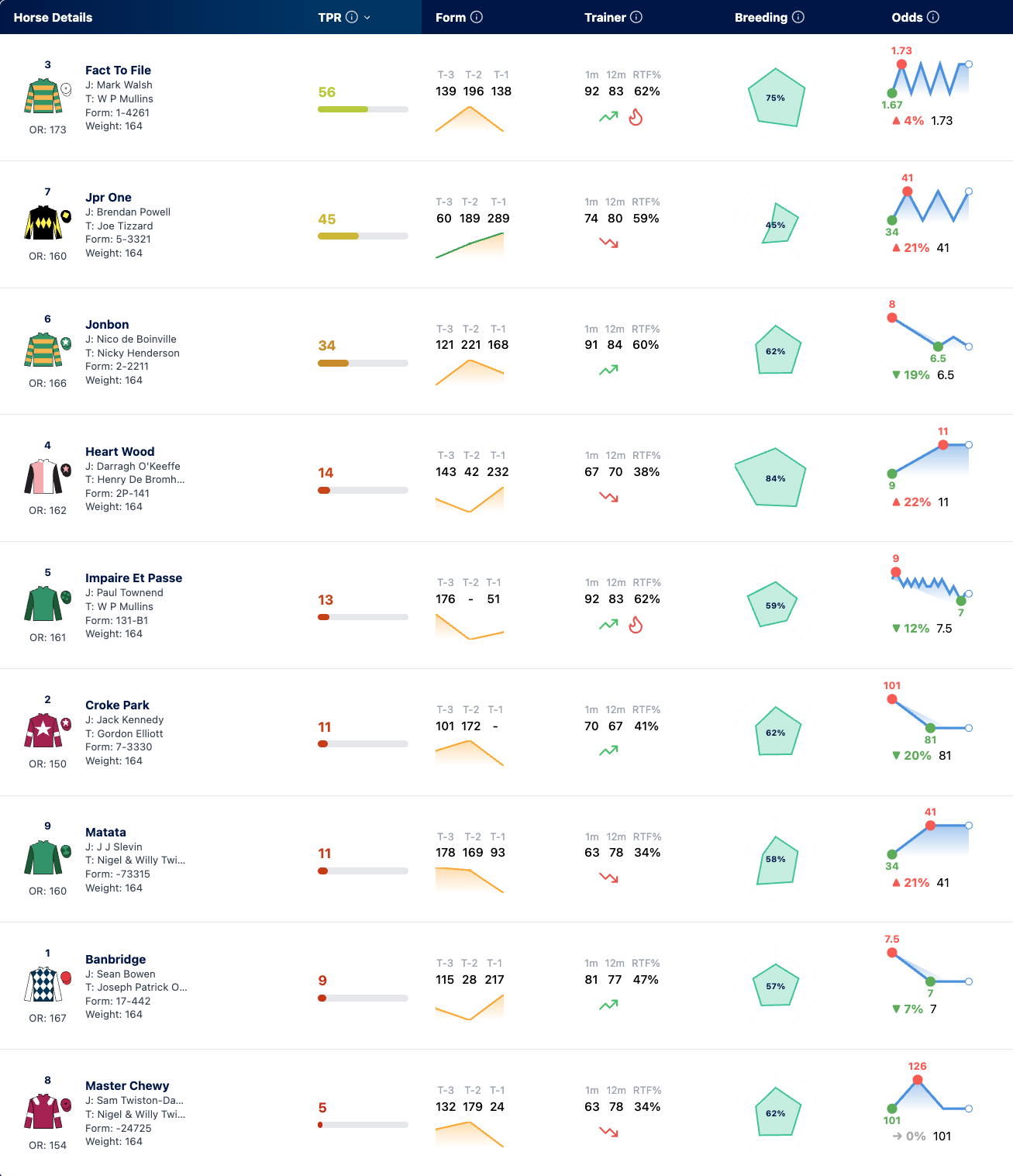
The Ryanair Chase is the race type where the EquiAnalytix convergence model has historically performed best across the entire Cheltenham dataset. Grade 1 chases have returned a 61.1% strike rate and +180% ROI for Filter E qualifiers over five festivals. Nine runners, Good ground, and our most selective filter fires on a single horse. This is the clearest signal of the day.
FACT TO FILE fires Filter E: TPR rank 1, GoingTPR rank 1 (non-zero at 196), TrackTPR rank 2, and the market’s SP rank 1. All four convergence criteria are met simultaneously, and the overnight going change to Good has actually strengthened the case rather than weakened it. The GoingTPR of 196 is the highest in the field by 21 points, built primarily from the Kempton Boxing Day run where the speed figure was the strongest FACT TO FILE has ever posted. The guide is clear on what Filter E means for a Grade 1 chase: maximum confidence. The defending champion ran in this race twelve months ago and the T-5 of 173 that came from it tells its own story: “travelled strongly, in touch with leaders, went second 12th, led going easily after 3 out, went clear before 2 out, not fluent last, shaken up run-in, impressive.” That is not a horse scraping home on the line. That is a horse in complete control of a Grade 1 field.
The T-2 of 196 from Kempton on Good on Boxing Day needs addressing directly, because the bare position of 6th with the comment “took keen hold, not fluent 5 out, no extra from 3 out” looks jarring against the headline speed figure. The 196 tells you the horse was travelling at a very high level before the stamina gave out in the closing stages on a flat, sharp track. Kempton’s configuration, right-handed and without any significant undulation, is about as different from Cheltenham as any British track. The T-1 of 138 at Leopardstown on Soft in February, where the comment notes “pricked ears towards finish, readily,” confirms the horse was back in form and not extended. The T-4 of 45 at Punchestown in April looks alarming in isolation, but the vet reported “an abrasion on his inside left fore fetlock,” a clear physical excuse. Willie Mullins’ yard is the hottest at this entire festival, a 1-month average of 92 against a 12-month baseline of 83, RTF of 62%, and the OR of 173 is the highest in the field by seven pounds.
The one honest complication is the jockey booking. Paul Townend, the champion jockey, takes the ride on IMPAIRE ET PASSE rather than FACT TO FILE, with Mark Walsh deputising. Walsh is no passenger, with a five-year festival strike rate of 16.1% that places him firmly in the top tier, but the Townend signal on the second string is worth naming even if the model strongly favours the horse Walsh is on. IMPAIRE ET PASSE’s TrackTPR of 178 is rank 1 in the field, and the T-3 of 176 came at Aintree on Good To Soft in April 2025: “midfield on outer, headway 4 out, not fluent 2 out, led before last where jumped right, ridden out.” But TPR rank 5, a T-1 of just 51 from Gowran Park on Heavy (a win, but the figure reflects the quality of opposition), and a T-2 of 0 from a brought-down incident at Punchestown leave too many question marks to follow the jockey switch over the model’s top-rated qualifier.
JONBON carries Filter A credentials that have strengthened overnight. GoingTPR of 175 now ranks second in the field on today’s Good ground, and the Henderson yard is running hot at 91 vs 84 baseline, RTF 60%. The T-1 of 168 at Ascot on Good To Soft in February, “rallied after 2 out, not fluent but led last, kept on well towards finish, gamely,” and a T-2 of 221 at Ascot on Soft in January show a horse running with real tenacity. The market has shortened to 5.5, reflecting genuine respect. The case against is a single word: DistTPR = 0. All five of JONBON’s recent runs have been at 2m1f or shorter: 2m1f, 2m1f, 2m, 2m, 2m. This is a horse whose entire career has been built around two miles, stepping up to 2m4f for the first time at the Festival. That is a genuine unknown, and when the alternative is a defending Grade 1 champion firing Filter E with GoingTPR rank 1 on the same ground and course, the trip question is sufficient reason to hold firm.
BANBRIDGE sits at SP rank 3 despite TPR rank 8, a significant market-data divergence. The T-1 of 217 at Kempton on Good on Boxing Day, “kept on well but headed final strides,” is a strong recent effort, and the GoingTPR of 162 ranks third in the field on today’s Good ground. The Joseph O’Brien yard is running at 81 against a 77 baseline, which is hot. But the wider picture is one of extreme volatility: 217, 28, 115, 104, 179 across the last five runs. The T-2 of 28 at Cork on Soft, “weakened before 2 out,” followed the very next start after the 217, and the two Cheltenham and Punchestown runs in the form book both contain “weakened” in the comments. A horse that swings between 217 and 28 is not one the data can endorse with confidence. HEART WOOD showed a striking T-1 of 232 at Tramore on Soft, “led clearly 4 out, kept on well, comfortably,” and the T-5 of 146 came in this exact race twelve months ago, finishing second to FACT TO FILE. There is genuine Ryanair course form here. But the GoingTPR is now zero on today’s Good ground, and the T-2 of 42 at Punchestown on Soft-Heavy, “weakening when lost third approaching last,” is a sharp reversal. De Bromhead’s yard runs at 67 vs 70, marginally below baseline. Tramore’s level of opposition bears no comparison to a Grade 1 Festival field.
The selection is FACT TO FILE. The model’s primary filter fires cleanly on the defending champion in the race type where it historically performs best, and the overnight going change has strengthened the case: GoingTPR rank 1 on today’s Good ground, the highest in the field. The course form, the trainer momentum, and the OR all point the same direction. Maximum confidence.
🎯SELECTION
FACT TO FILE
The full field
Pertemps Network Final Handicap Hurdle (Premier Handicap)
3m | Premier Handicap Hurdle | Good To Soft | 24 runners
Race Analysis
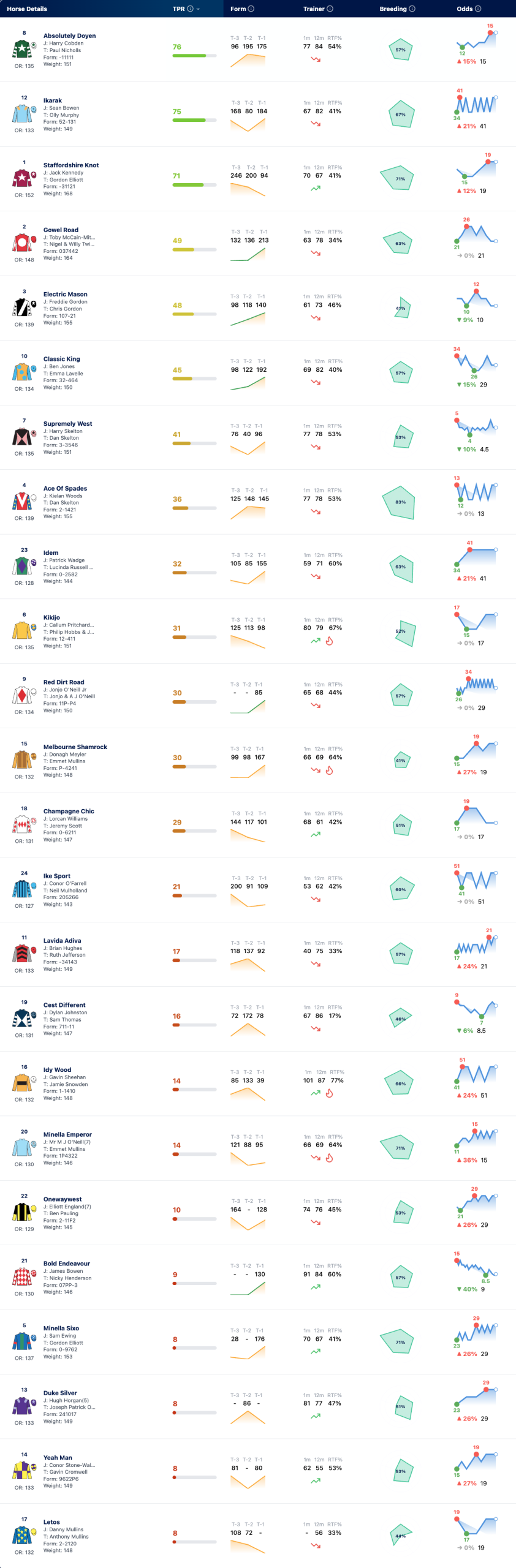
The Pertemps Final is the festival’s defining test of analytical discipline. Twenty-four runners, a compressed handicap, hurdle form’s inherent volatility, and a market that has settled on a favourite whose last three runs tell a story of consistent decline. Our convergence filters do not fire cleanly here, no Filter E, no Filter A, and the guide is explicit: handicap hurdles are the hardest race type at the festival, producing a 5.6% strike rate for SP favourites and negative ROI for every systematic filter tested across five years. We are being transparent with you: this is minimum-stakes territory, and we are naming two horses whose credentials are the least objectionable in a race designed to humble those who overcomplicate it.
The most important call to make in this race is what NOT to back. SUPREMELY WEST is the 4/1 favourite and, after the overnight going change to Good, now holds the highest GoingTPR in the field at 144 rank 1. We acknowledge that directly, because readers looking at the data dashboard will see it. But GoingTPR measures average performance on a surface, not current form, and the last three runs tell a story that GoingTPR alone cannot redeem. At Aintree in December: “took keen hold, dropped to rear before 2 out, weakened over 1f out.” At Sandown in December: “towards rear, weakened 2 out.” And at Cheltenham in November, after a stewards inquiry: “trainer’s rep had no explanation for the poor form shown.” Three consecutive deteriorations, no diagnosis. The trajectory reads 139, 124, 76, 40, 96, a horse whose form is in accelerating decline regardless of surface. SP favourites in Festival handicap hurdles win 5.6% of the time across five years of data. This one’s recent profile sits well below average for even that category. Good going credentials do not override a form collapse this severe.
The TPR hierarchy is led by STAFFORDSHIRE KNOT with Jack Kennedy booked for Gordon Elliott. The headline figures, T-3 of 246 at Clonmel on Heavy in December (“went clear before 2 out, readily”) and T-4 of 256 at Punchestown on Soft-Heavy in November (“ridden to lead before last, kept on well, comfortably”), are genuinely impressive. But all four recent runs came on Heavy or Soft-to-Heavy ground: Navan Heavy, Gowran Park Heavy, Clonmel Heavy, Punchestown Soft-Heavy. Today is Good, and the GoingTPR of zero tells the story: this horse has no form whatsoever on today’s surface. The T-1 of 94 at Navan on Heavy in February confirms the figure drops sharply even on the horse’s preferred surface when the competition improves. Without genuinely testing ground, the headline TPR rank is misleading.
ACE OF SPADES is our primary selection at each-way prices. Trained by Dan Skelton and ridden by Kielan Woods, the case rests on Cheltenham form and consistency rather than a single metric. The T-2 of 148 came at this course on Good on New Year’s Day, where “in rear, headway before 2 out, went second last, kept on” confirms form at this trip on today’s exact surface just ten weeks ago. That is the most directly relevant piece of form in this entire field: a run at this course, on this going, at this distance, with a strong figure. The T-1 of 145 came at Huntingdon on Soft in January, “led just after last, soon ridden, kept on well.” The T-4 of 140 at Aintree on Good To Soft: “pressed leaders, led narrowly last, kept on.” A five-run sequence of 150, 140, 125, 148, 145 is a model of consistency, with no jarring drops requiring explanation, no excuses to offer or explain away. The GoingTPR of 101 ranks eighth on today’s Good ground, a drop from the rank 1 position it held when the going was Good To Soft, but the Cheltenham course form on today’s exact surface is more meaningful than a statistical average. Skelton’s yard is operating at 77 against a 12-month baseline of 78, RTF 53%, essentially neutral. Each-way at 11/1 in a 24-runner field paying six places reflects the genuine uncertainty, but the place part of the bet carries real probability.
ABSOLUTELY DOYEN is our secondary each-way interest, and the overnight data refresh has significantly strengthened this horse’s case. Trained by Paul Nicholls and ridden by Harry Cobden, ABSOLUTELY DOYEN now sits at TPR rank 1 in the entire field at 76, the highest figure by some margin. The form sequence is the strongest in the field: five consecutive wins. The T-2 of 195 at Wincanton on Good To Soft in December: “led home turn, went clear when shaken up after 2 out, eased towards finish.” The T-1 of 175 at Musselburgh on Good To Soft in January: “led narrowly before last, went clear inside final 110yds, readily.” These are not close finishes dressed up by a favourable comment, these are wins where the horse had energy in reserve. The honest limitation is a TrackTPR of zero: this horse has never raced at Cheltenham. Nicholls’ yard is operating at 77 against a 12-month baseline of 84, RTF 54%, below peak. Include each-way at minimum stakes on the strength of the TPR rank, the form sequence, and the going match, acknowledging the unknown of the course debut.
Readers will notice C’EST DIFFERENT sitting at SP rank 2 in the market, and the data says to ignore it. TPR rank 16, TrackTPR zero, DistTPR zero, GoingTPR zero on today’s Good ground, and the Sam Thomas yard is running at 67 against an 86 baseline with an RTF of 17%, the coldest yard signal on the card by a distance. The T-2 of 172 at Market Rasen on Good To Soft stands out but the T-1 of 78, a win at Newbury on Good To Soft, tells you the level is inconsistent. BOLD ENDEAVOUR at 8.5/1 benefits from Henderson’s hot yard (91 vs 84) and a TrackTPR of 133 rank 2, but three of the last four runs returned figures of 0 (two pulled-ups and a weakened), and a single T-1 of 130 at Huntingdon after over a year off the track is not enough to build a case in a 24-runner Festival handicap.
The two selections are ACE OF SPADES and ABSOLUTELY DOYEN. Both each-way, both minimum stakes. This is not a race the convergence model identifies as a high-conviction opportunity. It is a race where we have identified the two horses with the most credible claims on today’s specific conditions, at prices that make the each-way element worth including. If neither wins, the place part of both bets is well supported by the data behind them.
🎯SELECTION
ACE OF SPADES
ABSOLUTELY DOYEN
The full field
Rosconn Group Fulke Walwyn Kim Muir Challenge Cup (Amateur Jockeys Handicap Chase)
3m2f | Class 2 Handicap Chase | Good To Soft | 24 runners
Race Analysis
The Kim Muir is the festival’s amateur riders’ showcase, 24 runners over 3m2f of Cheltenham’s most demanding terrain, and a race where the handicapper’s art and the market’s judgement carry more weight than the convergence model alone. For handicap chases, the guide inverts the normal hierarchy: lead with the market, confirm with going and course credentials. SP favourites in handicap chases at Cheltenham have won 37% of the time at +53% ROI across five festivals. Today, the market points clearly at one horse, though the overnight going change to Good has reshaped the going credentials across the field.
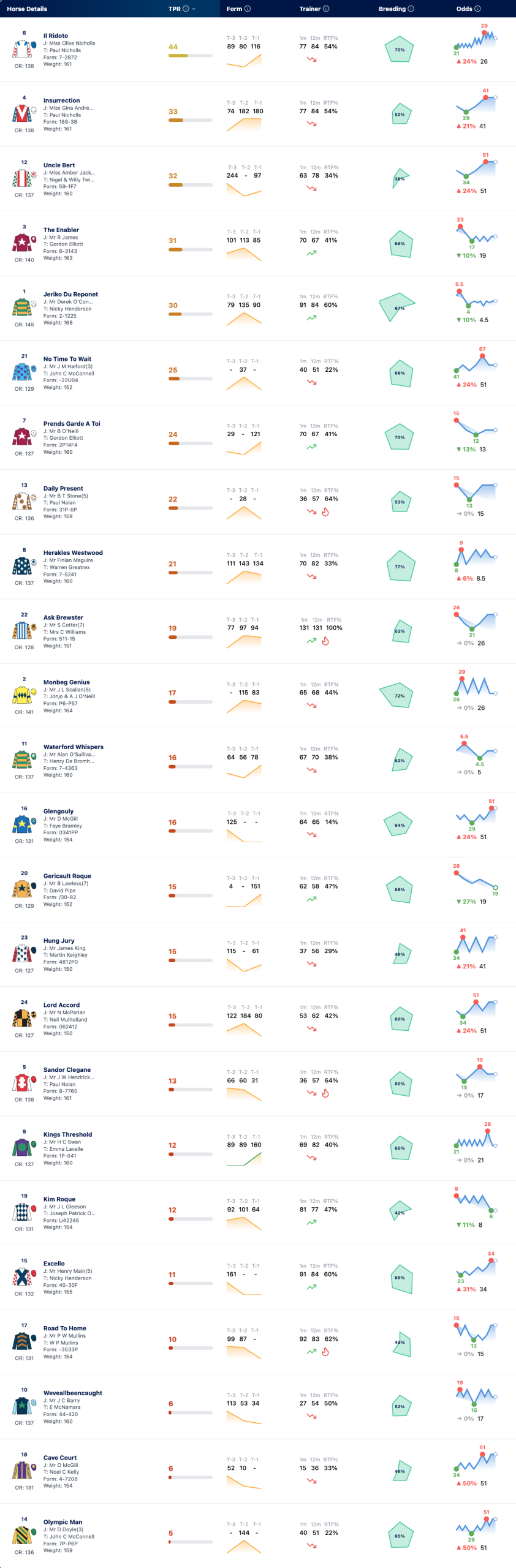
The TPR hierarchy is complicated by its top entries sitting well outside the market. INSURRECTION holds TPR rank 2 but sits at 36/1, SP rank 17. The market veto is non-negotiable: across five Cheltenham Festivals, horses ranked first on TPR but fourth or worse in the market produced a 2.3% strike rate. The T-1 of 180 from Musselburgh in January is a ghost figure. The horse finished eighth and the comment reads: “ran in snatches and always behind; jockey said gelding was never travelling; trainer’s rep could offer no explanation for the poor form shown.” The number was produced by a horse that did not perform on the day. The T-4 of 74 at Cheltenham last Festival, “some headway when hampered 3 out, no impression from 2 out,” confirms this is not a horse that has ever threatened at this meeting. The market has seen it, priced it accordingly, and we follow.
JERIKO DU REPONET is the selection. Trained by Nicky Henderson and ridden by the experienced amateur Derek O’Connor, this is the market leader at 4/1 in a handicap chase, and that is the starting point for the case. Henderson’s yard is running at 91 against an 84 baseline, RTF 60%, the joint-hottest trainer signal in the entire field. We should be transparent that the overnight going change has formally weakened the convergence case: GoingTPR has dropped from 121 to 70 on today’s Good ground, and the TPR rank of 5 means no convergence filter fires. But the handicap chase framework does not require a filter to fire. It requires the SP favourite confirmed by course form. That confirmation exists.
The form history requires honest reading, and there is both good and bad to report. The strongest credential is one that elevates this horse above every other runner in the context of this race: the T-5 of 130 came at this course at last year’s Cheltenham Festival, finishing second. The comment reads “midfield, headway and pressed winner before last, edged left and no extra final 110yds.” That is genuine Festival course form, under pressure, at the business end of a race, just twelve months ago. No other horse in this field can claim that. The T-2 of 135 at Wincanton on Soft in December is the most relevant recent figure: “didn’t always jump with fluency, raced in second, kept on from 3 out, not pace to challenge.” Good performance on soft ground, with the jumping note a recurring theme rather than a one-off. The T-1 of 90 at Windsor on Soft in January looks concerning until the comment explains it: “hampered 3 out, soon weakened.” A horse hampered at a crucial stage on a tight track is not a horse that ran poorly. The T-3 of 79 at Kempton on Good, “hung left on turn, not fluent 4 out, weakened after 2 out,” is less easily excused and is now directly relevant since today’s going is also Good. The counter-argument is that Kempton and Cheltenham are fundamentally different tracks: Kempton is flat, sharp, and right-handed, while Cheltenham’s undulations, left-handed bends, and stamina-sapping hill suit a different type of horse entirely. The GoingTPR of 70 on today’s Good ground reflects the Kempton run dragging the average down, but the Festival course form from twelve months ago carries more weight in our assessment than a moderate run at a track that could not be less like this one.
The honest caveat is DistTPR of zero. The 3m2f trip is uncharted territory, and at this marathon distance, stamina is a question the data cannot answer. The T-4 of 122 at Punchestown on Good To Soft over 3m was a win, “pushed along to lead last, ridden and hung right but went clear run-in,” which at least shows the horse stays 3m comfortably. Whether the extra two furlongs and Cheltenham’s hill make the difference is the principal risk. The market at 4/1 reflects confidence rather than certainty.
HERAKLES WESTWOOD is the horse most improved by the going change and now holds the strongest data profile in the race on today’s surface. GoingTPR of 134 is rank 1 in the entire field on Good ground. DistTPR of 143 is rank 1 at today’s 3m2f trip. Won at this course on today’s exact going ten weeks ago: “led narrowly inside final 110yds, kept on well, ridden out.” The T-2 of 143 from Cheltenham on Good To Soft in December, where losing a shoe explained a fourth-placed finish, adds further. Three of the last five runs have been at Cheltenham, making this a genuine course specialist with the best going and distance credentials in the race. The counter remains Warren Greatrex’s cold yard at 70 against an 82 baseline, RTF 33%, which is a significant enough drop to prevent this from being our primary selection. But for readers looking for each-way value, the going change has made this the most data-supported alternative in the field.
WATERFORD WHISPERS sits at SP rank 2 despite TPR rank 12, a GoingTPR of zero on today’s Good ground, and a form sequence of 78, 56, 64, 71, 29 across the last five runs. The Punchestown run is the most damning: “never going well, jumped left 3rd, towards rear throughout.” The market price invites attention; the data screams the opposite. KIM ROQUE showed Cheltenham form from two runs at the course (T-2 of 101, T-3 of 92), but the GoingTPR of zero on today’s Good ground and the T-1 of 64 at Leopardstown in February, “led clearly before last, not fluent last, soon headed, no extra towards finish,” combine to weaken the case materially. ROAD TO HOME carries the Patrick Mullins booking but TPR rank 21 and a T-1 of zero make this a market perception play rather than a data case.
The selection is JERIKO DU REPONET. The market favourite in a handicap chase at Cheltenham, Henderson’s yard running hot, and the only runner in the field with proven form under championship pressure at last year’s Festival. The going change has formally weakened the GoingTPR case, and no convergence filter fires on today’s revised surface, and we are transparent about both of those facts. But the handicap chase framework follows the market favourite confirmed by course form, and that confirmation comes from a Festival second twelve months ago. HERAKLES WESTWOOD at 8.5/1 is the strongest each-way alternative after the going shift, with rank 1 on both GoingTPR and DistTPR, held back only by the cold yard. Minimum stakes on both.
🎯SELECTION
JERIKO DU REPONET
The full field
The day at a glance
Where the data landed, race by race.
📋 Day 3 Summary: Selections at a Glance
Conclusion
That wraps up our Day 3 coverage of the Cheltenham Festival 2026. Thursday’s card is built around FACT TO FILE in the Ryanair Chase, our highest-confidence selection of the entire festival so far: a Filter E qualifier in a Grade 1 Chase, the defending champion, and the race type where our model has historically returned 61.1% winners and +180% ROI. JADE DE GRUGY in the Mares Hurdle and TEAHUPOO in the Stayers Hurdle complete the core plays, with KDEUX SAINT FRAY, REGENTS STROLL, and JERIKO DU REPONET offering supporting interest across the handicap races.
Day 2 was a difficult one. No winners, and a reminder that variance does not take days off. But the framework was not broken by Tuesday’s results, and the data for Day 3 presents the clearest single-race signal we have seen all week. The festival is not won or lost in a single afternoon. Discipline, honest assessment of what the numbers say, and the willingness to push when the data warrants it are what separate a system from a guess. Today the data warrants it.
Through our partnership with Tote UK, we will be back tomorrow for Day 4, with the Gold Cup headlining the final day of the festival. Until then, stay disciplined, stay data-led, and make the most of the edge.
Access every racecard, live analytics and the complete blog on your phone:
More racedays, read by the data
Get the next raceday guide, free
Every big raceday we read the whole card with the model: ratings, speed figures, pace and draw. We send the next one to your inbox the morning it is published. No charge, and you can unsubscribe in one click.
We use your email to send racing guides and occasional news about EquiAnalytix. We never share it. 18+ | Please gamble responsibly.
Every runner, every race, every day
Everything this guide runs on, the percentages, the engine readings, the figures, the pace maps, lives on the dashboard for every British and Irish race. From 27p a day.
Explore the dashboard →EquiAnalytix provides horse racing data and analysis only. We do not take bets. 18+ | Please gamble responsibly. GamCare 0808 8020 133.