Introduction
Grand National Day. The most famous race in the world, and a seven-race card at Aintree built around it. Saturday’s card is headlined by the Randox Grand National itself, supported by the Grade 1 Maghull Novices’ Chase and the Liverpool Hurdle, with the Mersey Novices’ Hurdle and competitive handicaps completing a day that defines the jumps season. The fields are strong, the good spring ground should let the best horses show their ability, and the data has plenty to say.
This is our race-by-race breakdown of Day 3 at Aintree, produced in partnership with the Tote. For each race, we lay out what the EquiAnalytix model sees, where the data aligns with the market, and, more importantly, where it disagrees. The Tote Placepot runs across the first six races, and we have built an interactive Placepot builder at the bottom of this guide so you can construct your perm as you read through.
How We Approach The Data
Our analysis is built around the TPR (Total Performance Rating), a machine learning-derived metric that combines a horse’s speed figures, going preferences, distance profile, track record, and trainer momentum into a single forward-looking score. Across our full database, horses ranked in the top three on TPR win approximately 55% of all races. The top four account for around 67%.
The supporting metrics you will see throughout:
- T-1 through T-5: Class-adjusted speed figures from the last five runs. T-1 is the most recent and carries the most weight. Context matters: a T-1 earned at a Cheltenham Festival Grade 1 is a different proposition to one posted in a Wetherby novice hurdle.
- DistTPR: Average performance at today’s race distance. Particularly important at Aintree where the unique track configuration rewards horses with proven stamina over these trips.
- GoingTPR: Performance on the relevant going. With Good to Soft ground expected, this metric highlights which runners have proven form when there is some give underfoot.
- Trainer Momentum: Comparing a trainer’s recent 1-month strike rate against their 12-month baseline. Several yards arrive at Aintree in peak spring form. Others have quietened down since Cheltenham.
Convergence Analysis
Where multiple independent data points, TPR ranking, recent speed figures, distance profile, going suitability, and trainer form, all point to the same horse, we call that convergence. It is the foundation of everything we do. A horse can top the TPR rankings but if they have never run on soft ground and the trainer’s strike rate has halved in the last month, the convergence is weak. When everything aligns, the signal is strong. We will show you exactly where that happens, race by race.
Let’s get into the card.
Maghull Novices’ Chase (Grade 1)
2m | Good To Soft | 8 runners
Race Analysis
Eight runners for the Grade 1 novice chase to open Grand National day and a race where the TPR leader looks deeply flawed. TPR is our machine learning-derived rating that synthesises speed figures, going preferences, distance profile, track record and trainer momentum into a single forward-looking score. The higher the number, the stronger the model considers the horse. Across our full database, horses ranked in the top three on TPR win approximately 55% of all races. BE AWARE leads this field at 67, eleven points clear of SALVATOR MUNDI at 56, with NO QUESTIONS ASKED at 49 and KALA CONTI at 34. But the TPR does not tell the whole story here.
BE AWARE’s T-1, the class-adjusted speed figure from his most recent run, is just 48. That came at Cheltenham three weeks ago where he “took keen hold, pressed leaders before 3rd, led before 5 out, headed 4 out, weakened before 2 out.” His RecentTrend, the difference between his most recent figure and the one from two runs ago, is -58. His PeakToRecent, the gap between his best figure and his last, is 115. The form has collapsed. He is also a confirmed front-runner (PaceScore 4.0, where 4.0 means they lead every time) in a race where six of the eight runners have a PaceScore above 3.0. When six horses want to go forward in an eight-runner Grade 1, the early gallop will be fierce.
The horse that looks most interesting on an upward trajectory is KALA CONTI. Her last three speed figures tell the story: T-3 of 102 winning at Cork on Good-to-Soft where she “challenged after 4 out, ridden to lead last, went clear run-in.” T-2 of 129 winning at Cork on Soft where she went “easily.” T-1 of 140 at Sandown on Soft where she was “in touch with leaders, went second 2 out, no extra approaching last.” Three runs, three consecutive improvements, and a career best last time despite being beaten. Her FormStdDev, the standard deviation of those last three figures where lower means more consistent, is 16. Her RecentTrend of +19 is the strongest positive trajectory of any horse in the race. PeakToRecent of 0 means that Sandown run was her peak.
There is a franking angle too. The horse that beat her at Cork, Kargese, went on to win at the Cheltenham Festival. That validates the level she was competing at. The breeding supports the move to fences: her sire Karaktar has a SireTypeTPR of 80 for chase progeny, the highest of any sire represented in this race. Her damsire Roli Abi has a DamsireTypeTPR of 94, an exceptional chase influence. She drops back to two miles from the 2m4f at Sandown, which should sharpen her. The one flag is Gordon Elliott running cold (49 vs 65 baseline), but Jack Kennedy takes the ride and she has been freshened up with 70 days since her last run. GoingTPR of 111 ranks joint second, confirming she handles cut in the ground.
The raw speed figure angle belongs to MIGHTY BANDIT. His T-2 of 198 at Doncaster on Soft is the highest individual speed figure of any runner in this race on any run. He “made all, bad mistake 3 out, went clear approaching last, readily.” His T-1 of 158 at Doncaster on Soft confirmed it was no fluke: “made all, clear last, ran on well.” Three consecutive wins, all front-running, all on soft ground. His T-3 of 100 winning at Newbury on Good-to-Soft was more modest, but the last two figures are outstanding. The concerns are real: no Aintree form (TrackTPR 0), a GoingTPR of just 63 ranking seventh, Greatrex running cold (52 vs 77), and he is a front-runner in a race full of them. But the figures demand respect.
SALVATOR MUNDI won at this course last year (TrackTPR 142, rank 1) and has Townend aboard, but the Mullins yard is cold (57 vs 79) and his T-1 of 104 came in a weak Thurles contest. NO QUESTIONS ASKED is the only closer (PaceScore 2.0) and leads on DistTPR at 135, but his T-1 of 34 at Cheltenham was dismal and the Pauling yard is cold. Neither horse is on an upward curve.
The convergence sits with the two horses whose recent form is trending in the right direction. KALA CONTI is the only runner improving across her last three figures, at career peak, with the strongest chase breeding in the field and form franked at the highest level. MIGHTY BANDIT brings the two biggest speed figures in the race from three consecutive wins.
🎯WHERE THE DATA CONVERGES
KALA CONTI
MIGHTY BANDIT
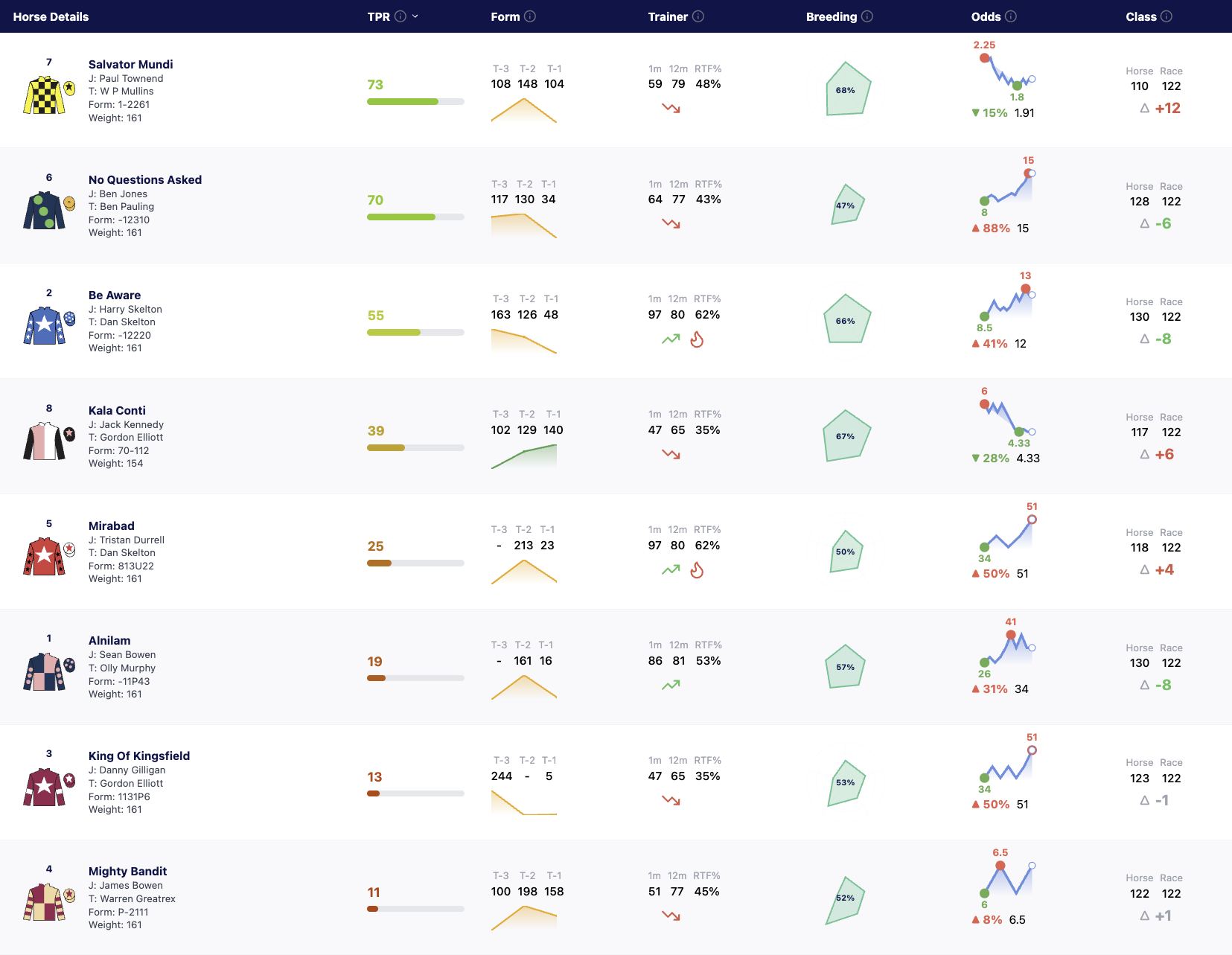
The full field
William Hill Handicap Hurdle (Premier Handicap)
3m ½f | Good To Soft | 22 runners
Race Analysis
Twenty-two runners in a Premier Handicap over three miles and a race where the data honestly cannot separate one horse from the pack. HARBOUR LAKE leads the TPR standings at 60 but has been off 100 days, is ten years old, and his T-2 is a pull-up. The top of the market is thin on conviction. In races like this, the convergence comes from different angles pointing to different horses, and the question is which angle you trust most: raw speed figures, proven course form, pace dynamics, or the handicap mark.
The raw figure angle belongs to HOLD THE SERVE. His T-1 of 216 winning at Kempton on Good-to-Soft is the biggest individual speed figure of any runner in this race on any run. He “led last, went clear inside final 110yds, kept on well.” Before that, his T-3 of 162 won at Wincanton on Soft where he “ridden to lead approaching last, kept on.” Three consecutive wins, each showing he can pick up and go through the gears late. His GoingTPR of 160 leads the entire 22-runner field by some distance, confirming he handles ground with cut. The Olly Murphy yard is running at 86 against an 81 baseline and has chosen Sean Bowen to ride, the stable’s first-choice jockey for the biggest targets. The flags are real: no Aintree form (TrackTPR 0) and no form at this trip (DistTPR 0). His three wins came at Kempton, Market Rasen and Wincanton over shorter distances. This is a significant step up in both track demands and stamina. But the figure and the jockey booking tell you the yard thinks he is up to it.
ACE OF SPADES brings the strongest proven Aintree form in the field. His TrackTPR of 140 ranks first of all 22 runners, built from winning here on Good-to-Soft in October where he “disputed lead after 2 out, led narrowly last, kept on.” His DistTPR of 137 ranks third, meaning he has performed well at staying trips before. His T-3 of 148 came finishing second at Cheltenham on New Year’s Day where he was “in rear, headway before 2 out, went second last, kept on.” His T-2 of 145 won at Huntingdon on Soft. The most recent figure is a concern: a T-1 of just 86, which has pushed the RecentTrend to -31 and means the trajectory is pointing the wrong way. The Dan Skelton yard is running hot at 97 against an 80 baseline, but the telling detail is that stable jockey Harry Skelton has chosen to ride SUPREMELY WEST instead. That said, ClassDelta of -7 means a significant class drop, GoingTPR of 120 ranks fifth, and the horse knows this track better than anyone in the field. Sam Twiston-Davies takes over in the saddle. If the Aintree form is the real Ace Of Spades, the T-1 could prove a blip at the wrong time. If the decline is genuine, the course form may not be enough to compensate.
GOOD TO BE ALIVE is the pace angle. His PaceScore of 1.73 makes him the deepest closer in the field bar one, and in a 22-runner handicap where twelve runners score above 3.0, including ABSOLUTELY DOYEN at 4.0 and FORTUNE TIMMY at 3.73, the early gallop will be fierce. He is only five years old, the youngest in the race, with a RecentTrend of +26 confirming strong improvement. His T-1 of 155 came second at Kelso on Good-to-Soft where he “held up in rear, headway after 2 out, pressed winner approaching last, kept on.” His T-2 of 160 won at Plumpton on Soft: “ridden to lead run-in, kept on well towards finish.” Murphy saddles him alongside HOLD THE SERVE, with Jack Kennedy taking the ride, another strong booking. The concern is that the 155 and 160 came at small tracks, he has never been to Aintree (TrackTPR 0), and he has never run beyond 2m5f. Whether the stamina lasts over three miles on the undulations of Aintree is the unanswered question.
At a bigger price, BOLD ENDEAVOUR has the most attractive handicap profile in the race. His ORDelta of -9 means the handicapper has dropped him nine pounds below the mark at which he last won, the strongest “Well In” signal in the field. His ORTrajectory is Falling, meaning the mark is still coming down. His T-2 of 130 at Huntingdon on Soft showed ability when he “went second after 3 out, kept on.” The concern is everything else: the Henderson yard is cold (80 vs 83), his GoingTPR of 58 ranks 20th, and his T-1 of 88 at Cheltenham was modest. But at the weights, he is the best-treated horse in the race, and in a 22-runner Premier Handicap, the mark matters.
A wide-open race with no standout convergence. HOLD THE SERVE has the biggest figures, the hottest going form and the strongest jockey booking. ACE OF SPADES has the best proven course and distance form, though the most recent figure is a worry. GOOD TO BE ALIVE has the pace angle and youth. BOLD ENDEAVOUR has the mark.
🎯WHERE THE DATA CONVERGES
HOLD THE SERVE
ACE OF SPADES
GOOD TO BE ALIVE
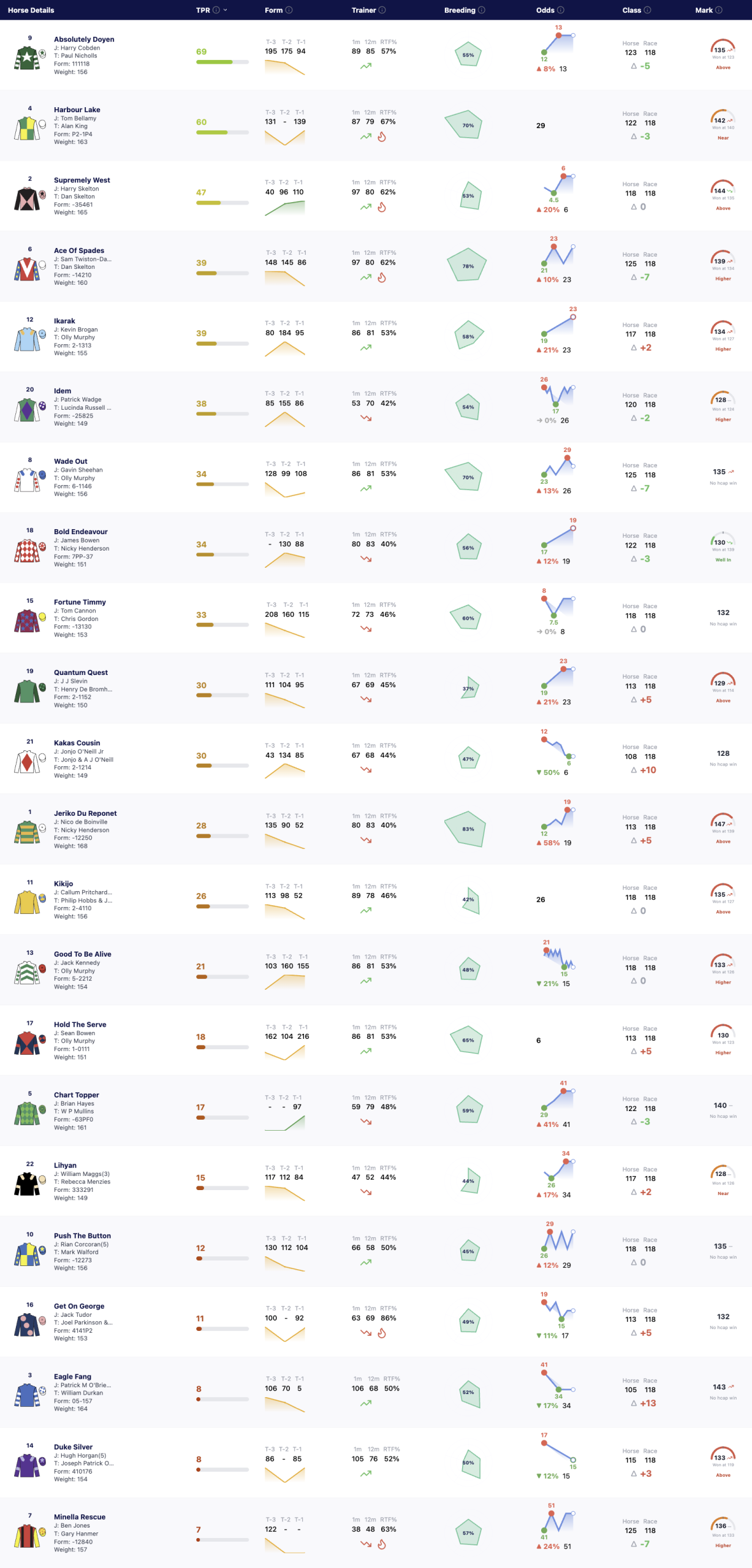
The full field
Turners Mersey Novices’ Hurdle (Grade 1)
2m 4f | Good To Soft | 13 runners
Race Analysis
Thirteen runners for the Grade 1 novice hurdle and a race where the TPR leader also has the biggest speed figures, which is not always the case. CHARISMA CAT leads the standings at 51, followed by BOSSMAN JACK at 43 with the Skelton hot trainer signal (97 vs 80) and stable jockey Harry Skelton aboard. Bossman Jack’s T-1 of 148 at Cheltenham came with a genuine excuse: “disputing third when bad mistake last, kept on but not recover.” He was finishing well when the jump stopped him. His T-3 of 200 winning at Ffos Las on Soft is a monster figure. But his T-2 of 113 at Chepstow, where he still won “easily,” shows the figures fluctuate (FormStdDev 36), and the RecentTrend of -26 means the trajectory is downward from that peak. His stablemate SOLDIER REEVES ran a huge race at Cheltenham at 100/1 (T-1 of 151: “in rear, plenty to do but headway after 2 out, ran on well run-in, nearest finish”) and his closing style (PaceScore 1.0) and ClassDelta of -8 make him interesting, but the T-2 of 73 at Haydock warns against relying on one run.
The biggest raw figures in the race belong to CHARISMA CAT, and they are why she leads the TPR. She won a mares’ hurdle at Newbury on Good-to-Soft three weeks ago over 20.5 furlongs, virtually identical to today’s trip, posting a T-1 of 186: “soon prominent, hit 4 out, led 3 out, not fluent 2 out, ridden and drifted left but kept on well.” Her T-2 of 184 came second at Market Rasen on Soft: “led before 2 out, headed last, kept on.” Those are comfortably the two highest recent speed figures of any horse in this race, and the RecentTrend of +49 is the strongest positive trajectory in the field. PeakToRecent of 0 confirms her last run was her career best. She is the only horse in the 13-runner field with proven Aintree form (TrackTPR 95, rank 1). Her GoingTPR of 124 ranks fourth, confirming she handles cut in the ground. The Alan King yard is running hot at 87 against a 79 baseline. The step from a mares’ hurdle to a Grade 1 against the boys is significant, and her FormStdDev of 46 shows the figures can fluctuate (T-3 of just 88 at Chepstow). But a mare in this kind of form, with figures that dwarf the rest of the field, proven at the trip, and the only course experience in the race, commands serious respect.
MONTEMARES is the horse on the clearest upward trajectory after CHARISMA CAT. Three consecutive improvements: T-3 of 105 winning at Market Rasen on Good-to-Soft where he won “comfortably.” T-2 of 144 fourth at Newbury on Good: “headway 3 out, disputing second 2 out, weakened run-in.” T-1 of 158 winning at Kelso on Good-to-Soft where the manner was striking: “joined leader going easily 2 out, led just before last, ridden clear run-in.” That last win was emphatic, the kind of performance where a horse barely comes off the bridle before putting the race to bed. His GoingTPR of 132 ranks second in the field, confirming strong form on ground with cut. His FormStdDev of 23 makes him one of the more consistent runners. PeakToRecent of 0. He is only five years old. The Tom Lacey yard is running at 63 against an 85 baseline on the broader numbers, but Lacey has a good record at the Aintree Festival and the horse has been specifically targeted for this race after 42 days off. ClassDelta of -2 means he is not out of his depth on class.
LORD BYRON brings the Faye Bramley hot trainer angle that featured on Day 2 (96 vs 70 baseline, the highest momentum in the race). He is only four years old, the youngest in the field, and Harry Cobden takes the ride, a booking that signals serious intent from a smaller yard. His T-1 of 125 at Cheltenham at 66/1: “in rear, headway after 2 out, kept on well run-in.” ClassDelta of -8. But the figures are a clear tier below the principals. BALLYFAD ran well at Cheltenham (T-1 139) for Elliott but the yard is cold (47 vs 65) and the earlier figures of 57 and 89 are poor. KOSAC DOUDAIRIES has a FormStdDev of literally 0 (figures of 138, 139, 139) and leads on GoingTPR at 141, the most metronomically consistent horse in the race, but Snowden is cold and the figures are a level below.
The convergence points to the two horses with the strongest recent evidence and improving profiles. CHARISMA CAT has the biggest figures in the race by a distance, the only Aintree form, and a mare in the form of her life. MONTEMARES won with authority last time, has three consecutive improvements, the second-best going form in the field, and a trainer who knows this meeting.
🎯WHERE THE DATA CONVERGES
CHARISMA CAT
MONTEMARES
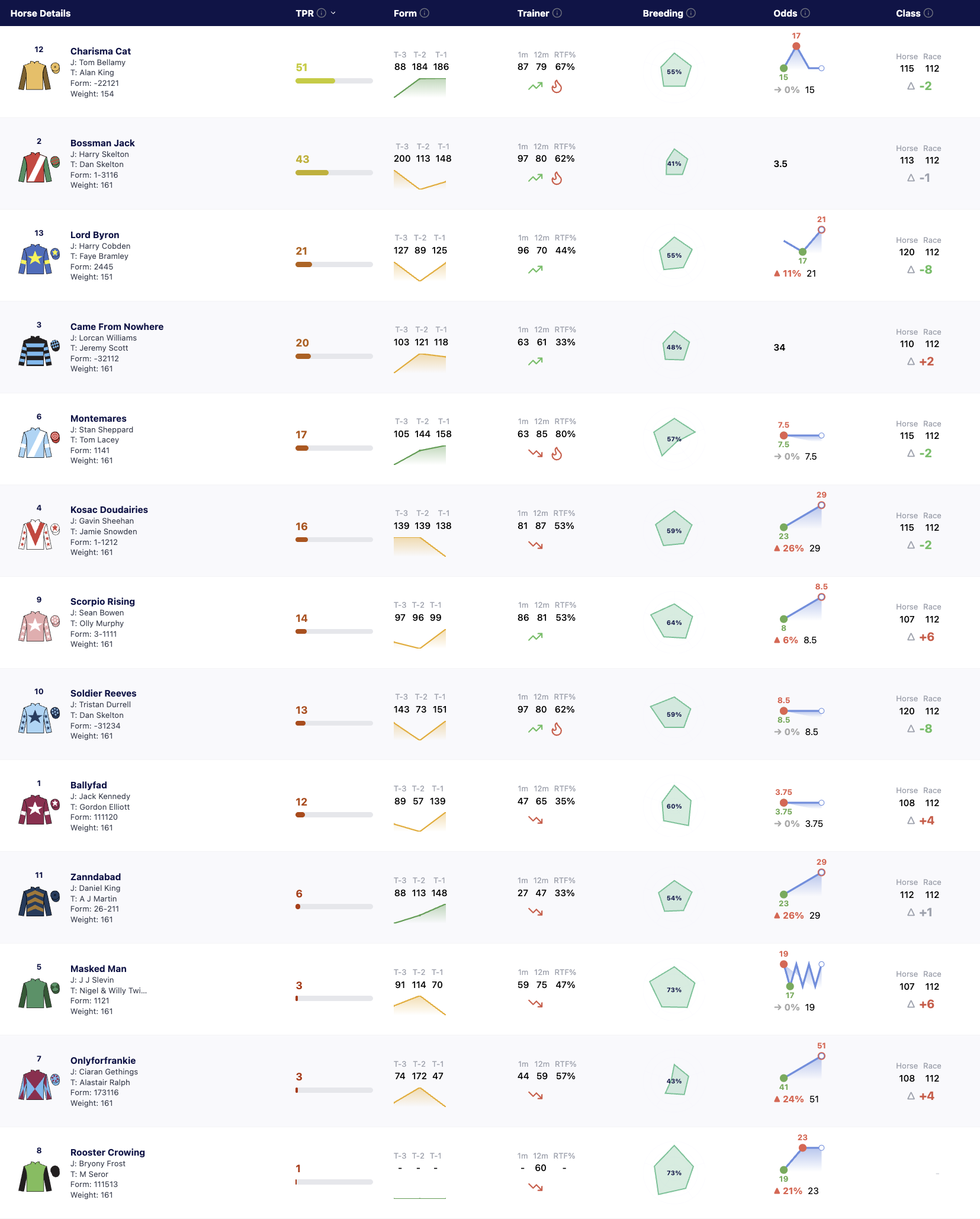
The full field
William Hill Freebooter Handicap Chase (Premier Handicap)
3m 1f | Good To Soft | 18 runners
Race Analysis
Eighteen runners in a Premier Handicap chase over three miles and a race with a fascinating pace dynamic at the top of the market. The TPR hierarchy is topped by LEAVE OF ABSENCE at 52, but recent figures of 88 and 60 and an ORDelta of +18 mean the handicapper has him well above his winning mark. BAD at 49 has two strong hold-up figures (T-1 177, T-2 185) but has never run beyond 2m5f and today’s 3m1f is a genuine stamina question. DEEP CAVE at 43 had his T-1 of 46 at Kempton when the vet reported he “lost his left-fore shoe,” and a PeakToRecent of 141 tells you this horse is a mile from his best even with an excuse. MR HOPE STREET at 34 has the Skelton hot trainer signal (97 vs 80) but figures of 68, 50 and 56 and a ClassDelta of +25, a massive step up in class. The headline TPR positions are misleading.
The two horses that make most appeal both race prominently and both know this course. LOOKAWAY has the two biggest speed figures in the race: T-1 of 188 winning at Kempton on Good-to-Soft where he “led after 3 out, kept on well, ridden out” and T-2 of 179 winning at Kempton on Good: “disputed lead, pushed along before 3 out, stayed on.” Two consecutive wins with authority. His GoingTPR of 152 leads the field by thirty points, confirming outstanding form on ground with cut. His TrackTPR of 136 ranks third, meaning he has proven Aintree form. RecentTrend of +45, PeakToRecent of 0, meaning his last run was his career best. The Neil King yard is running hot at 89 against a 70 baseline. He races prominently (PaceScore 3.67) and wants to get on with things from the front.
CRUZ CONTROL has won this exact race for the last two years. His T-3 of 162 came winning here last April on Good: “midfield, steady headway 13th, pressed leader 3 out, led after 2 out, went clear final 110yds.” He knows where the winning post is at Aintree over this trip better than any horse in the field, and his DistTPR of 137 ranks first of all 18 runners. His TrackTPR of 115 confirms the course form extends beyond just one performance. He arrives off a quiet prep: pulled up at Cheltenham and a figure of 42 at Newcastle, which looks poor on paper. But last year he arrived at Aintree off a similarly low-key preparation and won with real authority. The ORDelta of +1 means the handicapper has not punished him unduly. ClassDelta of -8 represents a significant class drop. He races prominently and could set or share the gallop with LOOKAWAY.
That is the angle. Two front-running types, both with proven Aintree form, both arriving with the confidence of recent course experience, both set to race prominently. In a field where the closers (DEEP CAVE at PaceScore 1.07, BAD at 1.73) have question marks around stamina and recent form, two horses controlling the gallop from the front and pulling the field apart is a credible scenario.
LEAVE OF ABSENCE has the best TrackTPR in the race at 161 and the second-best GoingTPR at 122, but those recent figures of 88 and 60 and the ORDelta of +18 are hard to overlook. DEEP CAVE has a shoe excuse and a T-2 of 187 that confirms ability, but the form is erratic. GLENGOULY brings the Bramley hot trainer angle (96 vs 70) with Sean Bowen, but three consecutive figures of 0 offer nothing to work with.
The convergence is the pace scenario. LOOKAWAY has the biggest figures and the best going form. CRUZ CONTROL has won this race twice and is not badly treated in the handicap. Together from the front, they could take this field apart.
🎯WHERE THE DATA CONVERGES
LOOKAWAY
CRUZ CONTROL
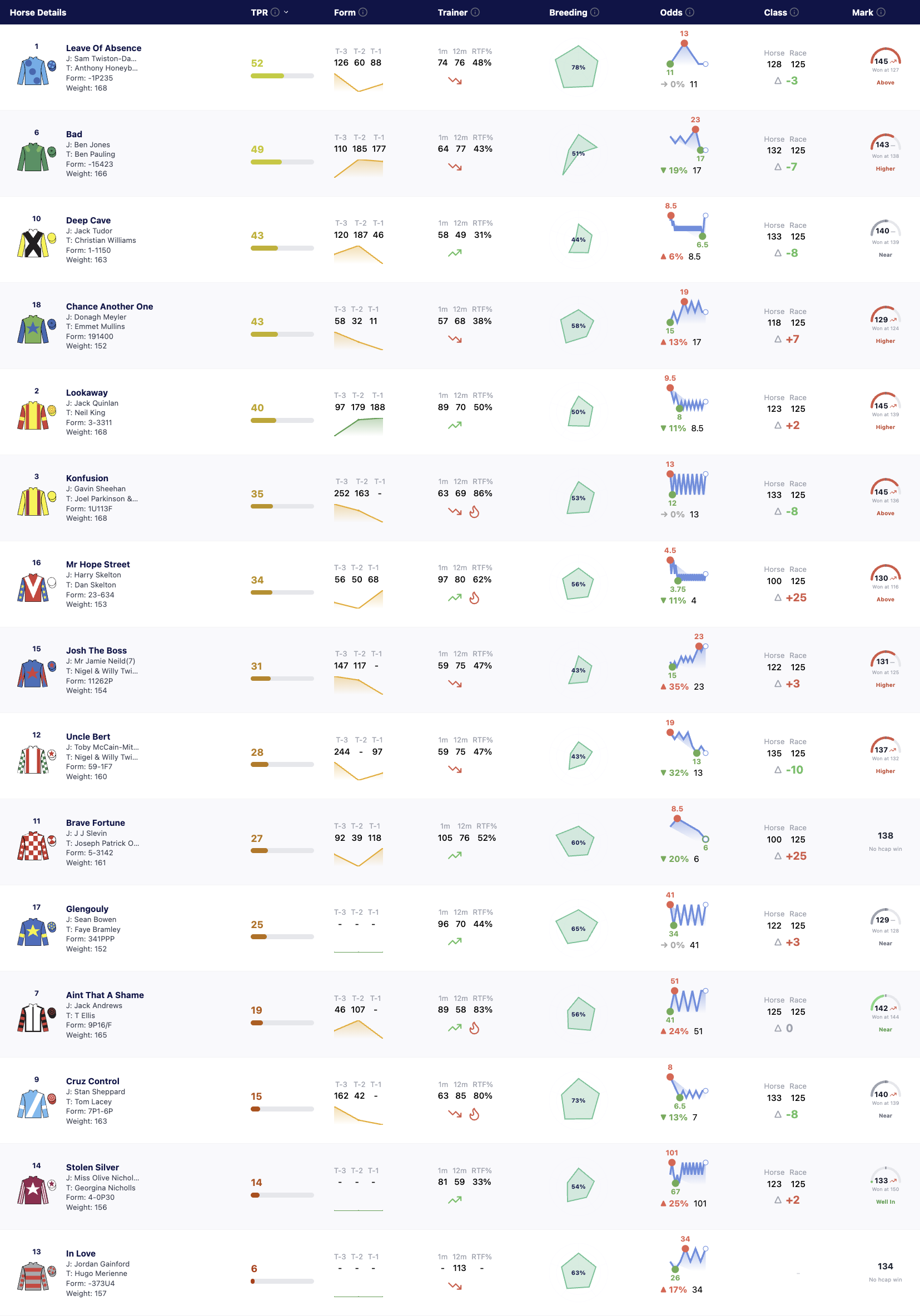
The full field
Jet2 Liverpool Hurdle (Grade 1)
3m ½f | Good To Soft | 12 runners
Race Analysis
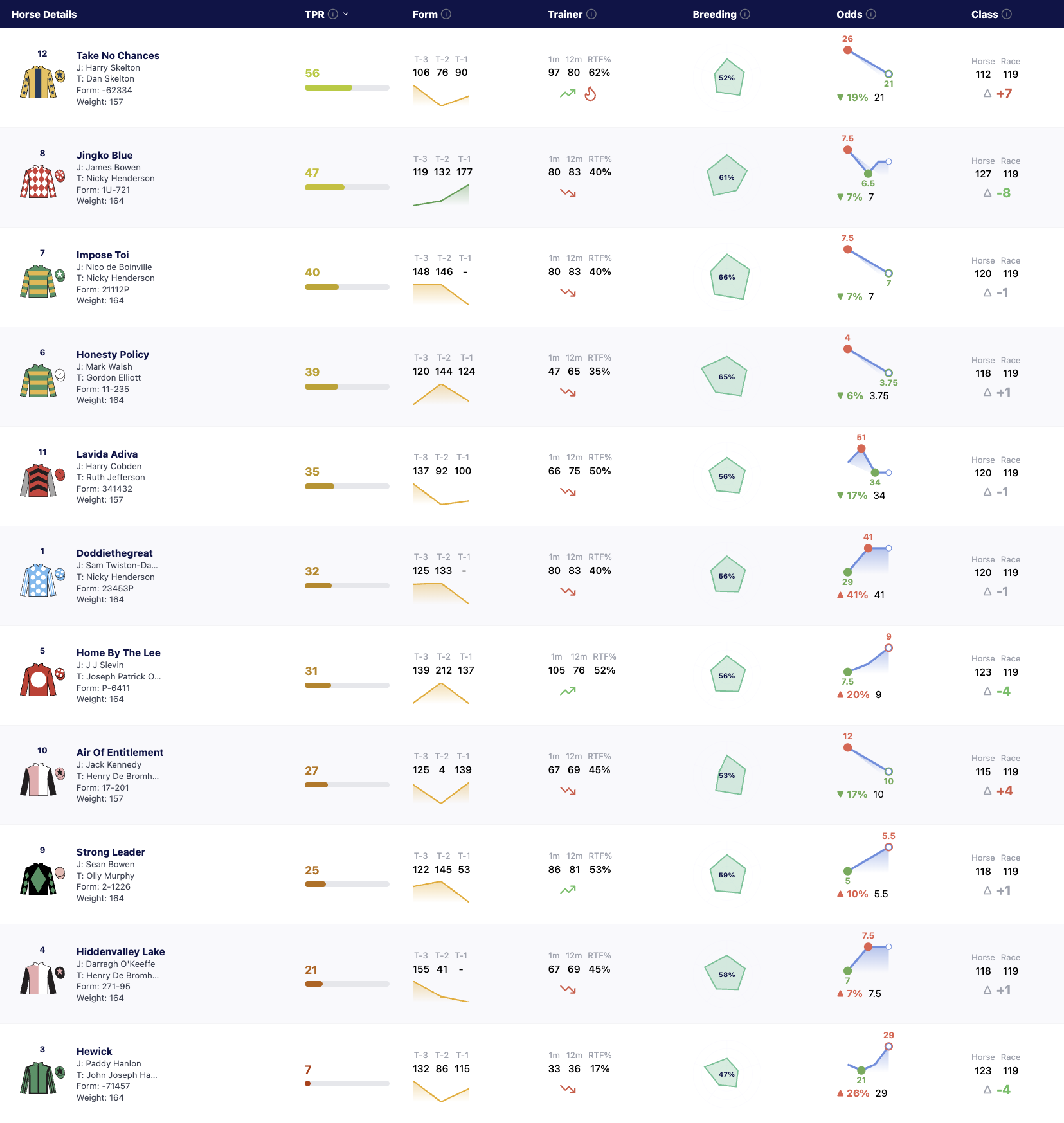
Twelve runners for the Grade 1 Liverpool Hurdle and a race where the Cheltenham Festival form provides the clearest guide. TAKE NO CHANCES leads the TPR standings at 56 with the Skelton hot trainer signal (97 vs 80), but his recent figures of 90, 76 and 106 look modest for Grade 1 company and a ClassDelta of +7 means he is stepping up significantly. The TPR has him higher than the figures suggest he belongs.
The strongest last-run form in the race belongs to JINGKO BLUE. His T-1 of 177 came winning the BetMGM Cup at the Cheltenham Festival on Good-to-Soft: “made virtually all, hit 3 out, good jump last, won going away.” That was a fiercely competitive handicap hurdle at the biggest meeting of the year, and the manner of the victory, going clear after the last, was authoritative. His T-2 of 132 came second at Cheltenham on New Year’s Day: “headed just after last, soon no chance with winner.” His GoingTPR of 143 ranks second in the field, confirming strong form on ground with cut. RecentTrend of +29, PeakToRecent of 0 meaning his Cheltenham win was his career best. ClassDelta of -8 means he drops from that Cheltenham level. He is only seven years old with scope for more improvement. The Henderson yard is running at 80 against an 83 baseline, which is a flag, and he has never been to Aintree (TrackTPR 0). But the Cheltenham figure dwarfs anything else in the recent form of this field, and the step from a competitive Festival handicap to a Grade 1 at Aintree is not as big a leap as it might seem on paper.
The horse they all have to beat is HONESTY POLICY. She won at Aintree last year: “midfield, headway 3 out, led towards finish.” Her DistTPR of 144 ranks first in the entire field, meaning her average speed figure at this trip is the best of any runner. Her FormStdDev of 11 makes her the most consistent horse in the race (figures of 124, 144, 120). Her TrackTPR of 122 ranks fourth, confirming the Aintree form extends beyond one run. Last time she ran fifth at Cheltenham where Stayers’ Hurdle winner HOME BY THE LEE was given a clever ride from the front and the race panned out in his favour. Her T-1 of 124 there was a solid effort in that context. The Gordon Elliott yard is cold (47 vs 65) and she races prominently (PaceScore 3.73), which may matter in a race where eight of twelve runners score above 3.0.
IMPOSE TOI has the best conditions profile in the race: GoingTPR of 150 ranks first, TrackTPR of 140 ranks first, DistTPR of 135 ranks second. Three metrics, three top-two rankings. His T-2 of 146 and T-3 of 148 are strong figures. But his T-1 is 0 after being pulled up at Cheltenham where the trainer confirmed the horse was “never travelling” on quick ground. Today’s Good-to-Soft would suit better, but the question is whether that run left a mark. The Henderson and de Boinville combination is respected but the yard is cold and the last-run evidence offers nothing to work with. STRONG LEADER has the second-best TrackTPR at 134, proven Aintree form, and the Murphy hot trainer signal (86 vs 81) with Sean Bowen, but his T-1 of 53 was a dismal run at Cheltenham and he has been off 77 days.
The data points to JINGKO BLUE. The Cheltenham Festival win is the strongest recent form in the race, the GoingTPR ranks second, he is at career peak, and the class drop from the Festival is significant. HONESTY POLICY is the proven Aintree performer with the best distance form and the most consistent profile, the clear danger.
🎯WHERE THE DATA CONVERGES
JINGKO BLUE
The full field
Randox Grand National Handicap Chase
4m 2½f | Good To Soft | 34 runners | Over the Grand National Fences
Race Analysis
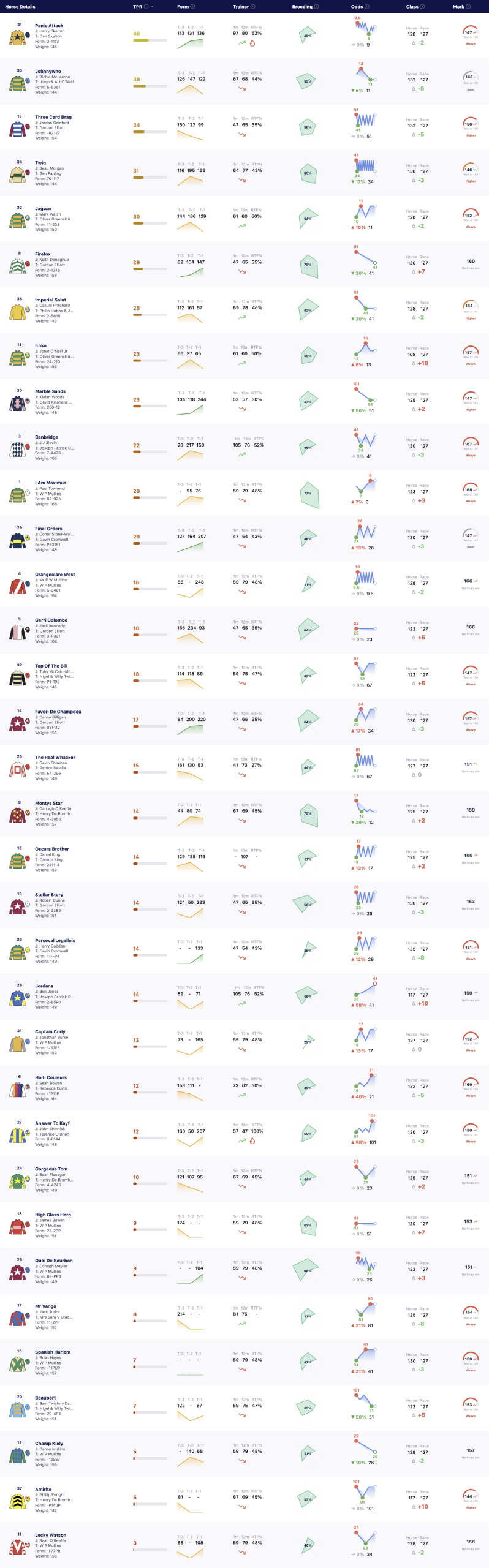
The Grand National. Thirty-four runners over four miles and two and a half furlongs of the most famous obstacles in racing. This is the race that defies normal analysis. Our standard convergence framework, where we rank horses by TPR, going form, track form and distance form and look for the one who leads across all metrics, does not work here. The reason is simple: most runners have never been to Aintree over this trip, never run on this specific going at this distance, and never faced these unique fences. The data that drives our analysis in a 12-runner Grade 1 is largely absent in a 34-runner Grand National.
So we built something different.
The Grand National Sweet Spot
A point-in-time historical database of every Grand National runner from 2016 to 2025. 342 runners. Nine renewals. Every metric computed using only data available before each year’s race. No hindsight. No leakage. A framework built to answer one question: what separates winners from the rest?
The six core filters: Age 7 to 9 (all nine winners fell in this range, zero winners aged 10 or older). OR 145-165 (the very top weights and the very bottom weights do not win Grand Nationals). T-1 above 60 (a meaningful recent speed figure, horses off a non-completion or blank run do not win). Not a front-runner, PaceScore below 3.5 (in a 34-runner cavalry charge, the leader does not last home). Grand National fresh, zero or one previous run in the race (eight of nine winners were first-timers). Going form proven, GoingTPR above zero (must have demonstrated it can handle ground with cut). All six filters were passed by all nine winners since 2016. Backing every horse that passed all six at SP across nine years returned +63% ROI win-only.
Three signal enhancers sit on top: improving form (RecentTrend above zero, six of seven winners with data were on an upward curve), class drop (ClassDelta below zero, combined with improving form this double signal identified the last three winners), and hot trainer (1-month TPR above 12-month baseline, six of nine winners came from yards running above their own average). A composite score of 9+ captured seven of nine winners. A score of 6 or below produced zero winners from 117 runners.
The 2026 Field Through The Sweet Spot
Thirteen of the thirty-four declared runners pass the Sweet Spot 6. However, this is the first year in our sample where no horse carries the full double signal, class drop combined with improving form, within the sweet spot. The class droppers are declining, the improvers are stepping up. That caveat is important and we are transparent about it. But the broader sweet spot pool remains highly relevant, and within it, three horses stand out.
MONTYS STAR is the horse the framework points to most strongly. He passes the Sweet Spot 6: age 9, OR 159, T-1 of 74, PaceScore 2.13 (hold-up horse), GN fresh, going proven (GoingTPR 103). He carries an improving RecentTrend of +15, meaning his figures are heading in the right direction. And the Henry De Bromhead yard, currently sitting at 67 against a 69 baseline, very close to being in positive trend territory. If that had happened, MONTYS STAR becomes the only horse in the entire 34-runner field carrying the specific triple combination of sweet spot, improving form and hot trainer. Five of the last nine Grand National winners carried that exact triple. The T-1 of 74 looks low, but context matters: Minella Times won off a T-1 of 77, Noble Yeats off 72. Low figures are not a barrier in this race because the National rewards stamina and jumping over raw speed. His FormStdDev of 16 confirms consistency. The flag is that he has never run at Aintree (TrackTPR 0) and has no form at this distance (DistTPR 0), but in a race where most runners are navigating these obstacles for the first time, that is not unusual.
FIREFOX is the horse with the strongest individual data profile within the sweet spot. He is the only qualifier who is both improving (trend +29, the highest positive trajectory in the pool) and at peak form (PeakToRecent 0, meaning his last run was his career best). Age 8, OR 160, PaceScore 2.2 (hold-up). His T-1 of 147 at Cheltenham over 3m2f on Good-to-Soft is a strong figure even though he finished sixth: “in rear, some headway 4 out, weakened from 2 out.” Crucially, he has proven Aintree form with a TrackTPR of 133, the highest of any sweet spot qualifier. His sire is Walk In The Park. The Gordon Elliott yard is cold at 49 against a 65 baseline, which prevents him from scoring higher, but the improving curve, career peak, proven course form and breeding make him the standout value play at 36/1.
GRANGECLARE WEST falls narrowly outside the Sweet Spot on age (10) and OR (166, missing by a single point). But the individual metrics demand attention. His T-1 of 248 at Fairyhouse on Heavy is the biggest speed figure of any runner in the entire 34-horse field: “held up in last, headway after 3 out, went second after 2 out, led run-in, went clear towards finish, pushed out.” His TrackTPR of 153 and DistTPR of 153 are joint-best in the field alongside I Am Maximus, proving he handles both Aintree and this extreme distance. His PeakToRecent of 0 means that Fairyhouse win was his career best, and a PaceScore of 1.53 makes him one of the deepest closers in the field. ClassDelta of -2 means he drops slightly in class. Patrick Mullins takes the ride. The Sweet Spot says no on age and OR, and those are meaningful filters. But in a year where the framework admits no horse carries the full double signal, a proven Aintree stayer at career peak with the biggest figure in the race, who sits off the pace and picks his way through, is hard to ignore.
Where The Data Says No
Perhaps the most surprising conclusion from the framework is who it rules out. I AM MAXIMUS, the reigning champion and current market leader, scores just 3 out of 9. He is 10 years old (every winner was 7-9), carries an OR of 168 (every winner was 145-165), and this is his third Grand National (eight of nine winners were first-timers). The data is not ambiguous: this profile does not win Grand Nationals. GERRI COLOMBE fails on age (10) and OR (166). THE REAL WHACKER is a declining front-runner (trend -54, PaceScore 3.53) aged 10. BEAUPORT is a front-runner aged 10 with a PaceScore of 3.67. The market has several of these horses at single-figure prices. The framework says look elsewhere.
JAGWAR at 10/1 is the interesting one the data cannot fully endorse. He passes the Sweet Spot 6 and carries a class drop (-2), but his trend is -8, mildly declining. In our data, every winner who carried the class drop signal was also improving. He is the obvious form horse without the momentum.
The Grand National will always produce surprises. Nine renewals is a meaningful but not enormous sample, and the absence of the full double signal this year is unprecedented in the data. But the Sweet Spot framework has identified the winner in every renewal since 2016, and its conclusions this year are clear. MONTYS STAR carries the golden triple if the trainer flips as expected. FIREFOX is the improving peak horse with proven Aintree form at a big price. GRANGECLARE WEST is the proven Aintree stayer at career best who narrowly misses the framework but ticks every other box. In a race where the market favourite scores 3 out of 9, the data says the value is elsewhere.
🎯WHERE THE DATA CONVERGES
MONTYS STAR
FIREFOX
GRANGECLARE WEST
The full field
Weatherbys nhstallions.co.uk NH Flat Race (Grade 2)
2m 1f | Good To Soft | 20 runners
Race Analysis
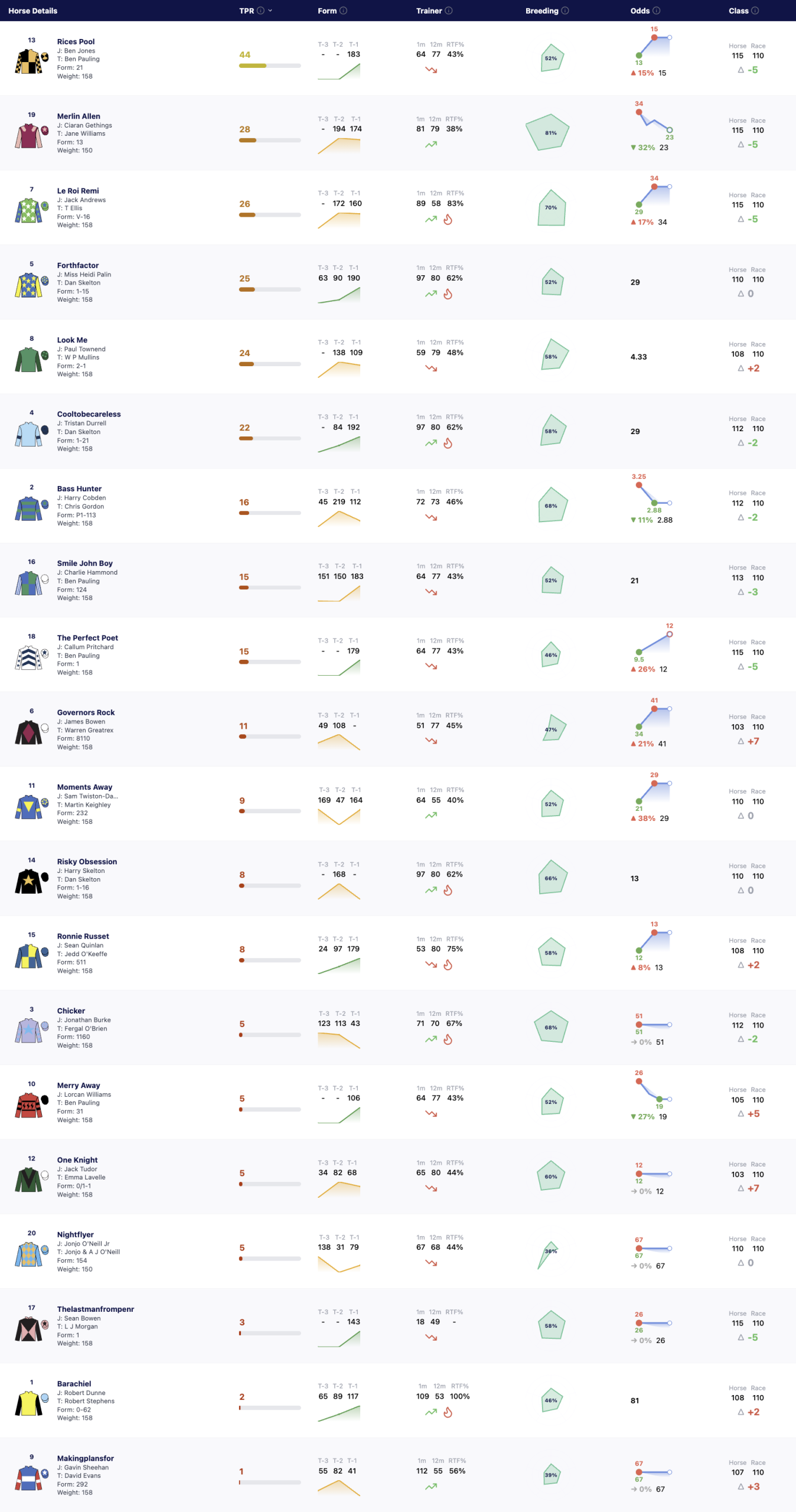
Twenty runners in a Grade 2 bumper to close the festival, and a race where the form book is thin by definition. Most of these horses have had just one or two career starts. When the racecourse evidence is this limited, two things carry extra weight: proven conditions form and breeding. On both counts, one horse stands out.
MERLIN ALLEN won at this course on Good-to-Soft in November, producing a T-2 of 194: “midfield behind clear leader, headway 5f out, led and shaken up over 2f out, clear inside final furlong, eased towards finish.” That is the highest individual figure recorded at Aintree by any horse in this field. His TrackTPR of 194 ranks first. His DistTPR of 194 ranks first. His GoingTPR of 184 ranks first. Three conditions metrics, three first-place rankings, in a 20-runner field. No other horse in the race has any Aintree form at all. His T-1 of 174 came third at Kempton on Good-to-Soft: “towards rear, headway 5f out, kept on and went third inside final 110yds.” The figure dropped slightly from the Aintree peak, which is a minor concern on a third career start, but 174 is still a strong figure. The breeding supports the selection: his sire Choeur Du Nord has a SireTypeTPR of 85 for NH Flat progeny, the second highest in the race, and his damsire Robin Des Champs (DamsireTypeTPR 68) is a proven National Hunt influence. The Jane Williams yard is running hot at 81 against a 79 baseline. He is only four years old, the youngest of the leading contenders, racing from off the pace (PaceScore 1.44) with ClassDelta of -5.
BASS HUNTER brings the strongest combined sire-damsire breeding profile in the race. His sire Authorized has a SireTypeTPR of 79 for NH Flat progeny and his damsire Monsun carries a DamsireTypeTPR of 76. That combined influence of 155 is the highest of any runner. His T-2 of 219 winning at Ascot on Soft is the biggest single figure in the entire field: “made all, went clear 3f out, nudged along and reduced lead final furlong, always doing enough.” That was a hugely impressive front-running performance. His T-1 of 112 came third at Cheltenham on Good: “soon led, headed over 1f out, ridden when unbalanced inside final furlong, kept on.” Harry Cobden takes the ride. The concern is that he is a confirmed front-runner (PaceScore 4.0) in a race where nine of twenty runners have a PaceScore above 3.0, and his GoingTPR of 45 ranks poorly, meaning his form on ground with cut is untested at this level. But the breeding and the Ascot figure demand respect.
RICES POOL leads the TPR standings at 44 with a T-1 of 183 on his only start, but a single run gives no trajectory to work with and a DamsireTypeTPR of 46 is the weakest of any contender. COOLTOBECARELESS has the highest T-1 at 192 with Skelton hot, but a GoingTPR of 0 on Good-to-Soft ground is a genuine unknown. RISKY OBSESSION gets Harry Skelton’s choice over the other Skelton runners, a significant jockey signal, but her T-1 is 0 after tailing off at Newbury on Heavy. LOOK ME has Mullins and Townend but the figures (109, 138) and breeding (SireTypeTPR 63) are modest for a Grade 2.
In a bumper where the form book is thin, conditions and breeding are the tiebreakers. MERLIN ALLEN leads every conditions metric in a 20-runner field and has the second-best bumper breeding. BASS HUNTER has the strongest breeding profile and the biggest figure in the race. Between them, the proven Aintree winner and the Ascot winner should be the two to focus on.
🎯WHERE THE DATA CONVERGES
MERLIN ALLEN
BASS HUNTER
The full field
The day at a glance
Where the data landed, race by race.
Conclusion
That is your lot for Grand National Day. Seven races, seven sets of data, and a card headlined by the most famous race in the world where our bespoke Sweet Spot framework has identified three horses the market may be underpricing. The Placepot pool makes this worth engaging with – a guaranteed minimum of £400,000 for a £2 perm.
That wraps up our coverage of the 2026 Aintree Grand National Festival. Three days, twenty-one races, and a data-driven approach to every one of them. Through our partnership with Tote UK, we hope the analysis has helped you engage with the festival in a different way. Stay disciplined, stay data-led, and enjoy the National.
Access every racecard, live analytics and the complete blog on your phone:
More racedays, read by the data
Get the next raceday guide, free
Every big raceday we read the whole card with the model: ratings, speed figures, pace and draw. We send the next one to your inbox the morning it is published. No charge, and you can unsubscribe in one click.
We use your email to send racing guides and occasional news about EquiAnalytix. We never share it. 18+ | Please gamble responsibly.
Every runner, every race, every day
Everything this guide runs on, the percentages, the engine readings, the figures, the pace maps, lives on the dashboard for every British and Irish race. From 27p a day.
Explore the dashboard →EquiAnalytix provides horse racing data and analysis only. We do not take bets. 18+ | Please gamble responsibly. GamCare 0808 8020 133.