Introduction
Day 2 at Aintree. Friday’s card is seven races deep, headlined by the Grade 1 Melling Chase and the Topham over the Grand National fences, with the Sefton Novices’ Hurdle and competitive handicaps filling out a card that is every bit as strong as Thursday’s opener. The fields are strong, the good spring ground should let the best horses show their ability, and the data has plenty to say.
This is our race-by-race breakdown of Day 2 at Aintree, produced in partnership with the Tote. For each race, we lay out what the EquiAnalytix model sees, where the data aligns with the market, and, more importantly, where it disagrees. The Tote Placepot runs across the first six races, and we have built an interactive Placepot builder at the bottom of this guide so you can construct your perm as you read through.
How We Approach The Data
Our analysis is built around the TPR (Total Performance Rating), a machine learning-derived metric that combines a horse’s speed figures, going preferences, distance profile, track record, and trainer momentum into a single forward-looking score. Across our full database, horses ranked in the top three on TPR win approximately 55% of all races. The top four account for around 67%.
The supporting metrics you will see throughout:
- T-1 through T-5: Class-adjusted speed figures from the last five runs. T-1 is the most recent and carries the most weight. Context matters: a T-1 earned at a Cheltenham Festival Grade 1 is a different proposition to one posted in a Wetherby novice hurdle.
- DistTPR: Average performance at today’s race distance. Particularly important at Aintree where the unique track configuration rewards horses with proven stamina over these trips.
- GoingTPR: Performance on the relevant going. With Good to Soft ground expected, this metric highlights which runners have proven form when there is some give underfoot.
- Trainer Momentum: Comparing a trainer’s recent 1-month strike rate against their 12-month baseline. Several yards arrive at Aintree in peak spring form. Others have quietened down since Cheltenham.
Convergence Analysis
Where multiple independent data points, TPR ranking, recent speed figures, distance profile, going suitability, and trainer form, all point to the same horse, we call that convergence. It is the foundation of everything we do. A horse can top the TPR rankings but if they have never run on soft ground and the trainer’s strike rate has halved in the last month, the convergence is weak. When everything aligns, the signal is strong. We will show you exactly where that happens, race by race.
Let’s get into the card.
William Hill Handicap Hurdle (Premier Handicap)
2m 4f | Good To Soft | 22 runners
Race Analysis
A 22-runner Premier Handicap to open Day 2 and a puzzle that rewards patience, both in the analysis and in the race itself. Our model rates each horse using a TPR (Total Performance Rating), a machine learning score that combines speed figures, going preferences, distance profile and trainer form into a single forward-looking number. The higher the TPR, the stronger the model considers the horse. FAVOUR AND FORTUNE leads the standings at 68, sixteen points clear of WELLINGTON ARCH at 52, with JOYEUSE at 45 and FIERCELY PROUD at 38. That is a significant margin in a 22-runner handicap.
What separates this race is the pace. We track running style through PaceScore, a number from 1 to 4 based on recent racing positions: 4.0 means they lead every time, 1.0 means always held up. Eight of the 22 runners score 3.0 or above, including WELLINGTON ARCH (3.93) who won this race last year from the front. FIERCELY PROUD (3.8) disputed the lead at Cheltenham three weeks ago before “weakened just before last.” TOP JIMMY (4.0) and SWINDON VILLAGE (3.93) will also press forward. When that many horses want to lead in a big-field handicap, the early gallop will be fierce and the closers should benefit.
FAVOUR AND FORTUNE is the closer. His PaceScore of 1.73 means he races towards the rear and delivers late, exactly the profile rewarded when the front end goes hard. Crucially, he has been here before. His T-2 of 146, our class-adjusted speed figure from his second most recent run, came finishing third at Aintree on Good-to-Soft last April where he was “prominent early, headway when hit 3 out, went second 2 out, lost second last, kept on.” His TrackTPR, the average speed rating at today’s course, is 131, confirming proven Aintree form. His DistTPR, average rating at today’s distance, is 146. He knows the track, he knows the trip. His T-1 of 179 at Kempton on Good-to-Soft is the second highest last-run figure in the top six, though context matters: he “took keen hold and weakened 2 out” that day. His ClassDelta, which measures whether a horse is stepping up or dropping down in class today compared to recent races, is -3: an easier race than he has been running in. His ORDelta, comparing his current official rating to the mark at which he last won, is +2, meaning he is near his winning mark. And the key detail: he finished behind WELLINGTON ARCH in this race last year but is now significantly better off at the weights. Alan King’s yard is running at 82 against a 78 baseline.
ACT OF AUTHORITY brings the best proven course form in the entire field. His TrackTPR of 159 leads all 22 runners, built on a figure of 202 at Aintree on Soft last December where he was “towards rear, headway when mistake 2 out, no match for first two.” That 202 is enormous, and even though he could not sustain it to win, it tells you this horse thrives on the track. His DistTPR of 165 ranks second in the field. Like FAVOUR AND FORTUNE, he is a hold-up horse (PaceScore 1.2) who will benefit from the strong gallop. His FormStdDev, the standard deviation of the last three speed figures where lower means more consistent, is 12, one of the steadiest in the race. ClassDelta of -8 means a significant drop in class. The Olly Murphy yard is running at 83 against an 81 baseline, and Murphy saddles four runners here, a sign the stable fancies its chances. Lewis Saunders takes the ride with a valuable 5lb claim that helps at the weights. The only concern is a GoingTPR of 89, ranking just 15th, but his Aintree run came on Soft and today’s Good-to-Soft should not be a barrier.
JOYEUSE is the safest horse in the race on consistency. FormStdDev of 12, PeakToRecent of 0 meaning her last run was her career best, and the Henderson/de Boinville combination demands respect. But her GoingTPR of 88 ranks 16th, she has never been to Aintree (TrackTPR 0), and her ORDelta of +14 means the handicapper has her well above her winning mark. FIERCELY PROUD’s T-2 of 188 winning at Ascot on Good-to-Soft is eye-catching but a FormStdDev of 52 and a cold trainer signal (64 vs 76) make him impossible to trust. WELLINGTON ARCH has the form in the book as last year’s winner but front-runners in these big-field handicaps are fighting the pace dynamic.
The convergence sits with the two hold-up horses who have proven Aintree form. FAVOUR AND FORTUNE ran a big race here last year, is better off at the weights against the reopposing winner, and his running style fits the pace scenario perfectly. ACT OF AUTHORITY has the best TrackTPR in the field, is dropping sharply in class, and comes from the hottest yard in the race.
🎯WHERE THE DATA CONVERGES
FAVOUR AND FORTUNE
ACT OF AUTHORITY
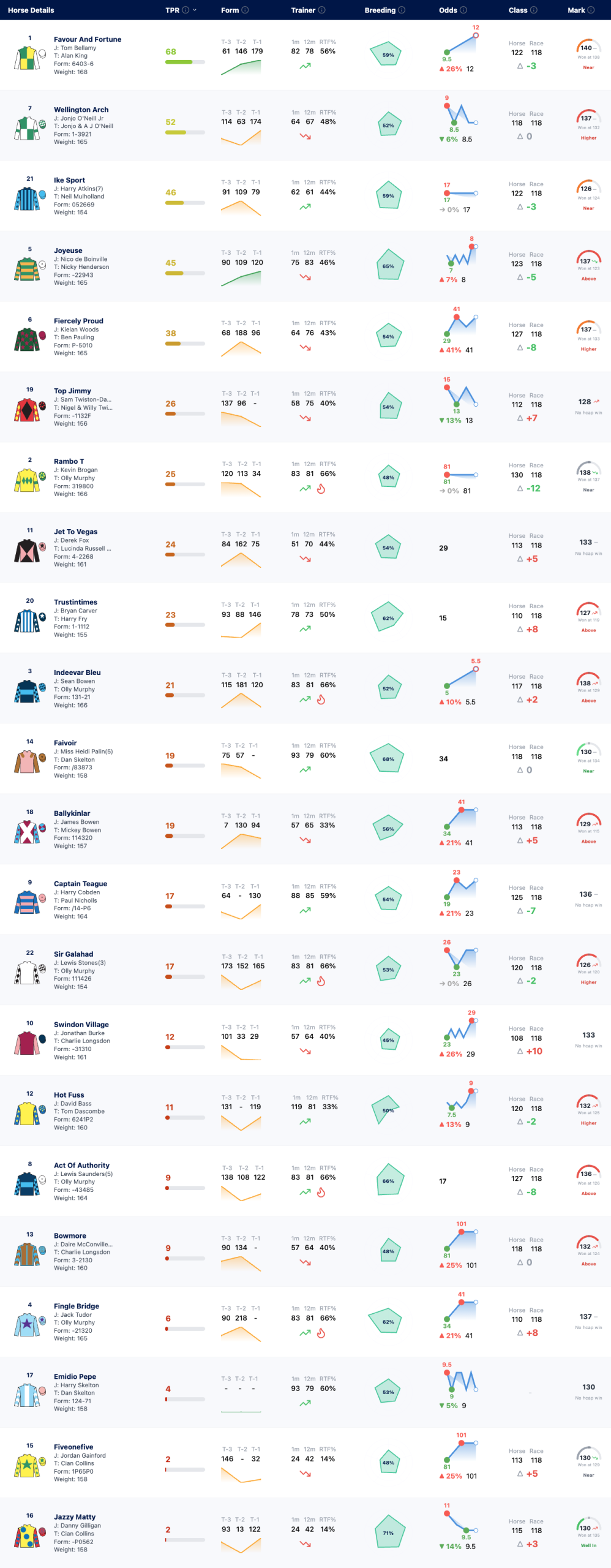
The full field
William Hill Mildmay Novices’ Chase (Grade 1)
2m 5f | Good To Soft | 8 runners
Race Analysis
Eight runners for the Grade 1 novice chase and a race where the Cheltenham form provides the clearest guide. Three of the first four on TPR ran at the Festival three weeks ago, and the form lines they bring set the framework for this analysis.
REGENTS STROLL leads the TPR standings at 57 on the back of proven Aintree form and the best GoingTPR in the field, but the convergence points elsewhere. SALVER at 53 brings the highest-grade Cheltenham form in the race. His run came in the Grade 1 Brown Advisory where he finished third despite being “hampered by faller 13th” with “still plenty to do 3 out” before staying on into third. That is the highest-grade form in the field by some distance, and the excuse was genuine. His T-2 of 129 came winning at Windsor on Soft where he was “towards rear, headed before 12th, ridden before 2 out, joined leader approaching last, led again run-in, kept on.” His T-4 of 140 came winning at Sandown on Good-to-Soft where the comment was simply “comfortably.” The hold-up style (PaceScore 1.2) means he races from the back and closes late. His GoingTPR of 132 ranks second in the field, confirming proven form on ground with cut. His DistTPR of 125 ranks second, meaning he has performed well at this sort of trip before. The ClassDelta of -12 is the biggest class drop in the race, and the Gary and Josh Moore yard is running at 81 against a 74 baseline. The concern is a declining RecentTrend of -31 and a FormStdDev of 29, meaning his figures fluctuate, but the Cheltenham run had a clear excuse that explains the dip.
GOLD DANCER ran second in the Grade 2 handicap chase at Cheltenham, 2 1/4 lengths ahead of REGENTS STROLL, where he was “prominent, led narrowly 3rd, briefly led 4 out, went clear with winner before last, no extra run-in.” That is strong form in context, and his FormStdDev of 12 makes him the most consistent horse in the field. PeakToRecent of 0 means that Cheltenham run was his career best, and RecentTrend of +9 confirms the upward trajectory. ClassDelta of -9 represents a significant drop from that level. The Mullins and Townend combination at Aintree commands respect regardless of numbers, though the yard is running cold at 57 against a 79 baseline. The flags are no Aintree form (TrackTPR 0) and no form at this trip over fences (DistTPR 0), making the 2m5f an untested question.
REGENTS STROLL has the best GoingTPR in the field at 134 and is the only runner with proven Aintree form (TrackTPR 121). The Nicholls and Cobden combination is reliable at spring festivals, and his T-3 of 146 winning at Wincanton on Soft showed real quality when he “made all, increased tempo before 3 out, eased when clear.” But he finished behind GOLD DANCER at Cheltenham, is stepping up in class (ClassDelta +8), and has no form at this distance (DistTPR 0). DOYEN QUEST leads on DistTPR at 148 and brings the Skelton hot trainer signal (93 vs 79), but his figures of 115 and 114 are a clear level below the top two and he is stepping up in class. MIAMI MAGIC has the best TrackTPR in the field at 133 but a cold trainer (58 vs 71) and a ClassDelta of +9 work against him.
The convergence sits with SALVER. Grade 1 Cheltenham form with a genuine excuse, the best TPR, the biggest class drop, proven at the distance, and a trainer in form. GOLD DANCER is the most consistent horse in the race, at career peak with Townend aboard, and the Cheltenham form behind him is solid. Those two look a level above the rest.
🎯WHERE THE DATA CONVERGES
SALVER
GOLD DANCER
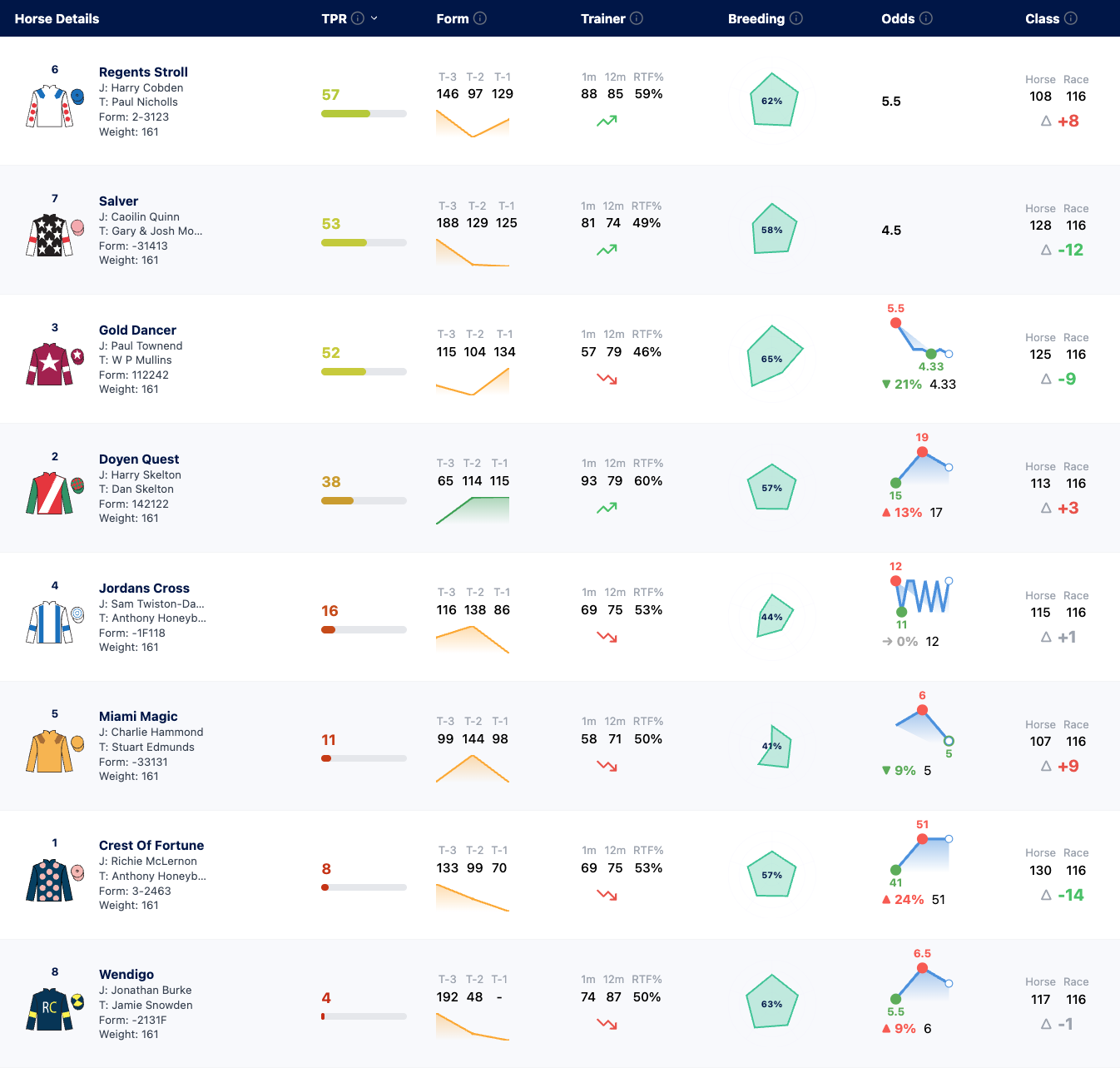
The full field
ThatPrizeGuy Top Novices’ Hurdle (Grade 1)
2m | Good To Soft | 6 runners
Race Analysis
Six runners for the Grade 1 novice hurdle and a race where the Cheltenham form makes the argument before you reach any other metric. SOBER GLORY ran second in the Supreme at Cheltenham three weeks ago, leading until the dying strides where he was “ridden when hung left and hit rail then headed run-in” after a “mistake last.” He led that Grade 1 field for virtually the entire race and was arguably unlucky not to win. In a smaller field at Aintree, the front-running style that nearly won a Supreme becomes an even more potent weapon.
SOBER GLORY sits third on TPR at 39, behind SINNATRA at 51 and BARON NOIR at 40, but the form underneath tells the fuller story. His T-1 of 151 came from that Cheltenham second. His T-2 of 143 came winning at Newbury on Heavy where the comment reads “made all, impressive.” His T-3 of 193 came winning at Newbury on Good-to-Soft where it was “made all, easily.” Two wins where he dominated from the front, and a Grade 1 second where he nearly did the same. His DistTPR of 176 ranks second in the field, confirming strong form at this trip. His GoingTPR of 130 ranks second. The Philip Hobbs and Johnson White yard is running hot at 86 against a 78 baseline. ClassDelta of -2 means he is dropping slightly from that Supreme level. In a six-runner field with only one other confirmed front-runner (STORMING GEORGE, whose figures are a class below), he should be able to dictate the pace on his own terms.
BARON NOIR sits second on TPR at 40 and arrives at career peak (PeakToRecent 0) with a RecentTrend of +20 showing clear improvement. His T-1 of 130 came fourth at Cheltenham on Good-to-Soft at 40/1 where he was “towards rear, headway and went fourth before last, soon outpaced.” That was a better run than his price suggested, and the Alan King yard is running at 82 against a 78 baseline. But his two wins came at Kempton and Uttoxeter at a lower level. ClassDelta of +6 means he is stepping up, and while the improvement curve is real, there is a gap between winning a Kempton novice and beating a Supreme runner-up in a Grade 1 at Aintree.
SINNATRA is the consistency play. His FormStdDev of 3 is remarkable, meaning his last three speed figures of 113, 121 and 119 are almost identical. The Skelton hot trainer signal (93 vs 79) has been a theme across the festival, and ClassDelta of -6 means a class drop. But those figures are a tier below SOBER GLORY’s level. He will run his race but the ceiling looks fixed. LA CONQUIERE leads on GoingTPR (137), TrackTPR (137) and DistTPR (178), the best condition metrics in the field by some distance. Ordinarily those numbers would demand serious attention. But her T-1 of 61 at Cheltenham, where she “lost position 3rd, no chance from 2 out”, and a RecentTrend of -58 tell you the form has collapsed. The talent may still be there from her Newbury win (T-3 of 178) but there is no recent evidence to support it.
The convergence is clear. SOBER GLORY ran second in the Supreme, has won his other starts impressively from the front, drops in class, handles the ground and the trip, and comes from a hot yard. In a small field where he can control the pace, he looks the dominant force.
🎯WHERE THE DATA CONVERGES
SOBER GLORY
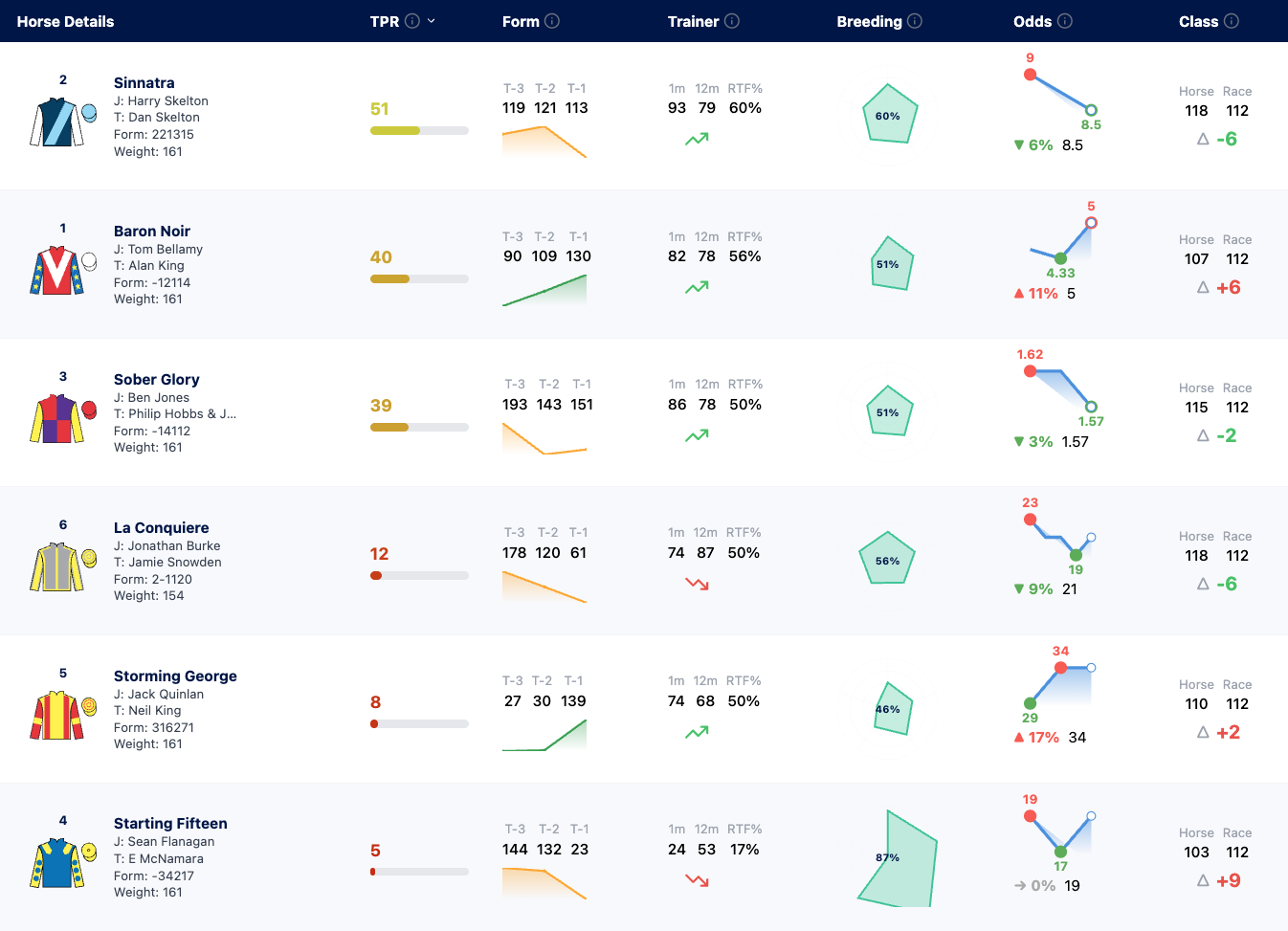
The full field
JCB Melling Chase (Grade 1)
2m 4f | Good To Soft | 7 runners
Race Analysis
The headline race of Day 2 and a Grade 1 where the pace dynamic may prove decisive. Six of the seven runners have a PaceScore above 3.0, meaning almost the entire field wants to race at or near the front. SOLNESS has a PaceScore of 4.0, LEAU DU SUD sits at 3.73, GIDLEIGH PARK at 3.53, JPR ONE at 3.47 and SAINT SEGAL at 3.2. When that many horses want to lead in a seven-runner Grade 1, the early gallop should be fierce and the one who sits off it has a structural advantage.
HEART WOOD is that horse. His PaceScore of 2.93 makes him the only runner in the field below 3.0. He won at Cheltenham on Good three weeks ago where he was “prominent, went second 4 out, led before 2 out, ridden and went clear before last, comfortably.” His T-1 of 179 from that run is the highest last-run figure in the top four on TPR. His T-2 of 232, winning at Tramore on Soft, came when he “led clearly 4 out, kept on well, comfortably.” He has Aintree experience too (TrackTPR 126, rank 3). The concern is volatility: a FormStdDev of 80 is the highest in the field, with a T-3 of just 42 at Punchestown where he “weakened when lost third approaching last.” The gap between his best and worst is enormous. But the Cheltenham win is recent, genuine Grade 1 form, and in a race where the front end should cut each other’s throats, his running style becomes the key differentiator. The figures say the horse arrives in the form of his life, though the De Bromhead yard has cooled recently (67 vs 68 baseline).
GREY DAWNING leads the TPR standings at 33 and has the best GoingTPR in the field at 159, meaning his average speed figure on ground with cut is comfortably superior. He ran second in the Bowl Chase at this course last year over 3m1f (T-4 of 192: “disputed lead, led before last, faced challenge and not fluent last, soon headed, kept on”) and his T-3 of 159 came winning at Haydock on Good-to-Soft described as “impressive.” The Dan Skelton yard is running hot at 93 against a 79 baseline. Today he drops back to 2m4f from those longer trips, which is an interesting move. His Cheltenham last time was over 3m+ where he “weakened run-in” after jumping mistakes. Whether the shorter trip sharpens him up or exposes a lack of speed is the question.
GIDLEIGH PARK has the best proven course form of any runner: TrackTPR of 172 (rank 1) and DistTPR of 172 (rank 1), earned finishing second at Aintree on Good-to-Soft last year where he “led clearly 3rd, headed before last, kept on.” Harry Fry’s yard is running at 78 against a 73 baseline. But his T-1 is 0 after being pulled up at Ascot where jockey said he “jumped poorly and ran flat”, and 83 days off adds a fitness question. The Aintree form demands respect but the last-run evidence is hard to reconcile. SOLNESS won at Leopardstown on Good-to-Soft (T-2 of 172) and Joseph O’Brien’s yard is running at 79 against a 75 baseline, but his T-1 is also 0 after being “tailed off” last time. JPR ONE brings a Tizzard hot trainer signal (96 vs 81) and is dropping in class (ClassDelta -5), but his T-2 of 289 at Musselburgh is an outlier that flatters the profile, and a FormStdDev of 62 says you cannot trust the figures. LEAU DU SUD is Skelton’s second runner with strong Aintree form (TrackTPR 160, rank 2) but has no form at this distance (DistTPR 0).
The convergence sits with the pace angle. In a field of front-runners, HEART WOOD is the one who waits. He won at Cheltenham, has Aintree form, and his running style gives him the structural edge when the speed horses fight for the lead.
🎯WHERE THE DATA CONVERGES
HEART WOOD
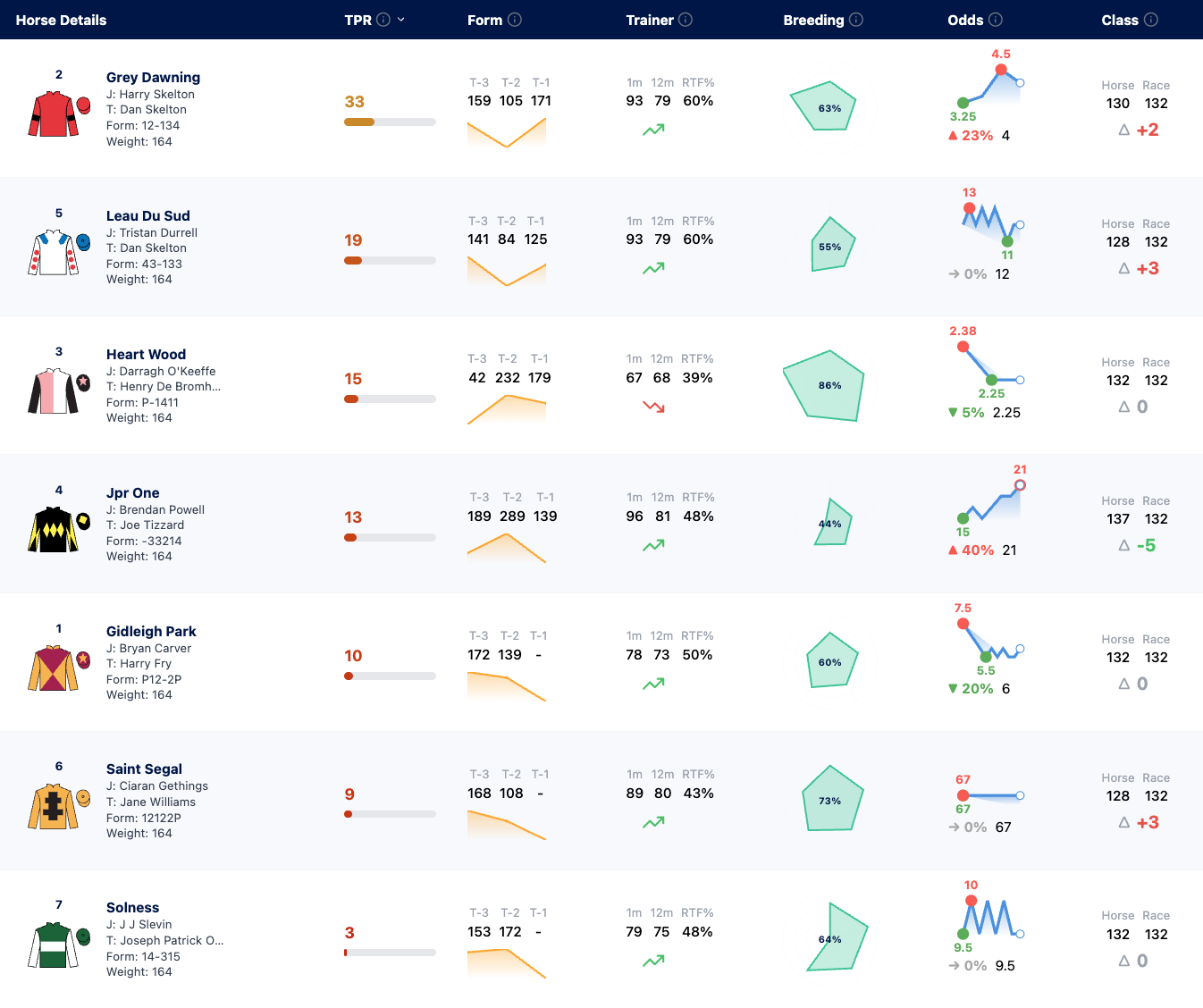
The full field
Randox Topham Handicap Chase (Premier Handicap)
2m 1f | Good To Soft | 30 runners | Over the National Fences
Race Analysis
Thirty runners over the Grand National fences in a Premier Handicap and a race where the data comes with an honest caveat: over these unique obstacles in a field this size, the unexpected happens more often than not. That said, the data still narrows the field, and two angles stand out when you filter through the noise.
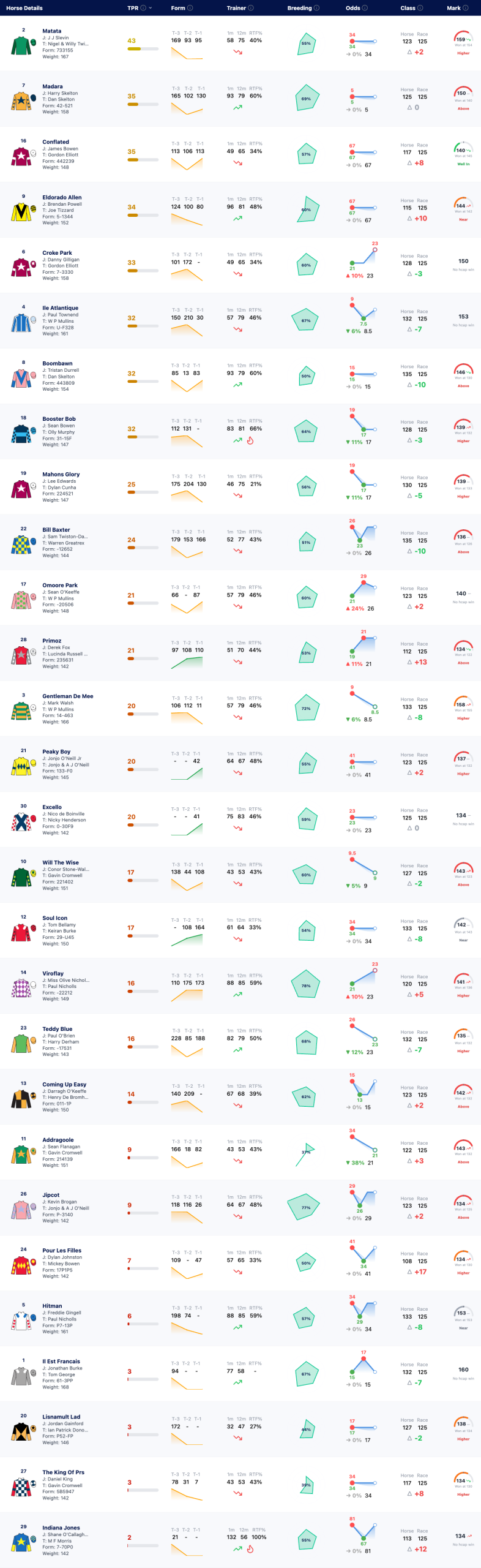
The pace will be fierce. Sixteen of the thirty runners have a PaceScore above 3.0, meaning more than half the field wants to race prominently. In a 30-runner chase over the National fences, that creates carnage at the front. The horses who sit off the pace and pick their way through have the structural advantage. The top of the TPR is bunched: MATATA leads at 42, ELDORADO ALLEN and WILL THE WISE share 38, MADARA and CONFLATED share 35 and CROKE PARK also at 35. No standout.
MADARA won at Cheltenham on Good-to-Soft three weeks ago where he produced “smooth headway from 5 out, led narrowly 2 out, good jump and went clear last, comfortably.” That is the strongest last-run comment of any horse in this field. His PaceScore of 2.33 means he races in mid-division and waits for the pace to unfold, exactly the style that thrives when sixteen horses are fighting for the lead over these fences. The Dan Skelton yard is running hot at 93 against a 79 baseline and has been a theme across the festival. His GoingTPR of 117 ranks fifth in the field, confirming he handles ground with cut. The caveat is real: he has never been to Aintree (TrackTPR 0) and has no form at this distance (DistTPR 0). But the Cheltenham win was authoritative, the running style fits, and Skelton would not send him here without believing he can handle the obstacles.
At a bigger price, SOUL ICON has the most convergent handicap profile of any horse in the thirty. His GoingTPR of 135 ranks second in the entire field, meaning his average speed figure on ground with cut is beaten only by one horse. His ClassDelta of -8 represents a significant drop in class. His ORDelta of -1 means the handicapper has him almost exactly at his winning mark, and his PeakToRecent of 0 confirms his T-1 of 164, posted at Kempton on Good-to-Soft, was his career best. Six independent metrics, going, class, handicap mark, career peak, course form (TrackTPR 82) and distance form (DistTPR 126), all point the same way. That is convergence. He will be a massive price because the trainer is unfashionable (Keiran Burke, 61 vs 64 baseline) and the TPR of 17 does not scream winner, but the handicap variables paint a picture of a horse arriving at his peak, well treated by the handicapper, and dropping sharply in class at a track he has run at before.
The field is deep. PRAIRIE WOLF brings two consecutive wins and the biggest upward trend in the race (RecentTrend +47), with Aintree form (TrackTPR 113), though his trainer acknowledged the improvement came from a drop in grade and this is back up to Class 1. VIROFLAY has the strongest pair of recent figures in the field (T-1 173, T-2 175) with Nicholls (running at 88 against an 85 baseline) and a 5lb claimer, but all his form is at Kempton, flat and sharp, nothing like the National fences. TEDDY BLUE won last time (T-1 188) and is dropping in class (ClassDelta -7) at a low weight, but a FormStdDev of 60 tells you the volatility is extreme. CONFLATED has the most consistent recent form of any runner (FormStdDev 4: literally 113, 106, 113) and is Well In (ORDelta -5, Falling), but at twelve years old with Elliott running cold, the peak has likely passed. BILL BAXTER posted a figure of 179 at Aintree over these fences last December and is dropping ten pounds in class, the most consistent horse in the field after CONFLATED (FormStdDev 11), but the trainer is running cold.
In a 30-runner cavalry charge, anything can happen. But MADARA brings the best recent form, the hottest trainer, and a running style that fits the pace scenario. SOUL ICON at a big price ticks more convergence boxes than any horse in the field.
🎯WHERE THE DATA CONVERGES
MADARA
SOUL ICON
The full field
Oddschecker Sefton Novices’ Hurdle (Grade 1)
2m 4½f | Good To Soft | 13 runners
Race Analysis
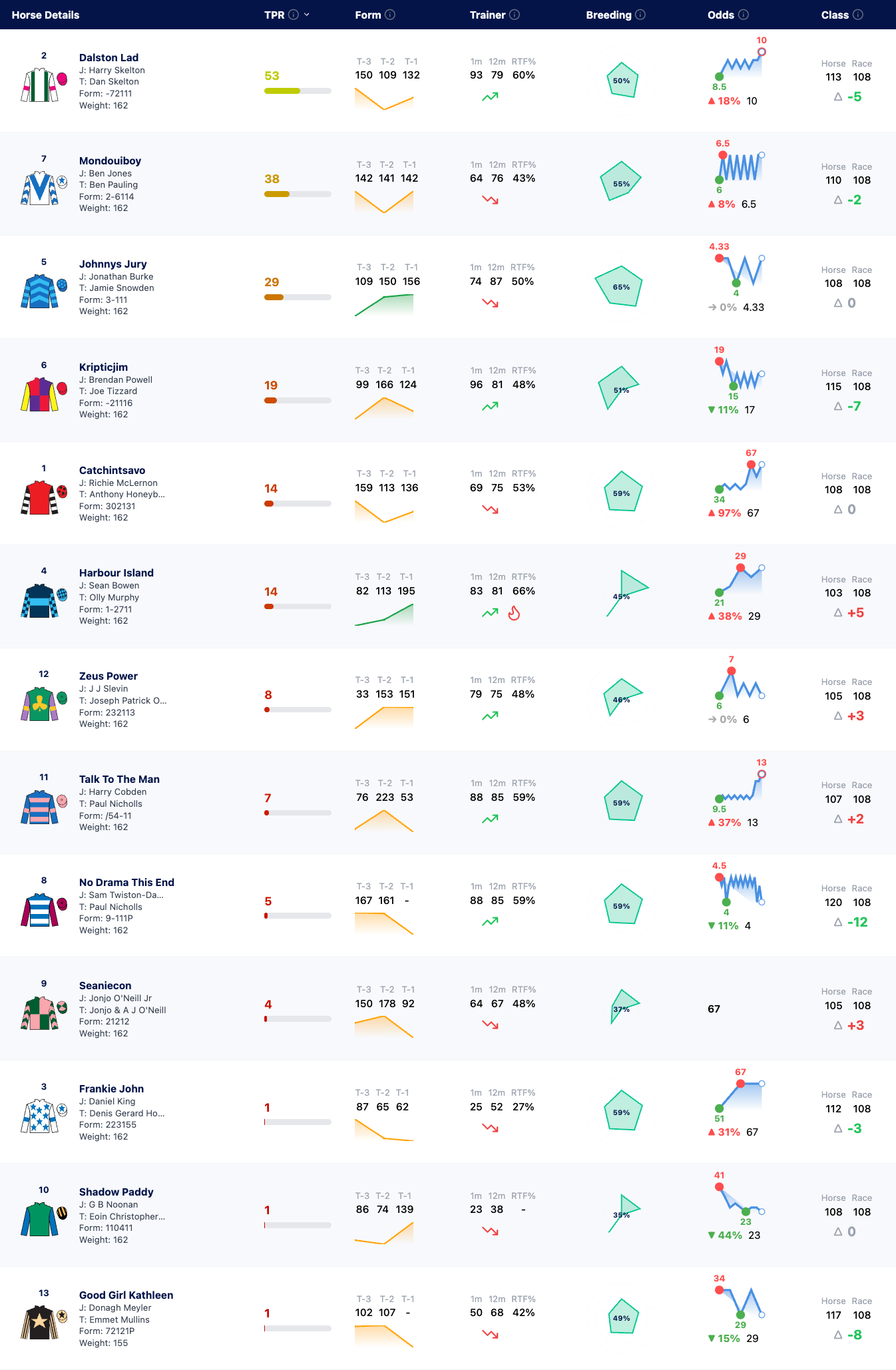
Thirteen runners for the Grade 1 novice hurdle and a race dominated by the Cheltenham form from three weeks ago, with a significant caveat. The Albert Bartlett at the Festival is one of the most demanding races for novice hurdlers, a gruelling three-mile slog that takes its toll physically. Horses who ran in it often bounce next time out. Two of the top four on TPR, MONDOUIBOY and JOHNNYS JURY, both ran in that race. Any assessment has to weigh the form against the risk of a quick-turnaround regression.
On figures alone, JOHNNYS JURY has the strongest case. He won the Albert Bartlett at Cheltenham on Soft at 22/1, coming from the back of the field: “in rear, still plenty to do before 2 out, ridden and headway on outer after 2 out, 2 lengths down last, kept on well and led towards finish.” His T-1 of 156 is the highest last-run figure of the principals. Before that, his T-2 of 150 came winning at Carlisle “comfortably.” Three consecutive wins, at career peak (PeakToRecent 0), and an improving RecentTrend of +23. His PaceScore of 2.93 means he sits off the pace, which matters here: ten of the thirteen runners have a PaceScore above 3.0, with SEANIECON and DALSTON LAD both at 4.0 guaranteed to set a strong gallop. JOHNNYS JURY is a proven closer in a race that should be run at a genuine tempo. The flag is the bounce risk after Cheltenham, and a trainer running cold (74 vs 87). The form says yes, the circumstances urge caution.
MONDOUIBOY is the consistency play. His FormStdDev of 0 is the lowest we have seen on the entire Aintree card across both days: his last three speed figures are 142, 141 and 142. He runs to an identical level every single time. He led the Albert Bartlett before “weakening inside final 110yds” and finishing fourth, beaten by JOHNNYS JURY. GoingTPR of 123 ranks second in the field, and ClassDelta of -2 means a slight drop. But the same bounce concern applies, and the trainer (Ben Pauling, 64 vs 76) is cold.
HARBOUR ISLAND is the one who avoided Cheltenham and arrives fresh. His T-1 of 195 came winning at Ffos Las on Heavy where he was “ridden and pressed leader before last, led after last, went clear run-in, readily.” That is the highest individual speed figure of any horse in the top six, and the way he powered clear suggests a horse with stamina reserves to spare. The Olly Murphy yard is running at 83 against an 81 baseline, and Sean Bowen takes the ride. His GoingTPR of 114 ranks fourth. The concern is the profile: a FormStdDev of 48 means the figures are volatile (195, 113, 82), and the 195 came at a small track in testing conditions against modest opposition. The breeding does not scream three miles. But the power he showed that day and the way he stayed on could suggest the step up in trip unlocks something. At a price, he is the fresh horse from a hot yard with a figure that dwarfs the field.
DALSTON LAD is the only horse with proven Aintree form (TrackTPR 166, rank 1) and proven distance form (DistTPR 120, rank 1). The Skelton hot trainer signal (93 vs 79) has been a recurring theme. Three consecutive wins, ClassDelta of -5. But his figures (132, 109, 150) are a level below the top contenders, and as a confirmed front-runner (PaceScore 4.0) he will be fighting for the lead in a race with strong pace. ZEUS POWER ran third at Cheltenham with excuses (“hampered after 4 out, bit short of room after 3 out, did well in the circumstances”) at 40/1, and Joseph O’Brien’s yard is running at 79 against a 75 baseline. His PaceScore of 2.0 makes him the deepest closer in the field. But a FormStdDev of 56 and a T-3 of 33 tell you the volatility is extreme.
The convergence is complicated by the bounce risk. JOHNNYS JURY has the best form, the right running style, and beat the most consistent horse in the field at Cheltenham. But three weeks after the Albert Bartlett, caution is warranted. HARBOUR ISLAND is the fresh alternative from a hot yard, with a figure that demands respect and the potential to improve for the trip.
🎯WHERE THE DATA CONVERGES
JOHNNYS JURY
HARBOUR ISLAND
The full field
Debenhams Handicap Hurdle (Conditional Jockeys & Amateur Riders)
2m | Good To Soft | 22 runners
Race Analysis
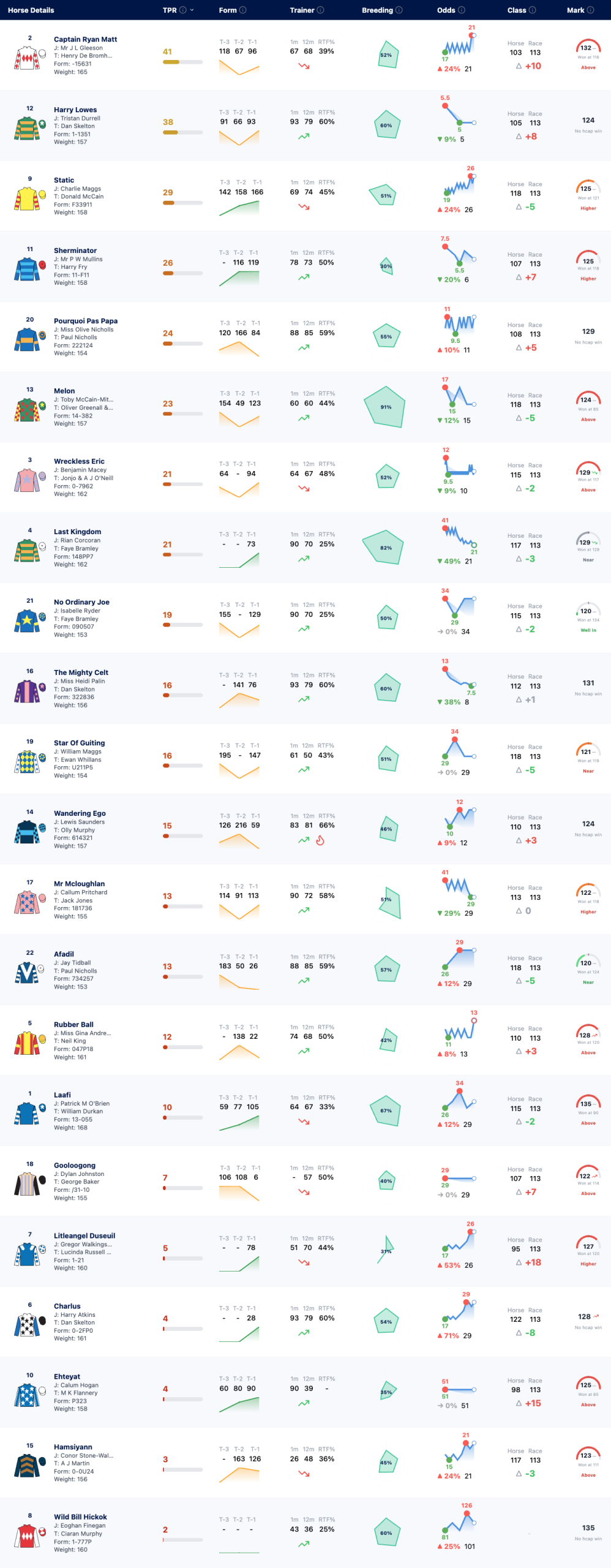
Twenty-two runners in a conditional jockeys handicap to close Day 2, and a race where the data is honest about its own limitations. The top of the TPR is bunched and uninspiring: CAPTAIN RYAN MATT leads at 41 but has been off 99 days with a ClassDelta of +10 and an ORDelta of +16. HARRY LOWES sits second at 38 with the Skelton hot trainer signal (93 vs 79) but his recent figures of 93, 66 and 91 are a tier below the class of race. No single horse screams convergence across the headline metrics. In races like this, the handicap variables and the trainer angles become the tiebreakers.
STATIC has the cleanest form profile. Two consecutive wins: T-1 of 166 at Bangor on Good where he “led, pushed along 3 out, kept on, gamely”, and T-2 of 158 at Haydock on Good-to-Soft where he was “prominent, led 3rd, ridden before last, ran on.” His FormStdDev of 10 across 166, 158 and 142 makes him one of the most consistent in the field, and the trajectory is upward: RecentTrend of +12, PeakToRecent of 0 meaning his last run was his career best. He is only five years old with scope to improve further. ClassDelta of -5 means he is dropping in class. His PaceScore of 2.93 means he sits just off the pace, relevant in a race where thirteen of the twenty-two runners have a PaceScore above 3.0. The going form (GoingTPR 79) is modest and the Donald McCain yard (69 vs 74) is not in peak form, but the figures are progressive and authoritative.
The other angle that demands attention is the Faye Bramley yard, running hot at 90 against a 70 baseline, the highest trainer momentum in the race. Bramley saddles two runners, and both carry interesting handicap profiles that our new handicap intelligence variables flag.
NO ORDINARY JOE has the best Aintree form in the field (TrackTPR 98, rank 1) and the best distance form (DistTPR 116, rank 2). His ORDelta of -14 is the most dramatic handicap advantage in the entire race, meaning the handicapper has dropped him fourteen pounds below the mark at which he last won. In our data, that labels him “Well In”, the strongest positive signal in the handicap framework. His T-3 of 155 at Ascot on Good-to-Soft showed real ability when he “led just before 2 out, headed approaching last.” The concern is that the other recent runs have been poor: T-1 129 “weakened gradually” and T-2 is 0 after losing a shoe. At ten years old and a front-runner in a strong-pace race, you are trusting the mark over the recent form. But -14 off the winning mark at a course where he has form is hard to dismiss entirely.
LAST KINGDOM is the quieter play. Bought from Willie Mullins in February, he has had three quick runs for Bramley, all unproductive on the surface: two pull-ups and a seventh. But the ORTrajectory is Falling, the mark has come down significantly as a result, and his ORDelta sits at 0 (Near Winning Mark) meaning he is now back at the level where the handicapper thinks he can compete. ClassDelta of -3 means he drops in class today. He is only five and the sire Choeur Du Nord (SireTPR 73, SireDistTPR 85) is a solid hurdle influence. The figures offer nothing to work with, but the pattern of three quick runs to get the mark down before a target race is a well-trodden training approach. Whether Aintree on a Friday evening is that target is the question only the yard can answer.
This is not a race for strong opinions. The data says STATIC on the figures: two wins, career peak, consistent, dropping in class. The Bramley yard at a bigger price offers NO ORDINARY JOE on the handicap mark and course form, with LAST KINGDOM as the intriguing outsider whose recent runs may not tell the whole story.
🎯WHERE THE DATA CONVERGES
STATIC
NO ORDINARY JOE
LAST KINGDOM
The full field
The day at a glance
Where the data landed, race by race.
Conclusion
That is your lot for Day 2. Seven races, seven sets of data, and another card where form, speed figures, and market confidence have clashed in fascinating ways. The Placepot pool makes this worth engaging with again — a guaranteed minimum of £400,000 for a £2 perm.
We will be back tomorrow with the full Day 3 guide for Saturday at Aintree, headlined by the Grand National itself. Same format, same data, same edge. See you then.
Access every racecard, live analytics and the complete blog on your phone:
More racedays, read by the data
Get the next raceday guide, free
Every big raceday we read the whole card with the model: ratings, speed figures, pace and draw. We send the next one to your inbox the morning it is published. No charge, and you can unsubscribe in one click.
We use your email to send racing guides and occasional news about EquiAnalytix. We never share it. 18+ | Please gamble responsibly.
Every runner, every race, every day
Everything this guide runs on, the percentages, the engine readings, the figures, the pace maps, lives on the dashboard for every British and Irish race. From 27p a day.
Explore the dashboard →EquiAnalytix provides horse racing data and analysis only. We do not take bets. 18+ | Please gamble responsibly. GamCare 0808 8020 133.