Introduction
The Grand National Festival. Three days at Aintree that follow hot on the heels of Cheltenham — the two pinnacles of the jumps calendar, barely three weeks apart. Thursday’s opening card is seven races deep, headlined by the Grade 1 Aintree Hurdle and the Bowl Chase, with competitive handicaps and the Foxhunters providing some of the best each-way puzzles of the spring. The fields are strong, the good spring ground should let the best horses show their ability, and the data has plenty to say.
This is our race-by-race breakdown of Day 1 at Aintree, produced in partnership with the Tote. For each race, we lay out what the EquiAnalytix model sees, where the data aligns with the market, and, more importantly, where it disagrees. The Tote Placepot runs across the first six races, and we have built an interactive Placepot builder at the bottom of this guide so you can construct your perm as you read through.
How We Approach The Data
Our analysis is built around the TPR (Total Performance Rating), a machine learning-derived metric that combines a horse’s speed figures, going preferences, distance profile, track record, and trainer momentum into a single forward-looking score. Across our full database, horses ranked in the top three on TPR win approximately 55% of all races. The top four account for around 67%.
The supporting metrics you will see throughout:
- T-1 through T-5: Class-adjusted speed figures from the last five runs. T-1 is the most recent and carries the most weight. Context matters: a T-1 earned at a Cheltenham Festival Grade 1 is a different proposition to one posted in a Wetherby novice hurdle.
- DistTPR: Average performance at today’s race distance. Particularly important at Aintree where the unique track configuration rewards horses with proven stamina over these trips.
- GoingTPR: Performance on the relevant going. With Good to Soft ground expected, this metric highlights which runners have proven form when there is some give underfoot.
- Trainer Momentum: Comparing a trainer’s recent 1-month strike rate against their 12-month baseline. Several yards arrive at Aintree in peak spring form. Others have quietened down since Cheltenham.
Convergence Analysis
Where multiple independent data points, TPR ranking, recent speed figures, distance profile, going suitability, and trainer form, all point to the same horse, we call that convergence. It is the foundation of everything we do. A horse can top the TPR rankings but if they have never run on soft ground and the trainer’s strike rate has halved in the last month, the convergence is weak. When everything aligns, the signal is strong. We will show you exactly where that happens, race by race.
Let’s get into the card.
Boodles Anniversary 4-Y-O Juvenile Hurdle (Grade 1)
2m 1f | Good To Soft | 10 runners
Race Analysis
The Cheltenham form from three weeks ago runs right through this race. Three of the principals, MAESTRO CONTI, MINELLA STUDY and SELMA DE VARY, all ran in the Triumph Hurdle. The finishing order that day: MAESTRO CONTI second, MINELLA STUDY third (lost second on the line), SELMA DE VARY fourth after being hampered approaching the last. That form is the starting point.
Our model rates each horse using a TPR (Total Performance Rating), a machine learning score that combines speed figures, going preferences, distance profile and trainer form into a single number. The higher the TPR, the stronger the model considers the horse. MINELLA STUDY tops the standings at 41, with LORD at 40 and MAESTRO CONTI at 39. The top three are closely matched and there is no standout.
Where things get interesting is the pace. We track each horse’s running style through a PaceScore, a number from 1 to 4 based on their recent racing positions: 4.0 means they lead every time, 1.0 means they are always held up at the back. Four of the ten runners here score above 3.0, which in a field this size means a strong early gallop. LORD and AQUA BLEU are both confirmed front-runners at 4.0, with WINSTON JUNIOR (3.2) and MINELLA STUDY (3.07) also pressing forward. When the pace is genuine, the data consistently shows it is the horses who sit off it and close late that benefit most.
MAESTRO CONTI is the closer. His PaceScore of 2.08 means he races in mid-division and delivers late, exactly the style rewarded when the front end goes hard. His two most recent speed figures, our class-adjusted T-1 (most recent run) and T-2 (the run before), came at Cheltenham on Soft: 132 and 145 respectively. The T-2 of 145 came with a win where he “ridden to lead run-in, ran on.” The T-1 of 132 came in the Triumph when he “pressed leaders 2 out, kept on well, went second post.” We measure consistency through FormStdDev, the standard deviation of the last three speed figures, where lower means more reliable. His FormStdDev of 11 is excellent. He is also trending upward: his most recent figure is 7 points higher than his figure from two starts ago, and he is only 13 points off his career peak. The Dan Skelton yard adds another layer. We compare each trainer’s average speed figures over the last month against their 12-month baseline. Skelton is running at 91 against a baseline of 79, the hottest yard in this race by a significant margin.
LORD is the data anomaly. His T-2 of 233, recorded at Aintree in December on Soft, is the highest individual speed figure in the entire field. He “made all, clear after 4th, went clear again after 2 out, kept on well.” His TrackTPR, the average speed rating at today’s course, is 233, best in the race. His GoingTPR, average rating on today’s ground conditions, is 170, also best in the race. And his ClassDelta, which measures whether a horse is stepping up or dropping down in class today compared to recent races (negative means an easier race), is -11: the biggest class drop in the field. Course form, going form, and class advantage all point his way. But the volatility is extreme. His FormStdDev of 91 means the gap between his best and worst is enormous: 233 at Aintree, 24 at Cheltenham. If the pace falls kindly and his jumping holds together, the Aintree form says he belongs at the front of this race. If not, history says he can empty quickly.
WINSTON JUNIOR is worth flagging through the class lens. His ClassDelta of +6 means he is the only horse in the top five stepping up from his recent level. He ran a gutsy second at Cheltenham after meeting trouble, but that was a handicap. This is a Grade 1 against horses who finished ahead of him on the biggest stage, and a declining speed figure trend works against him.
MINELLA STUDY is the safest horse in the race. FormStdDev of 8 means he runs to a near-identical level every time. His GoingTPR of 144 confirms he handles cut. But MAESTRO CONTI beat him at Cheltenham, the Skelton momentum is stronger, and the pace setup favours the deeper closer. The convergence points to MAESTRO CONTI: Cheltenham form, trainer momentum, consistency, running style that fits the pace, and a horse close to his peak. LORD is the wild card whose Aintree course form simply cannot be ignored.
🎯WHERE THE DATA CONVERGES
MAESTRO CONTI
LORD
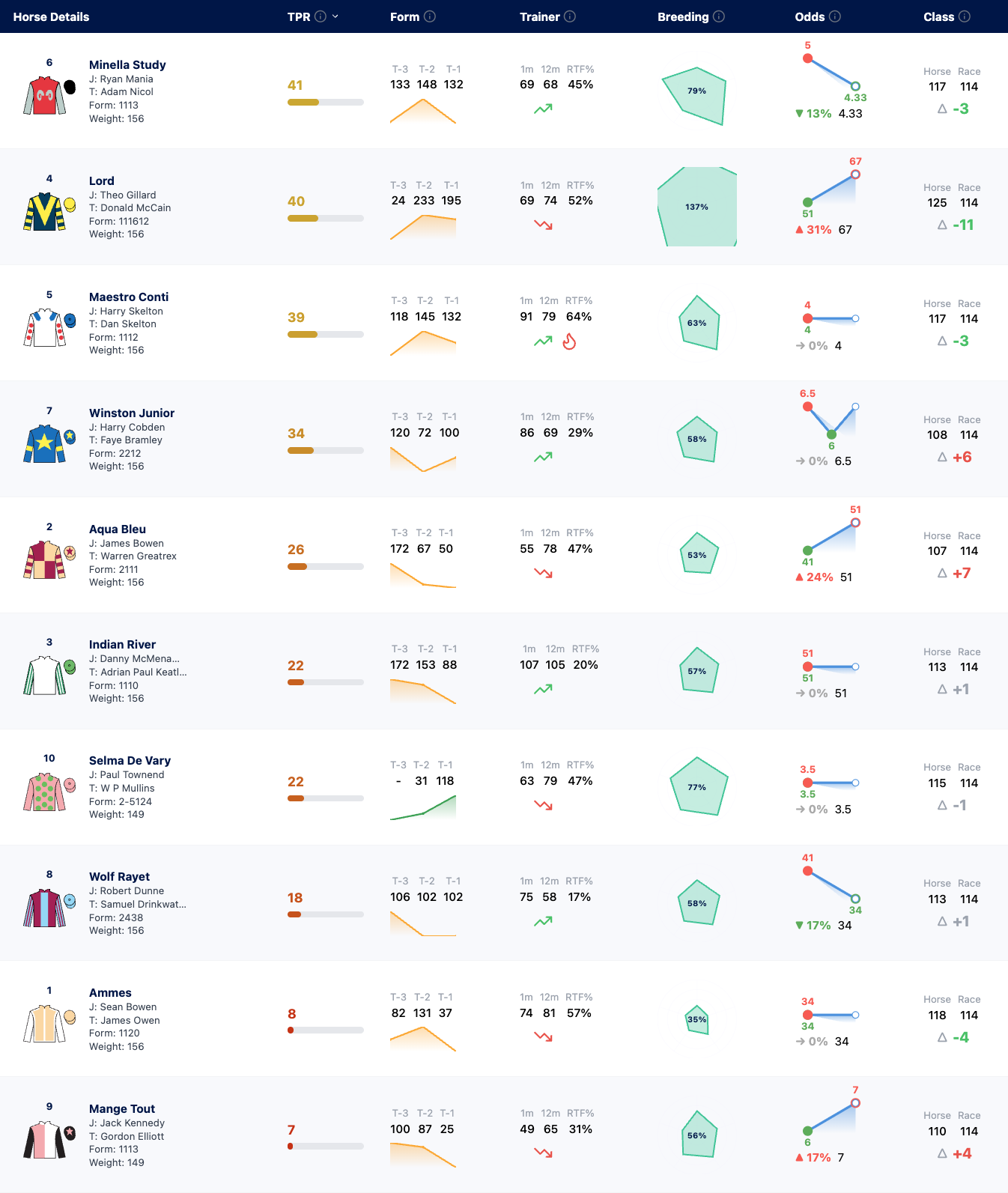
The full field
William Hill Manifesto Novices’ Chase (Grade 1)
2m 4f | Good To Soft | 5 runners
Race Analysis
Just five runners for the Grade 1 novice chase, but the small field masks a fascinating data picture. LULAMBA tops the TPR standings at 22, three points clear of the next horse. Nicky Henderson’s five-year-old also leads on GoingTPR at 164, meaning his average speed figure on ground with some give is comfortably the best in the field. On Good-to-Soft, that metric matters a great deal.
The form underneath the numbers is high class. LULAMBA‘s T-3 of 194 came at Sandown on Good-to-Soft in December where the comment reads “joined leader going easily 2 out, led after 2 out, went clear from last, impressive.” That word, impressive, is not one the race commentators reach for often. It was a performance that marked him out as a potentially special novice. His T-1 of 146 came at Cheltenham on Good-to-Soft three weeks ago when he was “challenging when mistake 2 out, no extra run-in” and faded to third. The blunder two out clearly cost him momentum, and the 146 should be read with that context. His T-2 of 134 came on Heavy at Newbury where he still won “readily.” Across varying conditions and opposition, this horse consistently competes at the top level. The step up from 2m to 2m4f looks a natural progression for a son of Walk In The Park from a Henderson yard that has always believed he would be better over a trip. ClassDelta of -2 means he is dropping slightly in class, and the Henderson/de Boinville combination at a spring festival needs no further endorsement.
BLUEKING D’OROUX brings a T-1 of 200 from Kempton three weeks ago, which is the highest last-run figure in the field. His PeakToRecent is 0, meaning that run was his career best, and his RecentTrend of +14 shows clear improvement. Those numbers are eye-catching. But context matters: the Kempton run came on Good ground against lesser opposition, and his GoingTPR of 102 ranks only third. The raw figures flatter him relative to the class of horse he has been beating. At 2m4f on Good-to-Soft in a Grade 1, the level rises sharply. He leads on DistTPR at 139 and has seen the track before (TrackTPR 88), so he is the most likely to be involved behind the favourite.
KOKTAIL DIVIN is the most consistent in the field with a FormStdDev of just 6, and has Aintree experience (TrackTPR 108, rank 2). But his ClassDelta of +13 is enormous, meaning today’s race is significantly harder than anything he has faced recently, and his figures of 108, 111 and 121 are a level below the top two. MAMBONUMBERFIVE has the best TrackTPR in the field at 114, having won at Aintree on Good-to-Soft in November where he “led approaching last, ridden and kept on.” Genuine course form, but a cold trainer signal (1-month TPR of 62 against a 76 baseline) and 61 days off after “jumping poorly” are hard to ignore. JAX JUNIOR won at Kempton and Sandown earlier in the season but managed just a T-1 of 74 at Cheltenham last time, a steep drop.
The convergence is clear. LULAMBA leads on TPR, leads on GoingTPR, is dropping in class, stepping up to a trip that should suit, and produced a performance at Sandown that puts him a level above this field on his day. The Cheltenham run had a valid excuse. Everything points his way.
🎯WHERE THE DATA CONVERGES
LULAMBA
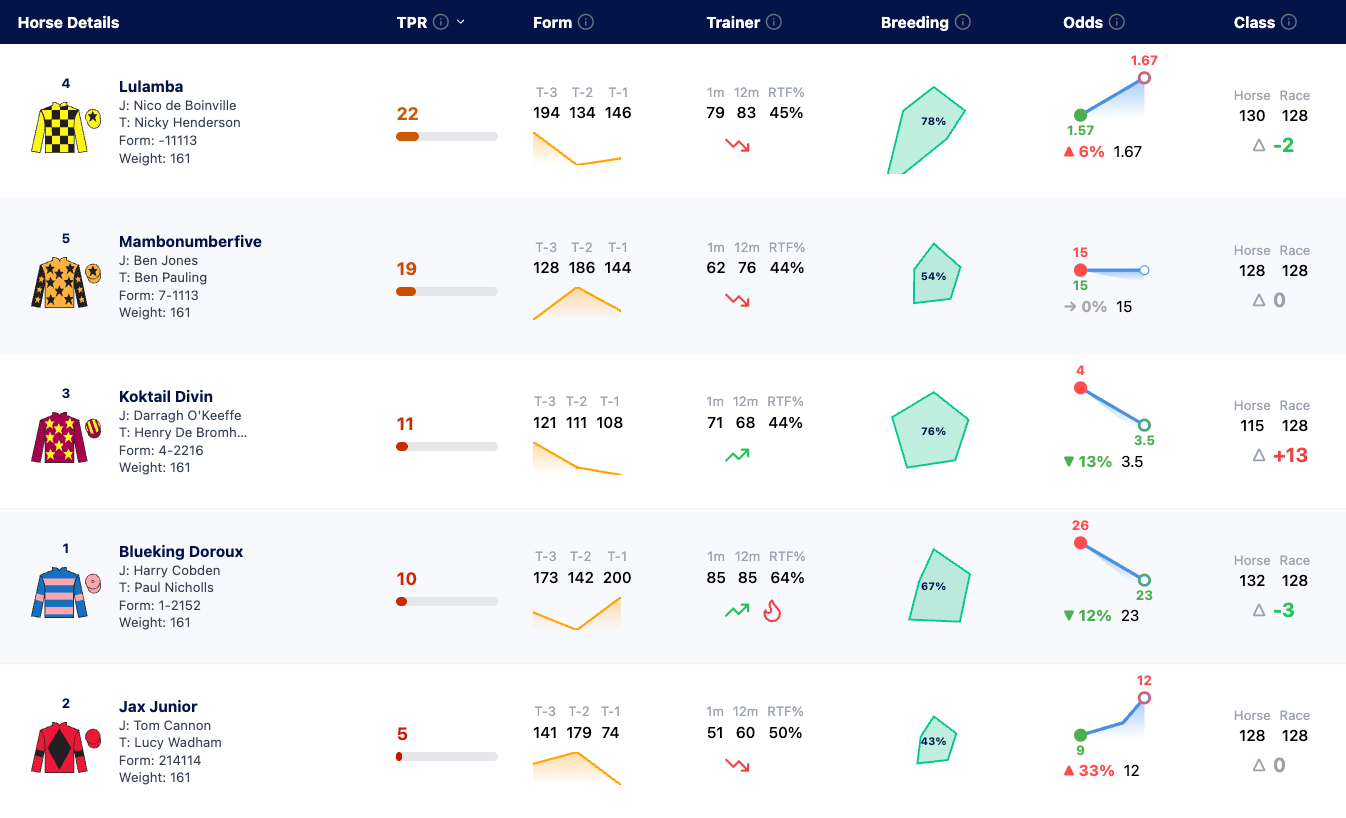
The full field
Racing Welfare Bowl Chase (Grade 1)
3m 1f | Good To Soft | 5 runners
Race Analysis
Another five-runner Grade 1, and this time the data convergence is as clear as it gets on the card. JANGO BAIE leads the TPR standings at 51, twenty-nine points clear of the second horse. That is the biggest margin on any race today. He also leads on GoingTPR at 154 and TrackTPR at 139, meaning he has the best average speed figures both on today’s ground conditions and at today’s course. When the same horse tops all three metrics, you pay attention.
The form underneath confirms it. JANGO BAIE‘s T-1 of 192 came at Cheltenham on Good-to-Soft three weeks ago where he was “4 lengths down last, kept on but no match for winner”, finishing second in strong company. His T-2 of 216, recorded at Kempton on Good in December, is the highest individual speed figure in the field: despite finishing fourth, “challenging 2 out, kept on” tells you he was competing at the highest level. His T-3 of 161 came winning at Ascot on Good where the comment reads “went clear after 2 out, impressive.” And crucially, he has been to Aintree before. His T-4 of 172 came here on Good-to-Soft last April where he was “headway after 2 out, ran on well” to finish third after a mistake cost him position. The RecentTrend of +15 means he is running faster than two starts ago, and PeakToRecent of 24 tells us he is close to his best. ClassDelta of -5 means he is dropping in class. Nicky Henderson and Nico de Boinville arrive with the strongest hand in the race by a significant margin.
The pace angle adds a wrinkle. Three of the five runners have a PaceScore above 3.8, meaning they want to race at or near the front. JANGO BAIE (3.93), PIC D’ORHY (4.0) and PROTEKTORAT (3.93) will all be prominent. In a five-runner race, that is unusual. PIC D’ORHY in particular will try to lead every step, and his T-3 of 201 at Wetherby on Good shows he has posted a huge figure in the past. But a FormStdDev of 51 tells you the other side of the story: his T-2 of 79 at Ascot came when he “weakened before 2 out.” At eleven years old and 54 days off, he is the volatile element who could set a searching pace or empty at any stage.
IMPAIRE ET PASSE is the question mark. Mullins and Townend won at Aintree on Good-to-Soft last April with this horse, where his figure of 176 was earned “midfield on outer, headway 4 out, led before last, ridden out.” He has proven course form (TrackTPR 114) and ranks second on GoingTPR at 112. But his recent profile is alarming: pulled up at Cheltenham three weeks ago (“never going well, never travelling, vet had nothing to report”) after a figure of just 51 winning on Heavy at Gowran Park before that. His T-1 and T-3 are both 0 from a pull-up and a brought-down. The talent is there from last spring, but there is no recent evidence he can reproduce it.
PROTEKTORAT brings remarkable consistency: a FormStdDev of 3 across his last three runs of 144, 138 and 138. The Skelton yard’s hot trainer signal (91 vs 79 baseline) applies, and his TrackTPR of 132 confirms strong Aintree form from last year. But a ClassDelta of +8 means he is stepping up significantly, and those consistent figures are a class below JANGO BAIE‘s level. SPILLANE’S TOWER at ClassDelta +12 and 75 days off does not belong in this analysis.
The convergence is emphatic. JANGO BAIE leads on TPR, GoingTPR and TrackTPR, is dropping in class, trending upward, proven at the course, and trained by a handler who targets these spring festivals. This is the most one-sided data picture on the card.
🎯WHERE THE DATA CONVERGES
JANGO BAIE
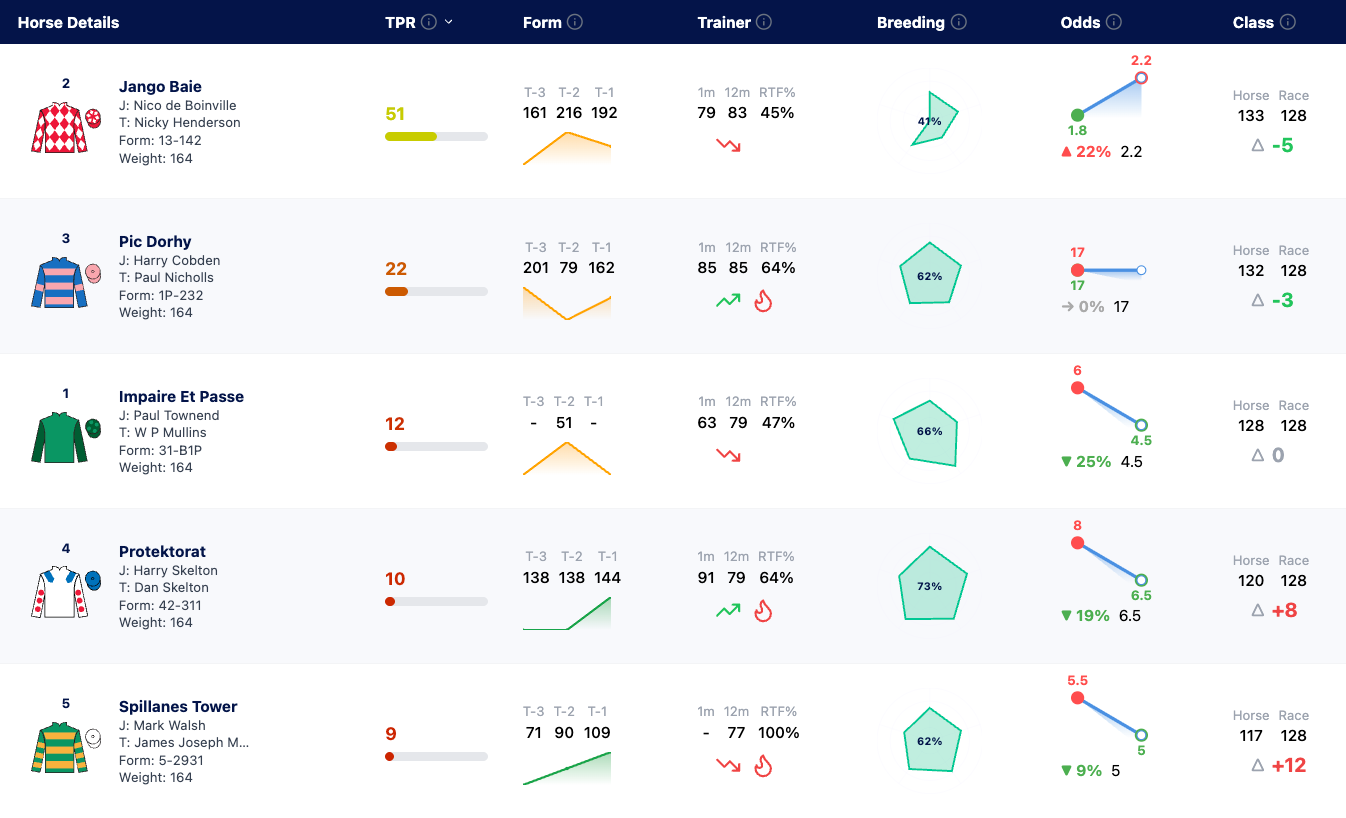
The full field
Randox Foxhunters’ Open Hunters’ Chase
2m 5f | Good To Soft | 25 runners
Race Analysis
Twenty-five runners over the Grand National fences and a race where the data comes with an honest caveat: several of these horses have significant point-to-point form that our model cannot capture. Where T-1 or T-2 shows as zero, it almost certainly means the horse has been competing between the flags rather than under rules. With that in mind, we focus on what the data does tell us, and one horse stands out clearly.
UNEXPECTED PARTY tops the TPR standings at 45, eight points clear of the rest of the field. He is a former Cheltenham Festival winner from 2024 who has taken to hunter chases really well. The step up to this sort of trip, often run at a slower pace than his previous races under rules, has suited him, and his T-1 of 135 and T-5 of 136 show he is operating at a consistent level. His ClassDelta of -13 is the biggest class drop in the entire race, meaning today’s contest is significantly easier than what he has been used to. The Dan Skelton yard is running at a 1-month TPR of 91 against a 79 baseline, the same hot trainer signal we flagged with MAESTRO CONTI in Race 1. A proven jumper of this calibre should handle Aintree’s unique obstacles. At Haydock last time he won with ease, and the horse he beat that day was subsequently only eighth at the Cheltenham Festival last month, giving the form a solid line of reference.
BARTON SNOW and ITS ON THE LINE bring the strongest recent form reference. BARTON SNOW was one of the easiest winners of last month’s Cheltenham Festival, with ITS ON THE LINE finishing second yet again. BARTON SNOW’s GoingTPR of 106 ranks second in this field, his FormStdDev of 11 makes him one of the most consistent, and he arrives fresh. ITS ON THE LINE has the pedigree of an Emmet Mullins horse with Derek O’Connor riding, always a potent hunters’ combination. But neither horse’s figures match UNEXPECTED PARTY‘s level. BARTON SNOW’s T-1 of 109 and ITS ON THE LINE’s 108 trail the top-rated horse significantly. The Cheltenham form is strong within its own context, but the class gap is real.
GRACCHUS DE BALME is worth noting: he leads the field on both TrackTPR (126) and DistTPR (126), the best proven course and distance form of any runner. But his T-1 and T-2 are both zero, meaning his recent runs are invisible to us, almost certainly point-to-point form we cannot assess. JAVA POINT carries an extraordinary trainer momentum signal, a 1-month TPR of 143 against a 76 baseline, and is near his career peak with a T-1 of 143 just 20 days ago. He is one for those who want to include a value angle in wider exotic bets.
In a 25-runner cavalry charge over the National fences, anything can happen. But when the data shows a former Festival winner dropping sharply in class, from a yard in peak form, with proven stamina credentials and a solid form reference through collateral lines, the convergence is hard to argue with. UNEXPECTED PARTY is the standout.
🎯WHERE THE DATA CONVERGES
UNEXPECTED PARTY
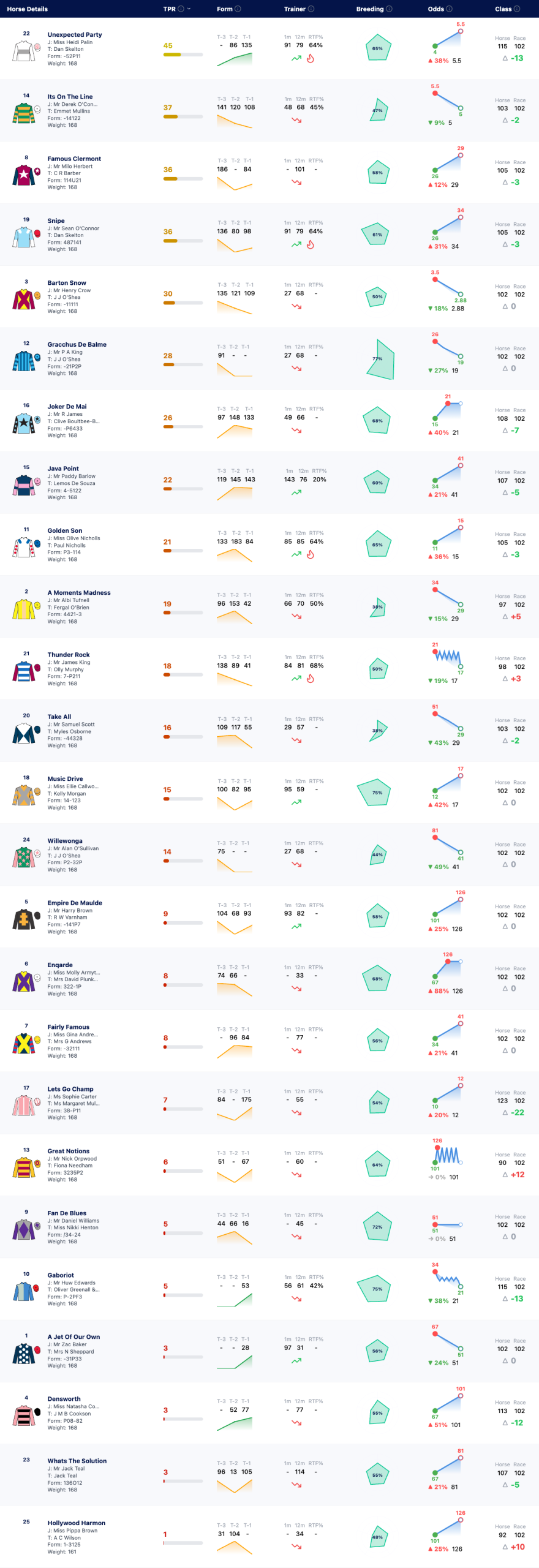
The full field
William Hill Aintree Hurdle (Grade 1)
2m 4f | Good To Soft | 7 runners
Race Analysis
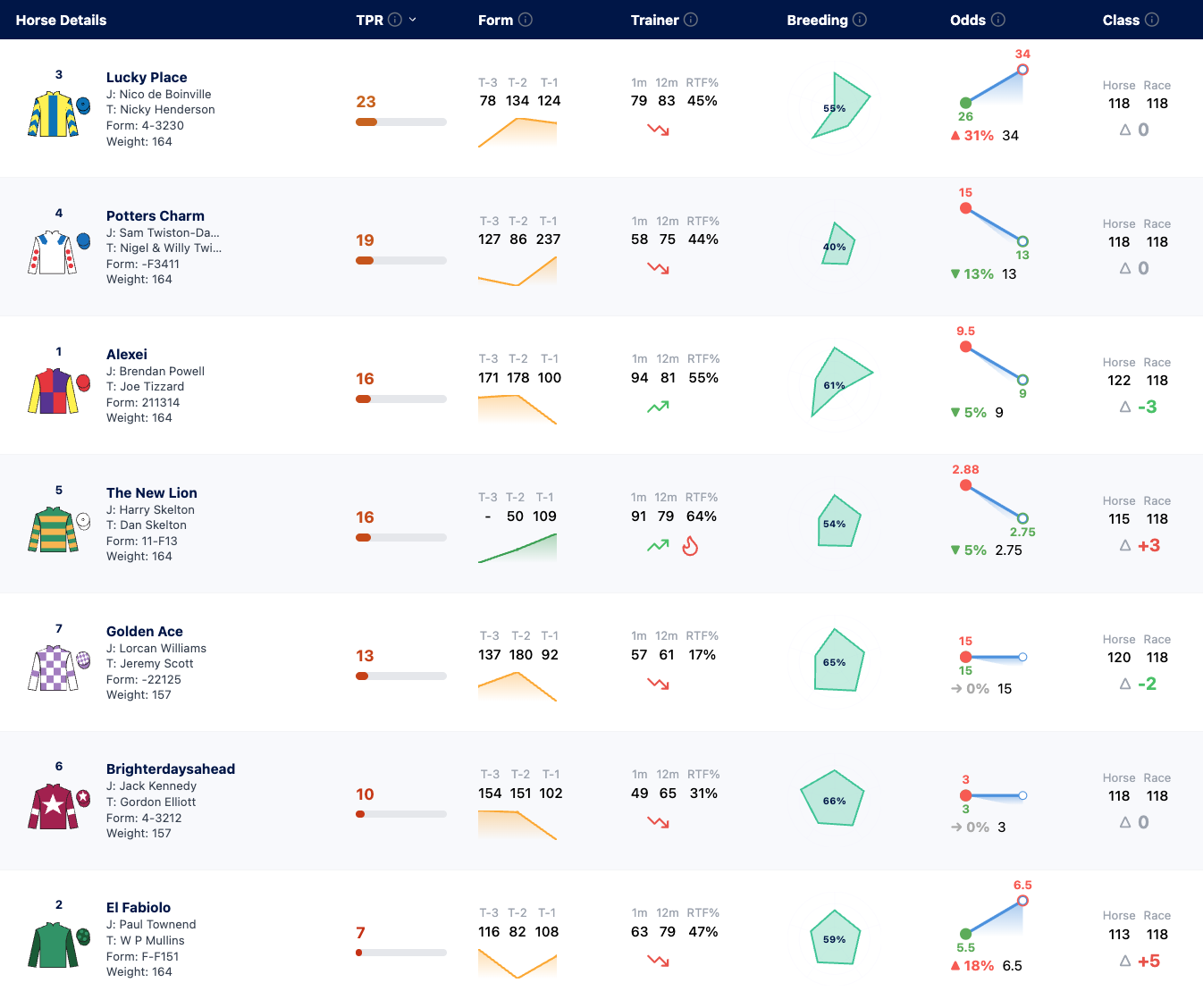
The feature hurdle of the day, and an immensely difficult race to assess. Seven runners, no clear TPR standout, and a pace dynamic that may ultimately decide the outcome. Six of the seven runners have a PaceScore above 3.0, meaning almost the entire field wants to race prominently. GOLDEN ACE and POTTERS CHARM are confirmed front-runners at 4.0, ALEXEI sits at 3.8, BRIGHTERDAYSAHEAD at 3.53, EL FABIOLO at 3.4 and LUCKY PLACE at 3.13. When that many horses are pressing forward in a seven-runner race, the early gallop should be fierce and the closers should benefit.
THE NEW LION is the one horse in the field with a PaceScore below 3.0, at 2.8. He is the natural beneficiary of a strong pace. Dan Skelton’s runner sits joint third on TPR at 16, behind LUCKY PLACE and POTTERS CHARM, but his T-4 of 122 came winning at Cheltenham on Good-to-Soft last March where he “pushed along and switched sharply right approaching last, pressed leader last, led final 110yds, kept on well.” His T-1 of 109 came at Cheltenham on Good-to-Soft three weeks ago where he was “outpaced after 2 out, went third run-in, kept on”, a respectable effort at Grade 1 level. The Skelton yard’s hot trainer signal (91 vs 79 baseline) has been a theme across the card and applies again here. The data is thinner than ideal, a fall at Newcastle wiping out his T-3, but the pace setup and running style put him in the right position to pick up the pieces when the front end comes back to him.
ALEXEI brings the strongest raw figures in the field from earlier this season: a T-2 of 178 winning at Wincanton on Heavy, a T-3 of 171 at Ascot on Good-to-Soft where he was “going easily before 2 out”, and a T-4 of 179 winning at Cheltenham on Soft described as “impressive.” Three runs in the 170s is high-class form. His GoingTPR of 138 leads the field by a clear margin, the best average on ground with cut. His T-1 of 100 looks a sharp drop, but context matters: that came in the Champion Hurdle at Cheltenham where he “made a bad mistake at the final hurdle” and weakened. The ClassDelta of -3 confirms he is dropping significantly from that level into the Aintree Hurdle. Joe Tizzard’s yard is running hot at 94 against an 81 baseline. If the Champion Hurdle run is read as an unlucky effort at the highest level rather than genuine regression, the ability on show earlier this season puts him a class above most of this field.
POTTERS CHARM is the data outlier. His T-1 of 237 at Fontwell on Heavy is the highest individual figure in the race by a distance, and his TrackTPR of 228 confirms strong Aintree form from a previous visit. PeakToRecent of 0 means he is at career peak right now. But FormStdDev of 64 tells the other side: his T-2 is just 86. The volatility is extreme and the Twiston-Davies yard is running cold (58 vs 75). BRIGHTERDAYSAHEAD was second at Cheltenham on Good-to-Soft three weeks ago, and her T-2 of 151 and T-3 of 154 show real ability, but the Elliott yard is cold (49 vs 65) and the declining trend of -26 is a concern. EL FABIOLO is the most consistent runner in the field (FormStdDev 14) with the second-best GoingTPR at 127, and the Mullins/Townend combination demands respect, but a ClassDelta of +5 means he is stepping up and the TPR of 7 suggests the model sees limits. LUCKY PLACE had a clear excuse at Cheltenham when hampered by a faller and is near peak form (PeakToRecent 10), but sits seventh on GoingTPR, the weakest going credential in the field.
The convergence is not emphatic in this race, but the pace angle tips the balance. When six of seven runners are fighting for the lead, the one who waits has the advantage. THE NEW LION is that horse, from the hottest yard on the card. ALEXEI is the class act dropping from the Champion Hurdle with the best GoingTPR in the field and figures earlier this season that dwarf the rest.
🎯WHERE THE DATA CONVERGES
THE NEW LION
ALEXEI
The full field
Close Brothers Red Rum Handicap Chase (Premier Handicap)
2m | Good To Soft | 15 runners
Race Analysis
The first proper handicap puzzle on the card, and a race where a new set of data variables becomes relevant. In handicaps, every horse carries a weight determined by its official rating (OR), and the key question is whether the handicapper has got it right. We track this through ORDelta, which compares a horse’s current rating to the mark at which it last won. A negative ORDelta means the horse has been dropped below its winning mark, what the data labels “Well In”, a positive signal that conditions are more favourable than when it last struck. We also track the ORTrajectory, whether the mark is Rising, Falling or Stable over recent runs. A horse that is Well In with a Falling trajectory is sliding down the weights towards its winning zone.
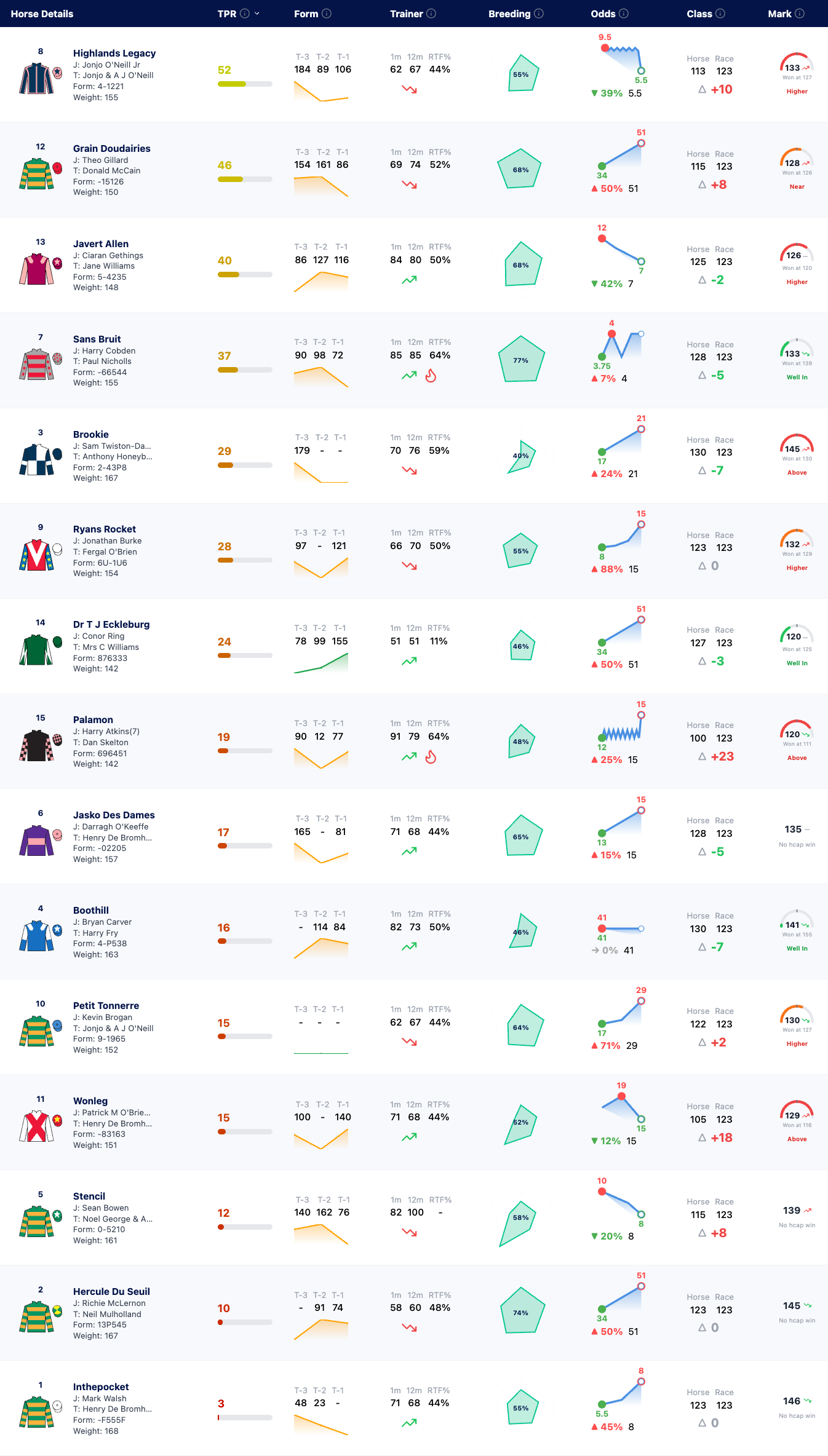
HIGHLANDS LEGACY leads the TPR standings at 52, six points clear. He also leads on GoingTPR at 111 (joint first) and TrackTPR at 184, the best proven course form in the field by a wide margin. That Aintree figure of 184 is his T-3 and it dwarfs everything else in the race. He clearly loves this track. The concern is the trend since: T-2 of 89 and T-1 of 106 show a horse who has not reproduced that level in recent starts, and a RecentTrend of -39 confirms the declining direction. He is also stepping up in class (ClassDelta +10) and sits above his last winning mark (ORDelta +6, Rising). At 81 days off, there is freshness but also a question of readiness. The case for him rests entirely on the course form. When a horse has posted a figure of 184 at a track and returns to it, the data says you respect that, even when the recent evidence is less encouraging.
SANS BRUIT brings the cleanest handicap profile in the race. His ORDelta of -6 means the handicapper has dropped him six pounds below the mark at which he last won, and the ORTrajectory is Falling, meaning the mark is still coming down. He is also dropping in class (ClassDelta -5). Paul Nicholls and Harry Cobden is a powerful combination in these spring handicaps, and his FormStdDev of 11 makes him one of the most consistent runners in the field. His TrackTPR of 124 (rank 4) confirms proven Aintree form. The flag is his GoingTPR of 64, which ranks 13th of 15. On Good-to-Soft ground that is a genuine concern, and his recent figures of 72 and 98 are modest. But the handicap variables paint a picture of a horse the weights have found, and Nicholls has a long record of placing horses like this to strike at spring festivals.
At a bigger price, DR T J ECKLEBURG deserves attention. His T-1 of 155 is the highest last-run speed figure of any horse in the race, and his PeakToRecent of 0 means that run was literally the best he has ever produced. His RecentTrend of +39 is the biggest improvement in the field. He is also Well In (ORDelta -5) and dropping in class (ClassDelta -3), with proven distance form (DistTPR 117, rank 2) and an OR of 120, the joint lowest in the race. The GoingTPR of 77 and an unfashionable trainer profile mean the market will likely overlook him, but the data says a horse arriving at career peak, well treated by the handicapper, and dropping in class deserves more respect than his odds will suggest.
JAVERT ALLEN has the best DistTPR (138, rank 1) and second-best TrackTPR (176), with an improving trend and consistent figures. But his ORDelta of +6 means the handicapper has raised him above his winning mark. BOOTHILL has the most dramatic handicap drop in the field (ORDelta -14, Falling) but aged eleven with a T-1 of 84, the figures no longer support the mark advantage. BROOKIE carries top weight of 145 with an ORDelta of +15, Well Above his winning mark, a tough assignment.
The convergence sits with HIGHLANDS LEGACY on course form credentials and SANS BRUIT on the handicap profile. Two different angles pointing to two different horses, which is exactly what you want in a competitive Premier Handicap.
🎯WHERE THE DATA CONVERGES
HIGHLANDS LEGACY
SANS BRUIT
The full field
Goffs Nickel Coin Mares’ Standard Open NH Flat Race (Grade 2)
2m 1f | Good To Soft | 20 runners
Race Analysis
Twenty runners in the mares’ bumper and a race where conventional form analysis hits a wall. Most of the field have one or two runs, the condition metrics are blank across almost every runner, and there is nothing to build a consistency or trend profile from. This is where the breeding data steps in. In bumpers, where race experience is thin and raw ability has not yet been fully expressed, the performance of the sire and damsire’s other offspring in the same race type becomes the most reliable predictive tool we have.
We track this through SireTypeTPR, which measures how all of a sire’s progeny perform in NH Flat races specifically, and DamsireTypeTPR, the same metric for the dam’s sire. Higher numbers mean the bloodline consistently produces bumper performers. In a race this open, these metrics carry more weight than usual.
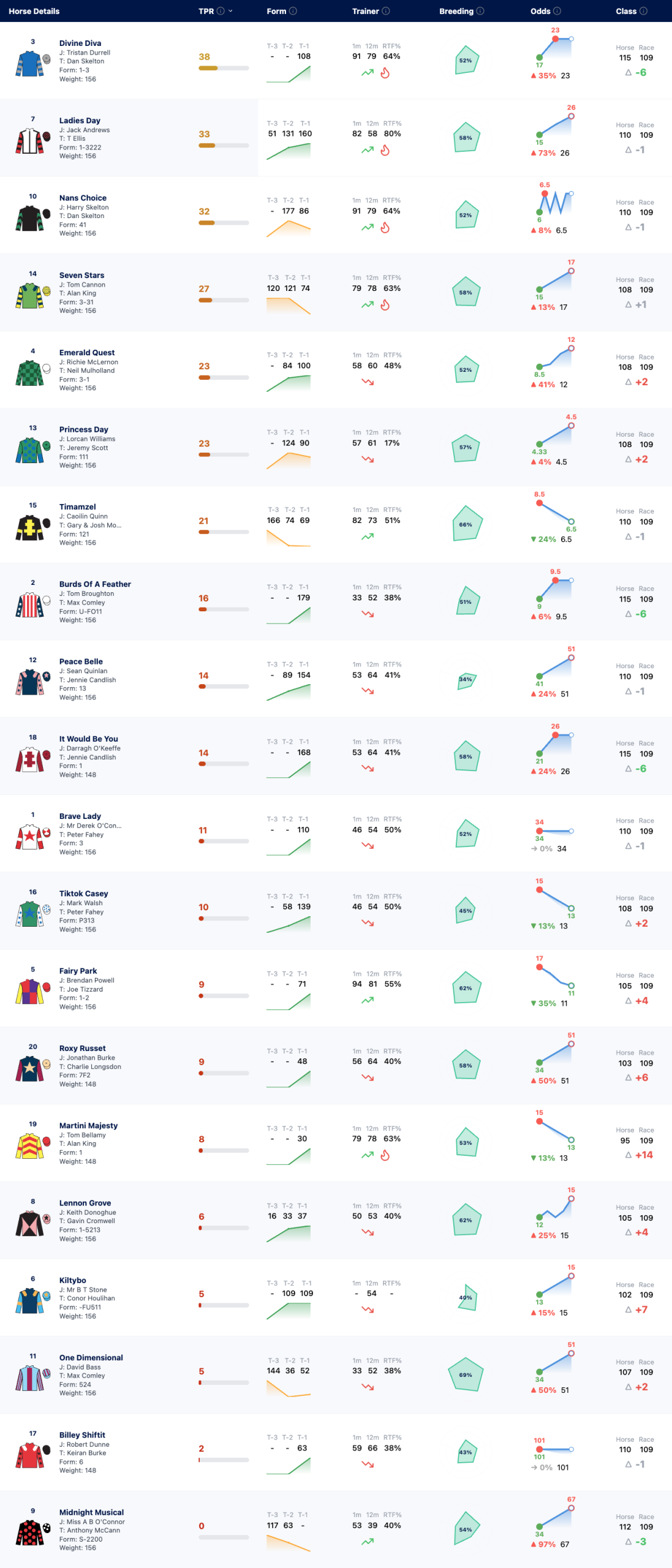
DIVINE DIVA has the strongest combined breeding profile in the field. Her damsire Leading Light returns a DamsireTypeTPR of 108, the highest single breeding metric of any runner in the race by a significant margin. Her sire Milan (SireTypeTPR 64) is a proven NH Flat stallion whose progeny regularly feature in bumpers at this level. She also leads the TPR standings at 38, comes from the Dan Skelton yard that has been the hottest operation on the card all day (91 vs 79 baseline), and her ClassDelta of -6 means she is dropping in class. The caveat is thin: one career run producing a T-1 of 108, and 145 days since that outing. In a bumper from a yard of this calibre, freshness can be a positive rather than a concern. They would not target this Grade 2 if she was not ready.
TI’MAMZEL brings the best individual sire metric in the race. No Risk At All returns a SireTypeTPR of 76, the highest of any sire represented, and her damsire Goldneyev adds a DamsireTypeTPR of 88. That combined breeding score of 164 ranks second in the field. No Risk At All is a sire whose progeny consistently outperform in NH Flat races, and in a bumper where the breeding is your best guide, that SireTypeTPR of 76 demands respect. The concern is her own form trajectory: a T-1 of 69 and T-2 of 74 after a T-3 of 166 represents a steep decline. Whether the raw ability shown earlier can resurface is the question, but the breeding says this is the right race type for her.
BURDS OF A FEATHER cannot be ignored. Her T-1 of 179 is the highest individual speed figure in the entire field by a distance, posted on her only career start. The raw talent is obvious. But the breeding (Westerner/Presenting, combined bumper score of 120) sits mid-pack for this race type, and the trainer is running cold (33 vs 52). She may be the most talented horse in the race, but the bloodlines do not scream bumper specialist in the way the top two do.
LADIES DAY is the only horse with proven Aintree form (TrackTPR 131, rank 1) and arrives at career peak with a T-1 of 160 and a trainer running hot (82 vs 58). But her combined breeding score of 119 (Yeats/Bobs Return) is unremarkable for this race type. NAN’S CHOICE gets first-jockey Harry Skelton from the same yard as DIVINE DIVA, which tells you something about how the stable views them, but a T-1 of 86 after a T-2 of 177 is a steep regression and the Getaway/Presenting breeding (combined 123) is modest. PEACE BELLE led on GoingTPR and DistTPR in the first data pull but her sire Massaat returns a SireTypeTPR of just 49, the worst in the race. The breeding actively works against her.
When the form is this thin, you lean on the bloodlines. DIVINE DIVA has the best combined bumper breeding in the field, leads the TPR, and comes from the hottest yard on the card. TI’MAMZEL has the best individual sire metric for this race type. In a Grade 2 bumper where almost nothing else separates the field, the breeding is the tiebreaker.
🎯WHERE THE DATA CONVERGES
DIVINE DIVA
TI’MAMZEL
The full field
The day at a glance
Where the data landed, race by race.
Conclusion
That is your lot for Day 1. Seven races, seven sets of data, and a card that should produce some fascinating clashes between form, speed figures, and market confidence. The Placepot pool alone makes this worth engaging with — a guaranteed minimum of £250,000 for a £2 perm is hard to ignore.
We will be back tomorrow with the full Day 2 guide for Friday at Aintree, including the Melling Chase, the Topham, and the Sefton Novices’ Hurdle. Same format, same data, same edge. See you then.
Access every racecard, live analytics and the complete blog on your phone:
More racedays, read by the data
Get the next raceday guide, free
Every big raceday we read the whole card with the model: ratings, speed figures, pace and draw. We send the next one to your inbox the morning it is published. No charge, and you can unsubscribe in one click.
We use your email to send racing guides and occasional news about EquiAnalytix. We never share it. 18+ | Please gamble responsibly.
Every runner, every race, every day
Everything this guide runs on, the percentages, the engine readings, the figures, the pace maps, lives on the dashboard for every British and Irish race. From 27p a day.
Explore the dashboard →EquiAnalytix provides horse racing data and analysis only. We do not take bets. 18+ | Please gamble responsibly. GamCare 0808 8020 133.